

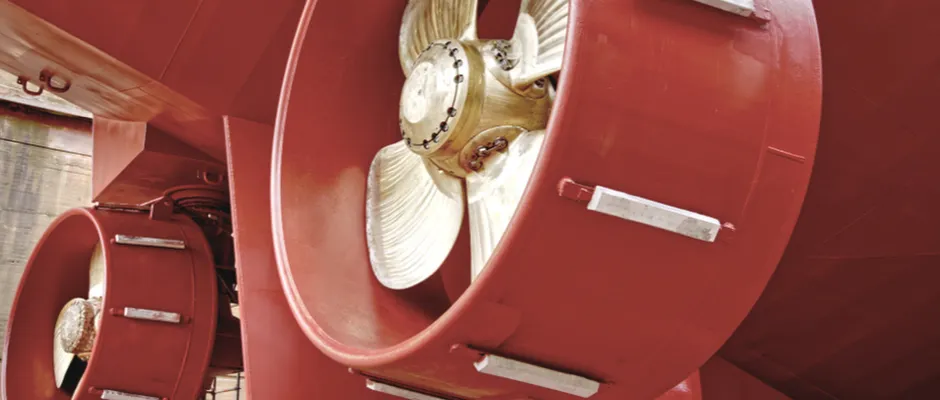
When Is an Open Propeller Configuration Within the Operating Profile a More Robust Alternative Than a Propeller Nozzle?
Author: Jeroen Berger • Publication date:
In retrofit studies and design discussions concerning the aft ship, the question regularly arises whether a propeller nozzle is actually needed to improve the behaviour of the propulsion system. In practice, that question is rarely determined solely by the hydrodynamic properties of the nozzle itself. What is decisive above all is the way the vessel is actually operated. The pattern of speeds, loading and manoeuvring conditions across the year determines where within the configuration of hull, ship propeller and ship rudder the greatest sensitivity arises.
For shipping companies, shipowners and technical management, this assessment becomes concrete when fuel consumption, rudder loading or course stability begin to deviate noticeably under certain operating conditions from earlier assumptions. At that point, the question arises whether the behaviour around the propeller plane itself is the cause, or whether the existing system behaviour already remains sufficiently stable within the actual aft ship configuration.
In part of the projects, it becomes clear under those circumstances that an open propeller configuration remains the most robust starting point. That is especially the case when the existing system behaviour around the propeller plane already remains predictable across the operating points that represent most of the operating hours.
The risk in an investment assessment arises when a nozzle becomes an implicit part of a newbuild or retrofit concept while the dominant speed and loading range has not yet been explicitly established. In such a situation, an intervention around the propeller plane is being considered without it being clear whether the actual annual profile lies in the regime in which such a configuration truly has decision value.
A meaningful comparison therefore begins with reconstructing the vessel’s annual profile. Speed range, power band and variations in operational loading are linked to the existing geometry of hull, propeller and rudder and to the available clearances around the aft ship. Only within that framework can a project-specific comparison under identical assumptions show which configuration produces the most predictable system behaviour.
Behaviour Across the Annual Profile as the Measure of Robustness
Within this assessment, robustness above all means that the propulsion system continues to respond predictably across several representative operating points. A configuration that performs favourably only at one design point but varies strongly outside that point rarely delivers the most stable result in daily operation.
An open propeller configuration can therefore remain appropriate when the system of hull, propeller and rudder already shows stable behaviour within the existing geometry across the speed and loading bandwidth that characterises the annual profile. The hydrodynamic balance is then carried by the existing aft ship form and by the available clearances around the propeller.
The question thereby shifts from the theoretical effect of the nozzle to the practical stability of the system. When the existing configuration already keeps the vessel’s operating point consistent, it must first be demonstrated that an additional geometric element around the propeller plane actually leads to more stable behaviour.
Where the Propulsion System Becomes Sensitive
A nozzle mainly influences the flow field around the propeller and therefore the way in which water reaches the propeller plane. The choice therefore gains meaning when precisely that area plays an important role in power uptake or course behaviour within the actual operating profile.
Not every operating profile shows the same sensitivity, however. Vessels that operate for most of their hours within a relatively stable speed range often already show a consistent inflow pattern within an open propeller configuration. In such situations, a nozzle changes the flow field at a location on which daily operation proves to depend only to a limited extent.
What then becomes decisive is the degree to which the total propulsion system remains stable across the annual profile without additional geometric intervention around the propeller. When the existing configuration already provides that behaviour, the presence of a nozzle becomes less decisive for operational robustness.
Geometry and Clearances as a Practical System Boundary
In addition to hydrodynamic considerations, the geometry of the aft ship plays a direct role in the choice between an open propeller and a nozzle. Clearances around the propeller, tip clearance at the blade tips, centring and the distance to the rudder determine how much tolerance margin remains available when the configuration around the propeller plane is changed.
When these margins are generous, a nozzle can be integrated relatively easily into the existing propulsion configuration. As space becomes more limited, sensitivity to fit-up and alignment increases. Small deviations in centring or roundness may then feed through more strongly into the inflow pattern, the pressure distribution around the propeller and the load distribution across the blades.
In such configurations, small variations in pressure distribution may moreover feed through relatively quickly into cavitation behaviour or local load peaks. Execution then becomes more sensitive to minor geometric deviations.
Within such boundary conditions, an open propeller configuration may prove more robust because the system becomes less dependent on an additional tolerance chain around a new structural component.
Comparing Within the Same Starting Conditions
The final choice between configurations only gains meaning when variants are compared under identical assumptions. Representative operating points must actually cover the annual profile, so that differences truly arise from the configuration and not from shifted boundary conditions.
The comparison loses meaning as soon as operating points, assumptions or geometric starting conditions differ between configurations. In that case, it becomes difficult to attribute the observed effect unambiguously to the system arrangement.
A complete assessment therefore looks not only at possible differences in power demand, but also at interactions with the rudder, manoeuvring behaviour and changes in cavitation sensitivity within the same vessel arrangement.
Retrofit Reality and Verifiability
In newbuild, a configuration can be aligned with the intended operating profile from the outset. In retrofit projects, the existing aft ship geometry usually forms the starting point, and design freedom is limited by what remains practically and verifiably feasible.
Limited clearances or incomplete documentation of the actual geometry shift attention in many projects towards verifiability. Without a reliable reference for the existing configuration, it becomes difficult to keep design decisions and fit-up control technically traceable.
Under such circumstances, an open propeller configuration may remain a more stable starting point until the actual geometry of hull, propeller and rudder has been established with sufficient accuracy.
Investment and System Behaviour
The economic assessment ultimately follows from the same system behaviour. An investment in a nozzle only becomes convincing when a project-specific comparison shows a clear difference pattern that remains reproducible both within the annual profile and within the available geometric margins.
When that difference becomes visible only in a narrow speed range or proves strongly dependent on limited execution tolerances, it may be rational to maintain the open propeller configuration as the starting point until operating profile, geometry and project conditions together indicate a clearer hydrodynamic advantage.
An open propeller configuration therefore proves more robust when the existing system behaviour of hull, propeller and rudder already remains stable and predictable across the dominant annual profile and the addition of a nozzle does not produce a clearly reproducible advantage within the same geometric and operational boundary conditions.
This Article Within the Series
Within Propeller Nozzle: Configuration Choice, Economics and Strategic Considerations, this article deepens the question under which circumstances a nozzle configuration is actually necessary.
The preceding article, When Does the Operating Profile Justify a Propeller Nozzle Instead of an Open Propeller Configuration, describes under which operational circumstances a nozzle can gain system value within the operating profile. This article focuses on the opposite situation: when the existing open configuration remains the most robust starting point within the available geometry and the dominant operating profile.
The series continues with When Does the Operating Profile Require an Optimized Propeller Nozzle Instead of a Standard Profile, which elaborates under which circumstances the choice no longer lies between open propeller and nozzle, but between different nozzle configurations.
For shipping companies, shipowners and technically responsible parties who want to translate these configuration choices into a concrete vessel arrangement, the page Propeller Nozzle for Ships forms a logical continuation. There, operating profile, geometry, system interaction and project-specific analysis come together in a traceable propulsion configuration for newbuild and retrofit.