
- English
- Nederlands

Propeller Nozzle for Ships

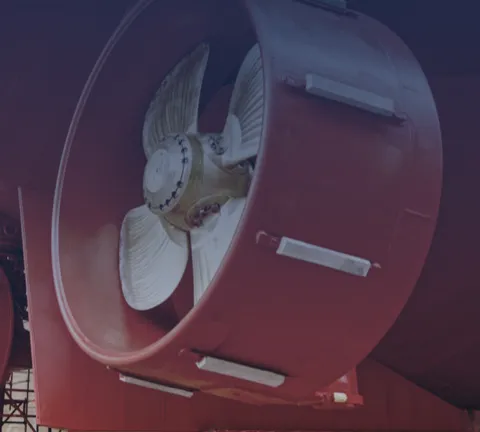
A propeller nozzle is a hydrodynamically profiled duct around a ship propeller that influences the flow through the propeller plane and can thereby improve thrust, propeller loading and propulsion efficiency. A ducted propeller is the combination of a ship propeller and a propeller nozzle, while a Kort nozzle is a specific propeller nozzle design. Depending on vessel type, loading condition and operational profile, a propeller nozzle can provide higher thrust at low speed, more favourable loading of the ship propeller and more efficient propulsion. In cooperation with our international partner, we support shipping companies, shipowners and technical project teams in the selection, engineering and delivery of a project-specific propeller nozzle. This may concern newbuild projects, as well as retrofit and replacement projects within an existing ship configuration.
Available worldwide
Selection and Project-Specific Starting Points
The starting point is not a standard solution, but an analysis of ship type, propeller and rudder configuration, installation constraints and intended operating profile. Based on this interaction, it is determined which configuration best matches the ship’s propulsion system from a technical perspective.
Depending on this initial situation, reference profiles such as propeller nozzle 19A and propeller nozzle 37 may be selected, or a project-specific optimized variant where the interaction between hull, propeller and rudder justifies this. Within many projects, 19A and 37 serve as a hydrodynamic reference framework for comparing configurations, after which the final geometry is determined on a project basis. The final selection follows from the hydrodynamic interaction within the propulsion concept rather than from the profile type alone.
Design Process and Project-Specific Alignment
A nozzle does not function independently from the stern, but forms part of the hydrodynamic system around the propeller and rudder. The shape of the duct influences the inflow to the propeller and the pressure distribution in the propeller plane, and therefore directly affects thrust, efficiency and manoeuvring behaviour.
Profile shape, diameter and positioning relative to the hull and stern jointly determine how this interaction develops. The practical implementation therefore always relates to the specific ship configuration and the intended operating profile. The technical basis of this system interaction and the geometric boundary conditions are elaborated further in Propeller Nozzle: Technology and Configuration.
Within the design process, profile selection is a core step. Reference profiles such as 19A and 37, developed within research programmes of the Maritime Research Institute Netherlands, are applied internationally as a technical starting point. They provide a standardized reference framework for comparison, but do not inherently constitute the final solution.
The choice between these reference profiles is always assessed on a project-specific basis. Where energy efficiency, loading conditions or installation constraints justify this, an optimized variant may also be considered. Suitability does not depend on a single property, but on the way in which hull form, stern geometry, propeller loading, blade geometry and rudder configuration jointly determine the inflow pattern and system behaviour.
Performance differences do not follow directly from the profile type. For that reason, the emphasis in the design process lies on the substantiated comparison of variants within the same ship context. Using Computational Fluid Dynamics (CFD), it can first be determined which reference profile within the same ship arrangement best matches the intended operating profile. Only where project-specific conditions justify this is an optimized geometry also assessed hydrodynamically in a digital towing tank environment.
No single design point is decisive. The assessment focuses on a range of speeds, loading conditions and manoeuvring scenarios that together represent the ship’s operating profile. This creates a framework within which configurations can be compared under identical boundary conditions within the actual ship arrangement. It thereby becomes clear which solution most consistently aligns with the ship’s operating profile. The methodology behind such comparisons and the interpretation of results are elaborated further in Propeller Nozzle: Design and Performance Validation. Where profile selection, dimensions and material specification are already fixed, a standard nozzle in accordance with project specification may be applied without a CFD study.
The transition from technical outcomes to investment assessment and configuration selection within the operating profile, including the choice between a nozzle and an open propeller, between reference profiles and optimization, and between different propulsion concepts, is addressed in Propeller Nozzle: Configuration Choice, Economics and Strategic Considerations.
Based on this analysis, the selected profile is translated into a concrete design. A reference profile may serve as the starting point and, where required by project boundary conditions, be adapted to the specific installation constraints. In other cases, an optimized geometry is developed where flow characteristics, pressure distribution or interaction with the propeller and rudder justify further refinement.
The final configuration therefore remains project-specific and follows from explicitly defined design choices and assumptions.
Where classification forms part of the project, the nozzle configuration, together with the associated design and supporting documentation, is aligned and submitted in accordance with the applicable requirements of the relevant classification society. In practice, this means that nozzles, depending on the project, may be assessed under regimes such as DNV, Lloyd’s Register, ABS, Bureau Veritas and RINA.
Acceptance and any certification proceed in accordance with the applicable procedures of the relevant classification society and remain subject to formal approval. Within the same process, material selection is also defined, for example a steel construction, a steel construction with a stainless-steel inner ring or, where project conditions, loading characteristics and installation constraints permit, a hybrid construction with a load-bearing structure and a hydrodynamic profile in composite material.
Application Context by Sector and Ship Type
The application of a nozzle is not determined solely by the profile type. The interaction between operating profile, speed range and thrust demand forms the design framework within which the profile selection is assessed. Sector and ship type primarily define the operational context.
In sectors such as inland shipping and short sea shipping, vessels often operate at relatively low speeds and under varying loading conditions. Predictable behaviour across a broad operating range generally carries more weight than optimal performance at a single design point. Reference profiles such as 19A and 37 often serve in this context as a starting point, after which project-specific optimization is considered where hull form, stern geometry or loading conditions justify this.
For seagoing vessels, the assessment differs. Hull form and speed range strongly determine whether a nozzle contributes to overall propulsion performance. For slender vessels with prolonged operation at higher speeds, application is generally less evident. In full-form configurations, such as tankers, bulk carriers and certain offshore vessels, the interaction between hull, nozzle and propeller may instead play a more significant role.
In segments such as dredging, offshore and towage, high loads, varying operating conditions and intensive manoeuvring are key factors. Requirements relating to bollard pull, station keeping and dynamic behaviour form part of the design analysis, always within the limits of the existing propeller and rudder configuration and the available installation space.
In fisheries, passenger shipping and specialised vessels, a nozzle is likewise assessed within the overall propulsion concept. Comfort, vibration behaviour and specific speed regimes may play a role without automatically leading to a preference for a particular profile.
Across all sectors, reference profiles primarily function as a design framework. An optimized variant is only considered where analysis and comparison demonstrate that operating profile, installation constraints or efficiency objectives provide a technical basis.
In practice, efficiency objectives rarely stand alone. Regulatory frameworks such as EEXI, CII, EU ETS and FuelEU Maritime may influence how shipowners and technical managers approach propulsion design. Design choices, including the application of a nozzle or an alternative inflow solution, are evaluated within this broader energy and emissions framework, without automatically resulting in a direct contribution to compliance.
Newbuild and Existing Ship
Both in newbuild projects and in existing vessels, a nozzle can form part of the propulsion design. The essential difference lies in the degree of design freedom.
In newbuild projects, the nozzle can be integrated from the outset into the design of hull, propeller and rudder. As a result, the propulsion system can be aligned as a coherent whole with the intended operating profile.
In existing vessels, the emphasis shifts to analysis and integration within an already defined configuration. In such cases, the nozzle often becomes part of maintenance, replacement or optimization of the propulsion system.
Depending on the initial conditions, it is determined which components can be retained. In replacement within an existing nozzle configuration, a reference profile may serve as the starting point. Where a vessel is converted from open propeller to a nozzle configuration, a redesign of both propeller and nozzle is generally required.
Where original vessel drawings are available, the design process can begin with a CFD analysis of the existing or intended configuration. Where drawings are not available, 3D scans and precise measurements can capture the stern geometry as the basis for further analysis. The role of verification and replacement logic in retrofit projects is elaborated further in Propeller Nozzle: Service Life, Retrofit and Regulations.
Pre-Duct
Within the same project-specific assessment, an alternative inflow solution may also be considered: the Pre-Duct. This is a so-called Energy Saving Device positioned upstream of the propeller and influencing the inflow to the propeller.
Where a nozzle primarily influences the flow in and around the propeller plane, a Pre-Duct acts earlier in the flow field. It therefore does not function as a complement to a nozzle, but as an alternative concept within the propulsion design.
The suitability of a Pre-Duct depends strongly on hull form, stern geometry, propeller design and the vessel’s operating profile. Using CFD, it can be assessed how modified inflow conditions affect propeller loading, pressure distribution and overall propulsion performance.
Which solution ultimately delivers the highest efficiency, whether a nozzle, an optimized profile or a Pre-Duct, is therefore always compared on a project-specific basis under identical boundary conditions.
In Practice
Reference profiles such as 19A and 37, as well as optimized nozzles, are applied across a wide range of maritime sectors, from inland shipping and short sea shipping to complex offshore and retrofit projects.
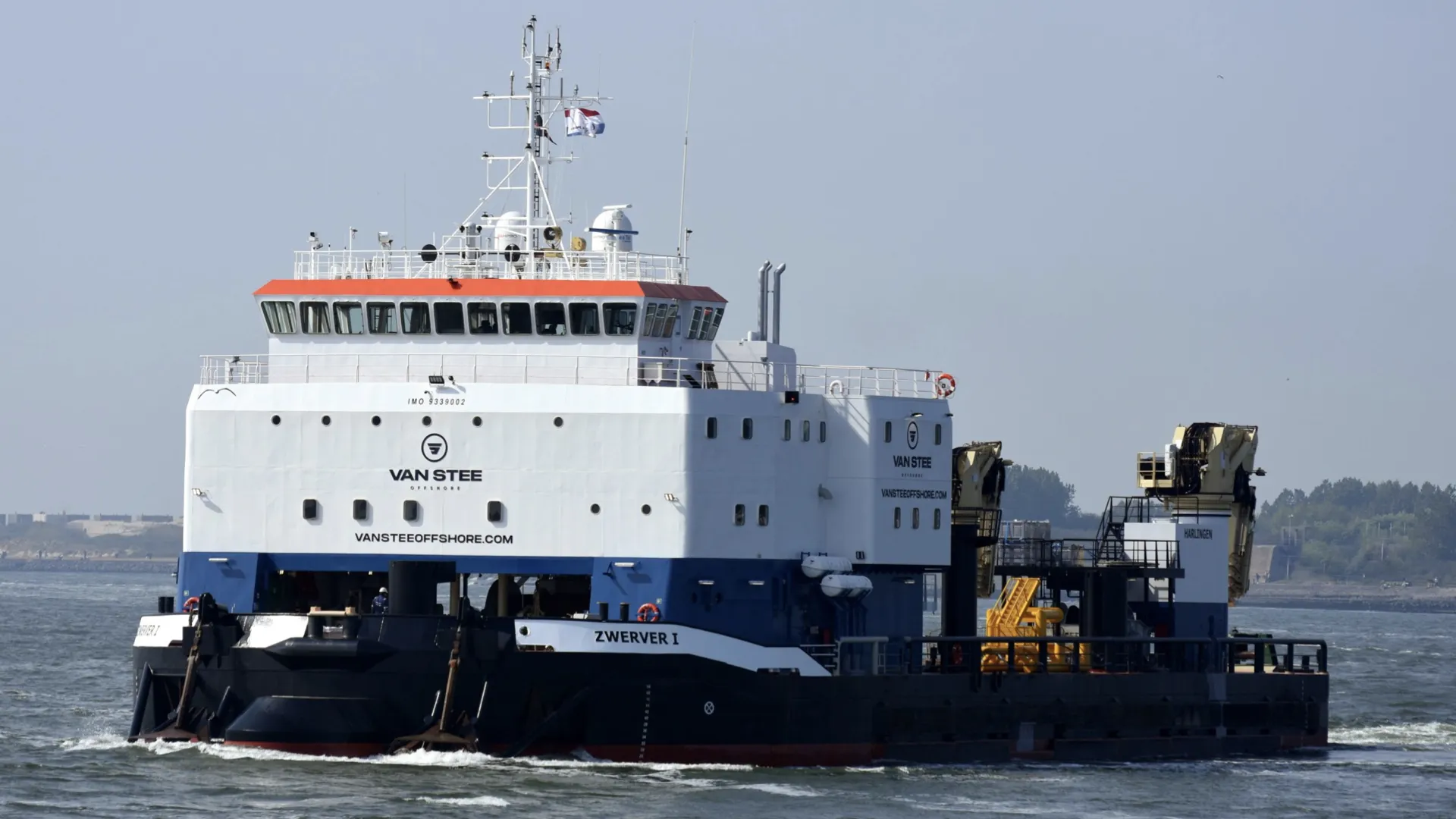
One example is the conversion of a work vessel from 2006 into a multifunctional diesel-electric DP-2 work vessel. In its original configuration, the vessel was equipped with four rudder propellers. In the modernized configuration, the choice was made for two electric bow thrusters in combination with two fixed, CFD-optimized propellers in a nozzle configuration.
This reconfiguration formed part of a broader technical redesign of the propulsion system. The nozzle was not assessed as an isolated component, but as part of the overall hydrodynamic interaction between hull, propeller and rudder.
Propeller Nozzle for Ships
In cooperation with our international partner, we support shipping companies, shipowners and technical project teams in the selection, engineering and delivery of a project-specific propeller nozzle. This may concern newbuild projects, as well as retrofit and replacement projects within an existing ship configuration.
Available worldwide
What Is a Propeller Nozzle?
A propeller nozzle is a hydrodynamically profiled duct around a ship propeller that influences the flow through the propeller plane and can thereby improve thrust, propeller loading and propulsion efficiency. A ducted propeller is the combination of a ship propeller and a propeller nozzle, while a Kort nozzle is a specific propeller nozzle design.
Depending on vessel type, loading condition and operational profile, a propeller nozzle can provide higher thrust at low speed, more favourable loading of the ship propeller and more efficient propulsion.
Selection and Project-Specific Starting Points
The starting point is not a standard solution, but an analysis of ship type, propeller and rudder configuration, installation constraints and intended operating profile. Based on this interaction, it is determined which configuration best matches the ship’s propulsion system from a technical perspective.
Depending on this initial situation, reference profiles such as propeller nozzle 19A and propeller nozzle 37 may be selected, or a project-specific optimized variant where the interaction between hull, propeller and rudder justifies this. Within many projects, 19A and 37 serve as a hydrodynamic reference framework for comparing configurations, after which the final geometry is determined on a project basis. The final selection follows from the hydrodynamic interaction within the propulsion concept rather than from the profile type alone.
Design Process and Project-Specific Alignment
A nozzle does not function independently from the stern, but forms part of the hydrodynamic system around the propeller and rudder. The shape of the duct influences the inflow to the propeller and the pressure distribution in the propeller plane, and therefore directly affects thrust, efficiency and manoeuvring behaviour.
Profile shape, diameter and positioning relative to the hull and stern jointly determine how this interaction develops. The practical implementation therefore always relates to the specific ship configuration and the intended operating profile. The technical basis of this system interaction and the geometric boundary conditions are elaborated further in Propeller Nozzle: Technology and Configuration.
Within the design process, profile selection is a core step. Reference profiles such as 19A and 37, developed within research programmes of the Maritime Research Institute Netherlands, are applied internationally as a technical starting point. They provide a standardized reference framework for comparison, but do not inherently constitute the final solution.
The choice between these reference profiles is always assessed on a project-specific basis. Where energy efficiency, loading conditions or installation constraints justify this, an optimized variant may also be considered. Suitability does not depend on a single property, but on the way in which hull form, stern geometry, propeller loading, blade geometry and rudder configuration jointly determine the inflow pattern and system behaviour.
Performance differences do not follow directly from the profile type. For that reason, the emphasis in the design process lies on the substantiated comparison of variants within the same ship context. Using Computational Fluid Dynamics (CFD), it can first be determined which reference profile within the same ship arrangement best matches the intended operating profile. Only where project-specific conditions justify this is an optimized geometry also assessed hydrodynamically in a digital towing tank environment.
No single design point is decisive. The assessment focuses on a range of speeds, loading conditions and manoeuvring scenarios that together represent the ship’s operating profile. This creates a framework within which configurations can be compared under identical boundary conditions within the actual ship arrangement. It thereby becomes clear which solution most consistently aligns with the ship’s operating profile. The methodology behind such comparisons and the interpretation of results are elaborated further in Propeller Nozzle: Design and Performance Validation. Where profile selection, dimensions and material specification are already fixed, a standard nozzle in accordance with project specification may be applied without a CFD study.
The transition from technical outcomes to investment assessment and configuration selection within the operating profile, including the choice between a nozzle and an open propeller, between reference profiles and optimization, and between different propulsion concepts, is addressed in Propeller Nozzle: Configuration Choice, Economics and Strategic Considerations.
Based on this analysis, the selected profile is translated into a concrete design. A reference profile may serve as the starting point and, where required by project boundary conditions, be adapted to the specific installation constraints. In other cases, an optimized geometry is developed where flow characteristics, pressure distribution or interaction with the propeller and rudder justify further refinement.
The final configuration therefore remains project-specific and follows from explicitly defined design choices and assumptions.
Where classification forms part of the project, the nozzle configuration, together with the associated design and supporting documentation, is aligned and submitted in accordance with the applicable requirements of the relevant classification society. In practice, this means that nozzles, depending on the project, may be assessed under regimes such as DNV, Lloyd’s Register, ABS, Bureau Veritas and RINA.
Acceptance and any certification proceed in accordance with the applicable procedures of the relevant classification society and remain subject to formal approval. Within the same process, material selection is also defined, for example a steel construction, a steel construction with a stainless-steel inner ring or, where project conditions, loading characteristics and installation constraints permit, a hybrid construction with a load-bearing structure and a hydrodynamic profile in composite material.
Application Context by Sector and Ship Type
The application of a nozzle is not determined solely by the profile type. The interaction between operating profile, speed range and thrust demand forms the design framework within which the profile selection is assessed. Sector and ship type primarily define the operational context.
In sectors such as inland shipping and short sea shipping, vessels often operate at relatively low speeds and under varying loading conditions. Predictable behaviour across a broad operating range generally carries more weight than optimal performance at a single design point. Reference profiles such as 19A and 37 often serve in this context as a starting point, after which project-specific optimization is considered where hull form, stern geometry or loading conditions justify this.
For seagoing vessels, the assessment differs. Hull form and speed range strongly determine whether a nozzle contributes to overall propulsion performance. For slender vessels with prolonged operation at higher speeds, application is generally less evident. In full-form configurations, such as tankers, bulk carriers and certain offshore vessels, the interaction between hull, nozzle and propeller may instead play a more significant role.
In segments such as dredging, offshore and towage, high loads, varying operating conditions and intensive manoeuvring are key factors. Requirements relating to bollard pull, station keeping and dynamic behaviour form part of the design analysis, always within the limits of the existing propeller and rudder configuration and the available installation space.
In fisheries, passenger shipping and specialised vessels, a nozzle is likewise assessed within the overall propulsion concept. Comfort, vibration behaviour and specific speed regimes may play a role without automatically leading to a preference for a particular profile.
Across all sectors, reference profiles primarily function as a design framework. An optimized variant is only considered where analysis and comparison demonstrate that operating profile, installation constraints or efficiency objectives provide a technical basis.
In practice, efficiency objectives rarely stand alone. Regulatory frameworks such as EEXI, CII, EU ETS and FuelEU Maritime may influence how shipowners and technical managers approach propulsion design. Design choices, including the application of a nozzle or an alternative inflow solution, are evaluated within this broader energy and emissions framework, without automatically resulting in a direct contribution to compliance.
Newbuild and Existing Ship
Both in newbuild projects and in existing vessels, a nozzle can form part of the propulsion design. The essential difference lies in the degree of design freedom.
In newbuild projects, the nozzle can be integrated from the outset into the design of hull, propeller and rudder. As a result, the propulsion system can be aligned as a coherent whole with the intended operating profile.
In existing vessels, the emphasis shifts to analysis and integration within an already defined configuration. In such cases, the nozzle often becomes part of maintenance, replacement or optimization of the propulsion system.
Depending on the initial conditions, it is determined which components can be retained. In replacement within an existing nozzle configuration, a reference profile may serve as the starting point. Where a vessel is converted from open propeller to a nozzle configuration, a redesign of both propeller and nozzle is generally required.
Where original vessel drawings are available, the design process can begin with a CFD analysis of the existing or intended configuration. Where drawings are not available, 3D scans and precise measurements can capture the stern geometry as the basis for further analysis. The role of verification and replacement logic in retrofit projects is elaborated further in Propeller Nozzle: Service Life, Retrofit and Regulations.
Pre-Duct
Within the same project-specific assessment, an alternative inflow solution may also be considered: the Pre-Duct. This is a so-called Energy Saving Device positioned upstream of the propeller and influencing the inflow to the propeller.
Where a nozzle primarily influences the flow in and around the propeller plane, a Pre-Duct acts earlier in the flow field. It therefore does not function as a complement to a nozzle, but as an alternative concept within the propulsion design.
The suitability of a Pre-Duct depends strongly on hull form, stern geometry, propeller design and the vessel’s operating profile. Using CFD, it can be assessed how modified inflow conditions affect propeller loading, pressure distribution and overall propulsion performance.
Which solution ultimately delivers the highest efficiency, whether a nozzle, an optimized profile or a Pre-Duct, is therefore always compared on a project-specific basis under identical boundary conditions.
In Practice
Reference profiles such as 19A and 37, as well as optimized nozzles, are applied across a wide range of maritime sectors, from inland shipping and short sea shipping to complex offshore and retrofit projects.
One example is the conversion of a work vessel from 2006 into a multifunctional diesel-electric DP-2 work vessel. In its original configuration, the vessel was equipped with four rudder propellers. In the modernized configuration, the choice was made for two electric bow thrusters in combination with two fixed, CFD-optimized propellers in a nozzle configuration.
This reconfiguration formed part of a broader technical redesign of the propulsion system. The nozzle was not assessed as an isolated component, but as part of the overall hydrodynamic interaction between hull, propeller and rudder.