

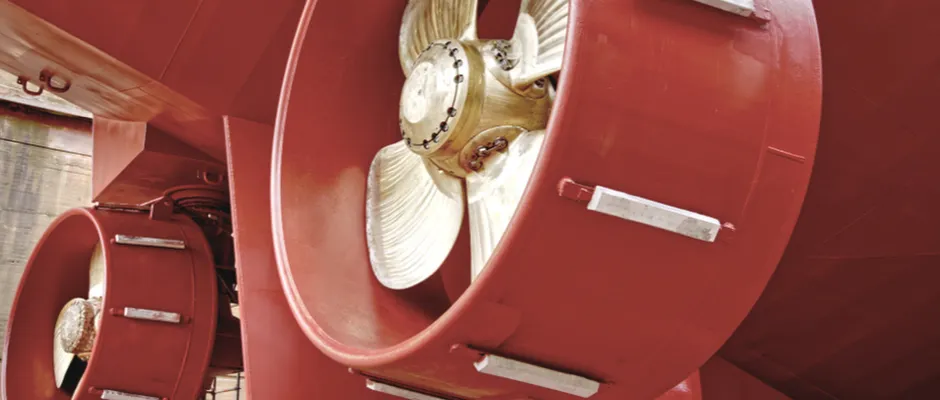
When Should You Not Choose a Propeller Nozzle for Your Ship or Operating Profile?
Author: Jeroen Berger • Publication date:
In retrofit and newbuild considerations around the aft ship, the question regularly arises whether a propeller nozzle truly provides a functional improvement within the existing or intended propulsion configuration. For shipping companies, shipowners and technical managers, that question becomes particularly relevant when a vessel operates for a large share of its hours in a regime where behaviour around the propeller plane determines power demand and steering response within the actual installation context of the aft ship.
Uncertainty arises when a propeller nozzle becomes an implicit part of a design or retrofit concept without the vessel’s dominant speed and loading range first being explicitly established. In such cases, a measure intended to improve energy behaviour or system stability may be applied outside the regime in which it delivers real value.
A substantive assessment therefore typically begins with defining the vessel’s annual operating profile. Speed range, power band and operational variation are linked to the existing configuration of hull, ship propeller and ship rudder and to the available clearances around the aft ship. Only then can a comparison under identical assumptions show whether a propeller nozzle represents a rational choice within this vessel arrangement.
A Higher and Stable Speed Window May Reduce Relevance
For vessels that operate for extended periods within a higher and relatively stable speed window, operational focus often lies on predictable behaviour within a limited range. In such profiles, a propeller nozzle may prove less appropriate when any potential energy advantage does not manifest within the dominant operating hours.
The intervention alters the hydrodynamic configuration around the propeller plane, while the operation primarily requires stability around the centre of the annual profile.
The decision variable therefore shifts when the vessel’s speed regime is already stable within a relatively narrow operating range. In that case, what matters is not the presence of a nozzle as a component, but whether the existing system behaviour of hull, propeller and rudder already performs consistently within that regime.
Practical Context by Vessel Type
In practice, the suitability of a nozzle strongly depends on hull form and operating profile.
Full-form vessels that operate for long periods at low speed with relatively high propeller loading, such as tugboats, inland vessels, dredgers and certain offshore support vessels, often operate within a regime where a nozzle can provide hydrodynamic benefit.
More slender vessels that spend a significant portion of their operating hours at higher speeds, such as fast passenger vessels, certain coastal vessels or specialised workboats, operate under different conditions. In these configurations, interaction around the propeller plane may already remain sufficiently stable in an open propeller configuration, maintaining the hydrodynamic balance between hull, propeller and rudder without a nozzle.
In such cases, adding a nozzle does not automatically produce a clear operational advantage within the dominant operating profile.
Installation Space and Clearances as Practical Limits
The geometry of the aft ship determines not only whether a propeller nozzle can be installed, but also how much tolerance margin remains for centring, tip clearance around the propeller and distance to the rudder within the fixed vessel arrangement.
When those margins are limited, a nozzle configuration becomes more sensitive to fit and alignment. Small deviations in centring or roundness may then feed through into inflow structure, pressure distribution and load patterns around the propeller plane.
In retrofit projects, this becomes particularly relevant when the initial geometry cannot be fully reconstructed from available documentation. In such cases, the actual installation condition must first be established before a design decision can be made in a technically traceable way.
Under these conditions, omitting a nozzle may be the most controllable choice, simply because the physical system boundaries do not allow sufficient margin for a robust implementation.
Inflow Sensitivity May Indicate a Different Intervention Point
The hydrodynamic effect of a nozzle is concentrated around the propeller plane and the downstream flow towards the rudder.
When the dominant sensitivity of the system arises upstream, in the inflow towards the propeller, the origin of the issue lies elsewhere in the flow field.
In such situations, it may be more appropriate to consider an alternative solution that conditions the inflow rather than assuming that a nozzle is the correct intervention. The starting point is therefore identifying where within the flow field the dominant sensitivity arises within the vessel’s actual operating profile.
Variation in Power Demand as a Decisive Factor
Operational energy behaviour is not determined by a single design point, but by the spread in power demand under small variations in speed or loading.
Within the annual profile, operating conditions vary continuously due to loading, water depth and manoeuvring conditions. When that variation determines fuel consumption and operational stability, a nozzle only becomes relevant if comparison shows that the pattern becomes demonstrably more stable across representative operating points.
If the difference remains limited to a narrow regime or lacks consistency, omitting a nozzle may better align with the vessel’s dominant operating profile.
Uncertain Geometry Increases Retrofit Risk
In older vessels, the actual geometry around the propeller aperture, shaft alignment and rudder arrangement may deviate from original drawings due to earlier repairs or local deformation.
When that deviation exceeds the design margin for fit and centring, the focus shifts from hydrodynamic optimisation to geometric verifiability.
Under such conditions, choosing not to install a nozzle may be the most logical step until the actual geometry has been clearly established and can serve as a reliable reference for design and installation control.
The Project-Specific Comparison Remains Decisive
The decision not to apply a nozzle is rarely a statement about a profile type or an individual component. It is usually the conclusion that within the dominant operating profile and the fixed vessel arrangement no robust difference pattern becomes visible that justifies the intervention.
As soon as operating points, assumptions or geometric reference conditions diverge between configurations, it becomes difficult to attribute any observed difference unambiguously to the configuration itself.
Using identical operating points, identical assumptions and identical physical system boundaries therefore remains the basis for an assessment that remains traceable in design, execution and operation.
Conclusion
Choosing not to apply a nozzle is technically most defensible when the dominant operating profile does not show a stable energy advantage, the available geometric margins in the aft ship are limited, and comparison under identical assumptions does not produce a consistent difference pattern within the same vessel configuration of hull, propeller and rudder.
This Article Within the Series
Within Propeller Nozzle: Configuration Choice, Economics and Strategic Considerations, this article forms the closing piece, bringing together the conditions under which a nozzle configuration is not the most logical choice within a vessel’s operating profile.
The series began with When Does the Operating Profile Justify a Propeller Nozzle Instead of an Open Propeller Configuration, followed by analyses of when an open configuration remains more robust, when project-specific optimisation becomes relevant, and when energy-efficiency objectives influence the comparison with alternative concepts such as a Pre-Duct.
This final article brings those considerations together from the opposite perspective: not when a nozzle provides benefit, but when the dominant operating profile, geometric constraints or project-specific comparison do not provide a stable basis for its application.
For shipping companies, shipowners and technically responsible parties who want to translate these strategic configuration choices into a concrete vessel arrangement, the page Propeller Nozzle for Ships forms a logical continuation. There, operating profile, geometry, system interaction and project-specific analysis come together in a traceable propulsion configuration for newbuild and retrofit.