

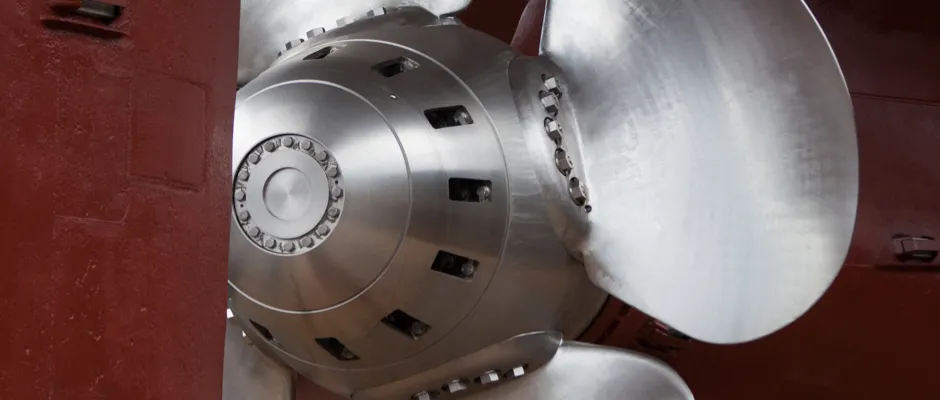
When Must You Include Not Only the CPP Blade but Your Entire Propulsion Configuration in the Intervention?
Author: Jeroen Berger • Publication date:
In practice, issues around CPP blades often trigger a rapid tendency to locate the technical cause directly at blade level. This is understandable, as deviations in load, manoeuvring behaviour, or performance frequently appear to manifest there first. Yet within existing propulsion installations, this is precisely the point at which analysis can become technically too narrow. Not every issue that becomes visible at the blade originates in the blade itself. In CPP systems in particular, blade behaviour is continuously shaped by the broader configuration in which it operates.
The decisive question therefore does not lie in the condition of the blade in isolation, but in the boundary at which an intervention can still be defensibly defined as a blade-level project. Once that boundary is exceeded, it is technically incorrect to continue treating the issue as a purely blade-related question. At that point, not only the CPP blade, but the entire propulsion configuration must be included in the intervention.
A Blade-Level Project Becomes Technically Unsustainable When the Blade Still Shows the Problem but No Longer Explains It
Within existing propulsion installations, technical issues rarely arise purely at the level of a single component. In practice, a deviation often appears at the CPP blade, while its cause only becomes understandable once the broader configuration is considered. The relevant turning point therefore does not lie in identifying a deviation, but in recognising that it can no longer be logically explained from the blade alone.
As long as system behaviour responds consistently to changes in pitch, load, and speed, blade-level assessment may still suffice. The boundary is reached when that relationship becomes diffuse. When an adjustment in blade angle no longer results in a predictable change in load absorption, propulsion, or manoeuvring response, the blade loses its status as a sufficiently explanatory intervention point. From that moment onward, a blade-level project is no longer the correct technical scope, because the phenomenon remains visible at blade level while its cause can no longer be convincingly contained within it.
A CPP Blade Is Not a Standalone Intervention Level Once System Interaction Becomes More Determinative than Blade Condition
A CPP blade does not operate as an independent hydrodynamic element, but as part of a mechanically and hydrodynamically coupled system. While blade geometry defines interaction with the water, the way that interaction translates into load, propulsion, and response is directly influenced by the hub, pitch mechanism, inflow conditions, hull, and rudder.
When blade angle is adjusted, not only thrust changes, but also the distribution of forces across the entire system chain. These forces are transmitted through the hub and mechanism and respond simultaneously to inflow shaped by stern, hull, and rudder. As a result, visible effect and primary technical cause do not automatically coincide. Once this system interaction becomes more determinative than the blade condition itself, it is no longer technically defensible to define the intervention as a blade-level project. At that point, blade level is no longer the correct project boundary, but merely the location where the issue first becomes visible.
A Blade-Level Intervention Becomes the Wrong Scope Once the Relationship Between Blade Condition and System Behaviour No Longer Closes Reliably
An intervention remains technically defensible at blade level only as long as the problem can be consistently traced back to blade-specific properties such as wear, damage, or geometric deviation. Once that relationship no longer holds, not only does the solution become vulnerable, but the project definition itself loses validity.
This becomes apparent when load patterns, manoeuvring behaviour, and system response under comparable conditions no longer correlate consistently with pitch settings or blade condition. In such cases, replacement, reproduction, or profile modification may appear to be logical steps, yet there is no longer certainty that these actions address the functional cause. At that point, a blade-level project ceases to be technically precise. The blade remains a visible intervention point, but no longer the correct level at which to define the intervention.
Changed System Conditions Render a Blade-Level Project Invalid Once They Remove Existing Blade Logic from Its Context
In existing vessels, system conditions often shift without manifesting as a single identifiable change. Variations in operational profile, load cycles, sailing area, operational intensity, or manoeuvring frequency can gradually alter system behaviour without any single component being clearly identifiable as the cause.
An installation may appear to continue functioning, while the underlying coherence between components becomes less logical. The CPP blade may remain physically usable, yet operate within a system that no longer reflects the conditions under which its original logic was valid. This tension often becomes visible only in retrofit or replacement scenarios. Once the blade appears usable only within a system that has functionally shifted, it becomes technically incorrect to define the intervention as a blade-level issue. At that point, the technical core no longer lies in the blade itself, but in the relationship between the blade and the configuration in which it must operate.
The Quality of the Solution Is Determined at the Moment Blade Level Is Chosen Too Narrowly as the Project Boundary
The core decision does not lie in choosing between reproduction, replacement, or redesign, but in determining at which level that choice is made. A technically strong outcome always begins with a technically correct definition of the problem scope.
When analysis is prematurely limited to the CPP blade, there is a risk that the solution appears logical within that scope while the actual limitation lies outside it. In such cases, not only does the chosen route become vulnerable, but the entire solution logic on which the project is based. A seemingly well-executed component intervention may ultimately prove to be too narrow, while a broader system-level intervention may offer greater technical stability and project certainty. The most critical error therefore does not lie in incorrect execution. It lies in defining the project as a blade-level intervention when the problem has already moved beyond that boundary.
For Technical and Investment Decisions, the Real Boundary Lies in the Defensibility of Blade Level as a Decision Framework
For shipowners, operators, superintendents, and technical managers, this means that the first step is not selecting a solution, but determining whether blade level remains a defensible decision framework. An intervention that appears logical at component level may be insufficient at system level, making this assessment directly investment-relevant.
Including the full propulsion configuration increases analytical complexity, but reduces the risk of inefficient, repeated, or structurally too narrow interventions. The decision therefore shifts from short-term executability to long-term technical effectiveness. Once it can no longer be convincingly argued that the issue both originates and can be resolved at blade level, a blade-level project becomes not only technically vulnerable but also economically weaker. At that point, it is less defensible to treat the issue as a pure blade project than to include the configuration as a whole.
When the Entire Propulsion Configuration Must Be Included
The full propulsion configuration must be included once system behaviour still deviates but can no longer be convincingly explained from the CPP blade as an isolated component. At that point, the technical question shifts from component condition to system logic, making it necessary to assess blade, hub, pitch mechanism, inflow pattern, hull and rudder interaction, and operational loading in conjunction.
The decisive boundary lies not only in the complexity of the problem, but in the unsustainability of blade level as a project definition. As long as the blade merely reveals the issue without sufficiently explaining it, an isolated blade intervention becomes technically too narrow. From that point onward, it is technically incorrect to define the intervention as a pure blade-level project, because only at configuration level can it be convincingly established which solution truly fits the system reality of the vessel.
This Article Within the Series
Within Strategic Decision-Making Around CPP Blades, this article forms the closing piece of the series. Where the previous article, When Does Reproduction of CPP Blades Remain More Economically Viable Than Redesign, defines when a blade-level decision remains economically proportional and defensible, this final article establishes the outer boundary of that logic. Once a technical issue can no longer be convincingly explained from the CPP blade alone, blade level ceases to be a defensible project boundary. It therefore concludes the progression in which the series moves step by step from reproducibility, replacement, and retrofit logic towards the question at which technical level an intervention can still be correctly defined.
This gives the article its closing function within the full CPP blade series. It makes explicit that the most critical error in many projects does not arise in the choice between reproduction, replacement, or redesign itself, but earlier. It arises at the point where a blade-related question is incorrectly treated as a pure blade-level project while the actual limitation lies at system level. At that point, the central lines of the entire series converge. Reproducibility, compatibility, retrofit logic, investment discipline, and technical delimitation all lead back to the same core question, namely how much of the existing propulsion logic can still be maintained as a valid basis, and at which level an intervention remains technically defensable.