

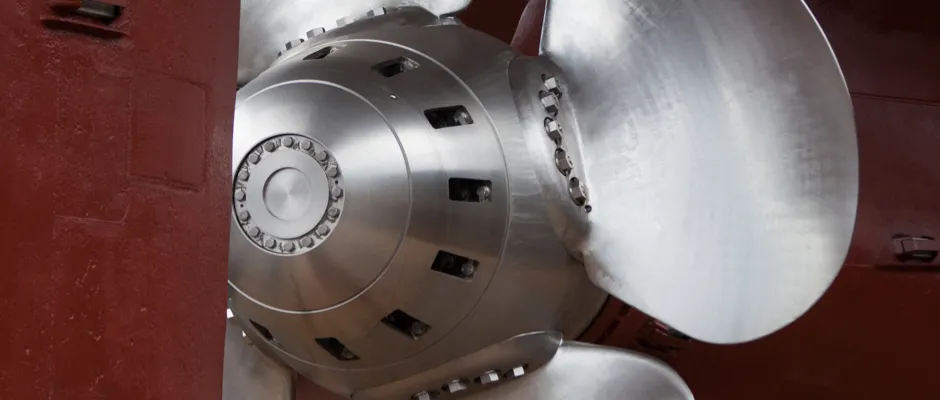
When Must CPP Blades Be Assessed Together with the Hub and Pitch Mechanism?
Author: Jeroen Berger • Publication date:
In existing Controllable Pitch Propeller (CPP) installations, the initial technical reflex is often deceptively simple: as soon as performance, load behaviour, or manoeuvring behaviour no longer remains technically convincing, attention quickly shifts to CPP blades. It is precisely at that point that CPP blades can no longer be assessed in isolation, but only in conjunction with the hub and pitch mechanism, and that moment is technically far more important than it may initially appear.
This shift is not triggered by a clear break, but by behaviour that no longer resolves cleanly within the same system logic. Once propulsion response, load distribution or pitch reaction no longer align consistently, an isolated blade assessment loses technical value. The risk then is not mismeasurement but misattribution. A component intervention may appear technically sound, while the actual sensitivity lies in the relationship between blade, hub and pitch mechanism. The correct next step is not immediate replacement, but recognition that blade-level assessment has become too narrow to support a defensible conclusion.
A CPP Blade Operates as a Loaded Element Within an Adjustment System
A CPP blade is not only a hydrodynamic surface generating thrust. It is a loaded element within a mechanically controlled pitch system. A change in blade angle alters not only flow conditions, but also force distribution in the blade, load transfer into the hub, and the way the pitch mechanism translates movement into propulsion response.
This defines the dependency. As long as this chain remains stable, traceable and repeatable, blade-level assessment can remain relatively isolated. Once that behaviour becomes diffuse, the situation changes. The blade continues to carry the visible effect, but no longer explains it on its own.
That is the first hard boundary. The blade does not lose importance. Its meaning can no longer be separated from the system response in which it operates.
Deviations in Performance and Response Undermine Isolated Blade Assessment
Not every deviation points directly to the hub or pitch mechanism. However, unstable load behaviour, inconsistent response to pitch variation or diffuse propulsion characteristics across operating points reduce the reliability of blade-only interpretation.
A phenomenon visible at blade level can be generated elsewhere in the chain. A blade may appear hydrodynamically suspect while the underlying cause lies in actuation, positioning or load transfer within the hub and pitch system. In such cases, a blade-focused analysis remains incomplete, even when the deviation is concentrated at the blade.
The assessment then shifts. The question is no longer what the blade shows, but under which system response that behaviour is produced.
The Pitch–Response Relationship Marks the Transition
In a properly functioning CPP system, a change in pitch produces a traceable change in load, thrust and manoeuvring behaviour. When that relationship becomes inconsistent or non-linear, the basis for assessment shifts.
The condition of the blade is no longer the primary reference. The alignment between mechanical input and hydrodynamic outcome becomes decisive. Cause and effect must still connect in a technically defensible way. If they do not, blade-level conclusions lose validity.
In practice, this transition appears in system behaviour before it becomes visible in geometry or inspection data. Staying at component level too long exposes the effect but not the mechanism.
A Usable Blade Is Not Necessarily a Logical Blade
In existing installations, failure is rarely abrupt. Systems often remain operational while internal consistency degrades. That is where this question becomes relevant.
A CPP blade may remain usable, reproducible and apparently compatible, while its interaction with hub and pitch mechanism is no longer consistent. This separates manufacturability from suitability. A blade can be produced or replaced without guaranteeing that it still fulfils the correct technical role within the system.
If that distinction is not made, the assessment shifts too early towards a component solution. That is where technically correct actions produce insufficient system-level outcome.
Changing Operating Profiles Can Shift the Assessment Level
A broader assessment is not only required after physical modification. Changes in operation alone can be sufficient. Increased duty cycles, more frequent manoeuvring, altered load patterns or a shift in operational focus can change how the propulsion system behaves without altering a single component.
The installation may still function, but no longer aligns with its original system logic. The blade remains serviceable, but operates within a system that has effectively changed. In such cases, treating the issue as a blade problem becomes technically incorrect. The issue lies in the relationship between blade and system context.
A combined assessment then produces more reliable results than an isolated blade analysis. Not because the blade is less important, but because only within that context does its technical role become clear again.
Ambiguous Behaviour Increases the Risk of Misdiagnosis
Clear failure is easier to trace. Greater risk lies in systems that still function but no longer resolve clearly. The difficulty is not severity but ambiguity.
In that phase, visible deviations tend to carry excessive explanatory weight. The actual sensitivity often remains in the interaction between blade, hub and pitch mechanism. A component-level intervention may be technically correct and still miss the underlying issue.
For shipowners, operators and technical managers, this has direct investment consequences. Not every unclear signal justifies escalation. But this is the point where resources are most often applied to a solution that addresses the wrong layer of the problem.
CPP Blades Must Be Assessed Together with Hub and Pitch Mechanism When System Logic Dominates
This is not a product question. It is a boundary question. The issue is not which blade is required, but within which technical frame a blade can still be assessed in a meaningful and defensible way.
Once the relationship between blade, hub and pitch mechanism can no longer be assumed, it must be made explicit in the analysis. CPP blades must be assessed together with the hub and pitch mechanism when propulsion behaviour, load distribution or pitch response deviate without remaining fully explainable at blade level.
At that point, the assessment shifts from component condition to system logic. That shift determines whether reproduction, replacement or redesign remains technically valid, operationally effective and economically defensible.
The decisive moment is not the first indication of blade relevance. It is the point at which the blade still carries the effect, but the explanatory power has moved to the combined behaviour of blade, hub and pitch mechanism.
This Article Within the Series
Within Technical Design and Configuration of CPP Blades, this article brings the cluster to the point where a CPP blade can no longer be read as an isolated component but only as part of the mechanical chain in which it operates. Earlier articles established when the blade becomes a technical decision point, how it governs load distribution, how geometry affects manoeuvring behaviour and when compatibility becomes a technical risk. This article defines when those signals can no longer be resolved without including hub and pitch mechanism in the same assessment.
From this position, the series moves logically to Why Can You Not Assess CPP Blades Independently of Hull and Rudder. Once blade behaviour is understood to depend not only on the pitch system but also on inflow, stern geometry and rudder interaction, the analysis extends from internal system logic to full hydrodynamic context.