

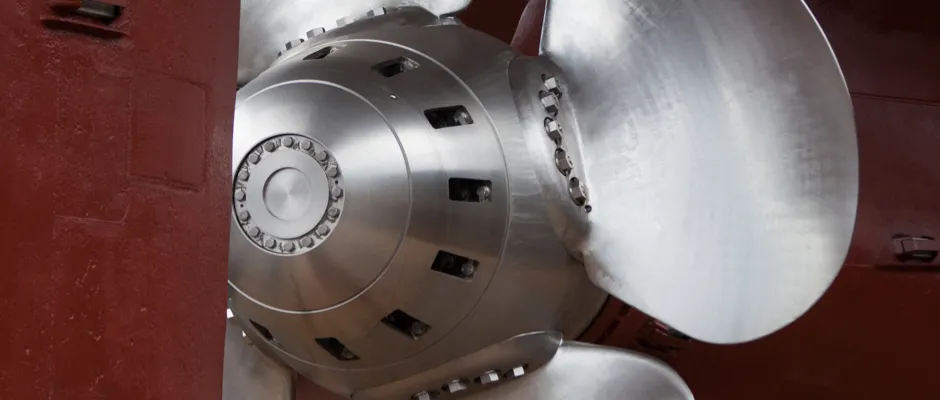
Technical Design and Configuration of CPP Blades
Author: Jeroen Berger • Publication date:
Controllable Pitch Propeller (CPP) blades only become a true technical assessment point within existing propulsion installations when deviating behaviour can no longer be convincingly explained without explicitly including the blade in the analysis. This moment arises when load distribution, pitch response, manoeuvring behaviour, and propulsion reaction still function, yet no longer align coherently with the vessel’s current operational profile. At that point, the risk emerges that an intervention at blade level appears plausible, while the underlying technical explanation remains too narrow. For shipping companies, shipowners, technical managers, and superintendents, the next step is therefore not automatically replacement, but a systematic assessment of whether the existing blade still operates defensibly in conjunction with control systems, inflow, hub, rudder, and hull within the actual propulsion configuration.
Within the full series, this cluster page forms the technical starting point. Where Design, Validation and Performance Assessment of CPP Blades shifts towards assessability, CFD, system conditions, and blade behaviour under representative operating conditions, and Service Life, Retrofit and Compliance of CPP Blades focuses on reproduction, replacement, redesign, and reproducibility within existing installations, Strategic Decision-Making Around CPP Blades places emphasis on investment logic, retrofit choices, and the risk of technically incorrect solution paths. This page positions itself by first defining the system framework within which CPP blades must be interpreted technically before design questions, retrofit decisions, or strategic choices can be made convincingly.
Within this cluster, CPP blades function as part of an integrated maritime system. The propeller, hub, pitch mechanism, inflow around the stern, hull, and rudder together determine the actual behaviour of the installation. The technical value of blade assessment therefore only emerges when it is interpreted within the hydrodynamic and mechanical environment in which load, propulsion response, and controllability are actually generated.
Within this cluster page, the narrative progresses from the initial decision point around the blade to load absorption, manoeuvring control, system compatibility, and the broader interaction with hub, pitch mechanism, hull, and rudder. The underlying articles elaborate on these aspects individually. For that reason, this page adds something different from the individual articles themselves. It does not centre on one mechanism or one type of deviation, but on the technical framework within which CPP blades must be assessed as part of an existing configuration to make any subsequent step defensible.
The coherence between these aspects also determines how this cluster should be read. Load, control, compatibility, and system context are not presented as separate observations, but together form the assessment field within which CPP blades gain their technical meaning.
When Do CPP Blades Become a Technical Decision Within Your Propulsion Configuration?
The technical decision point around the CPP blade arises when the system can no longer be fully explained without explicitly accounting for the blade. As long as load absorption, pitch response, manoeuvring behaviour, and propulsion response remain logically consistent within the expected system margin, the blade remains part of an integrated whole and not yet an independent assessment object.
This changes when an installation continues to function but no longer responds coherently within the current combination of load, control, inflow, and operational profile. The relevant question then shifts away from visible deviation. Not wear, local damage, or geometric irregularity defines the turning point, but the observation that the configuration under real operating conditions responds less convincingly than technically expected.
This moment often first becomes visible in signals that do not yet point to a single component. A deviating power profile, a less stable pitch response, a less convincing propulsion reaction, or subtly altered manoeuvring behaviour only gain meaning when they can no longer be convincingly attributed to a single isolated cause. The blade does not automatically become the dominant cause, but it does become a factor that can no longer be excluded from core analysis.
The detailed elaboration of this decision point is provided in When Do CPP Blades Become a Technical Decision Within Your Propulsion Configuration. It explains why the relevant assessment does not begin with immediate replacement, but with the question of whether further analysis without explicitly considering the blade has become too narrow.
How Do CPP Blades Affect Load Distribution Within Your CPP System?
Load absorption within a CPP system arises from the way the blade takes in water, accelerates it, and converts it into hydrodynamic resistance and thrust. The blade therefore determines not only how much load is absorbed, but how that load develops across the vessel’s actual operating range.
This distinction is decision-relevant because load within this configuration cannot be interpreted solely as an engine, control, or machinery issue. Blade shape, pitch setting, inflow conditions, and system response together define the load profile. A blade profile that aligns well with the configuration supports a gradual and controlled increase in load. When that alignment weakens, the same system can become more sensitive to instability, inefficient load distribution, or a narrower usable operating window.
The relationship between pitch adjustment and load response is also part of this layer. Every change in pitch affects not only thrust but also the character of the load response. Sensitivity therefore lies not only in operation or control, but in how the blade profile responds under varying operating conditions. Once load behaviour becomes less reproducible under comparable conditions, the assessment shifts from absolute capacity to the quality of load development.
Further elaboration of this system layer is provided in How Do CPP Blades Affect Load Distribution Within Your CPP System. That article shows why load distribution only gains technical meaning when it remains traceable, repeatable, and controlled within the available system margin.
How Does the Blade Geometry of CPP Blades Affect the Manoeuvring Behaviour of Your Vessel?
The manoeuvring value of CPP blades arises from the way blade geometry shapes the propeller slipstream. This determines how controlled, sensitive, or damped the vessel responds when propulsion and directional control are required simultaneously. Manoeuvring behaviour therefore does not result solely from pitch adjustment, rotational speed, or power, but from the hydrodynamic response generated by the blade shape itself around the propeller, stern, and rudder.
This makes the assessment stricter than a reading of propulsion figures alone. A vessel may deliver sufficient thrust while controllability, responsiveness, and precision at low speed or during manoeuvres have already shifted. It is precisely in these situations that it becomes clear whether a blade supports controlled and reproducible response, or makes the system more sensitive to small variations in input or inflow.
Adjustability only has real manoeuvring value when the blades translate pitch changes into manageable propulsion response. The decision point therefore lies not only in whether the system responds, but whether that response remains usable and predictable within the required control characteristics of the vessel.
The detailed analysis is provided in How Does the Blade Geometry of CPP Blades Affect the Manoeuvring Behaviour of Your Vessel. It clarifies why controllability is the determining factor.
When Does CPP Blade System Compatibility Become a Technical Risk?
System compatibility becomes a technical risk when a blade still fits formally but no longer interacts logically with load, control, and operation. Compatibility then shifts from physical fit to system logic, fault tolerance, and reproducibility.
This transition rarely occurs abruptly. More often, a configuration gradually loses robustness. An installation may remain usable while predictability and stability already narrow outside its most stable operating range. This reveals that a functioning configuration is not automatically a technically healthy configuration.
Load behaviour and pitch response often expose this boundary earlier than physical fit. Once system response becomes less coherent within the same operational profile, compatibility becomes a substantive question: does the blade still sufficiently support system logic to keep decisions defensible?
Further elaboration is provided in When Does CPP Blade System Compatibility Become a Technical Risk.
When Must CPP Blades Be Assessed Together with the Hub and Pitch Mechanism?
The relationship between blade, hub, and pitch mechanism becomes decision-relevant when blade behaviour can no longer be convincingly explained without including the mechanical chain. At that point, an isolated blade assessment loses value.
A CPP blade is a loaded component within an adjustable system. When blade angle changes, so do force distribution, load transfer, and system response. As long as this chain remains traceable, the blade can be assessed relatively in isolation. Once that relationship becomes diffuse, the analysis shifts to system logic.
Further elaboration is provided in When Must CPP Blades Be Assessed Together with the Hub and Pitch Mechanism.
Why Can You Not Assess CPP Blades Independently of Hull and Rudder?
The hydrodynamic significance of CPP blades arises in interaction with the hull and rudder. A blade never operates in uniform inflow, but within a flow field shaped by the hull and extending towards the rudder.
As a result, the location where an effect becomes visible is not necessarily where it originates. Deviations at blade level may result from inflow conditions, wake, or rudder interaction. An assessment that isolates the blade risks separating symptom from cause.
Further elaboration is provided in Why Can You Not Assess CPP Blades Independently of Hull and Rudder.
The technical viability of CPP blades within an existing propulsion configuration ultimately only holds when the blade remains traceable across the actual operational profile in load absorption, manoeuvring behaviour, compatibility, and system interaction.
How This Cluster Contributes to a Technically Defensible Assessment
This cluster provides the framework to assess CPP blades not as isolated components, but as part of a propulsion configuration. It shows that deviations only gain meaning once it is clear within which hydrodynamic and mechanical context they arise. In doing so, it prevents blade assessment from prematurely shifting towards replacement while the underlying explanation remains insufficiently defined.
For shipping companies, shipowners, technical managers, and superintendents, this acts as an initial filter layer. It must first be established whether the existing CPP blade still interacts logically with hub, pitch mechanism, inflow, hull, and rudder within the current operational profile. Only then does a defensible basis emerge for reproduction, replacement, or redesign.