

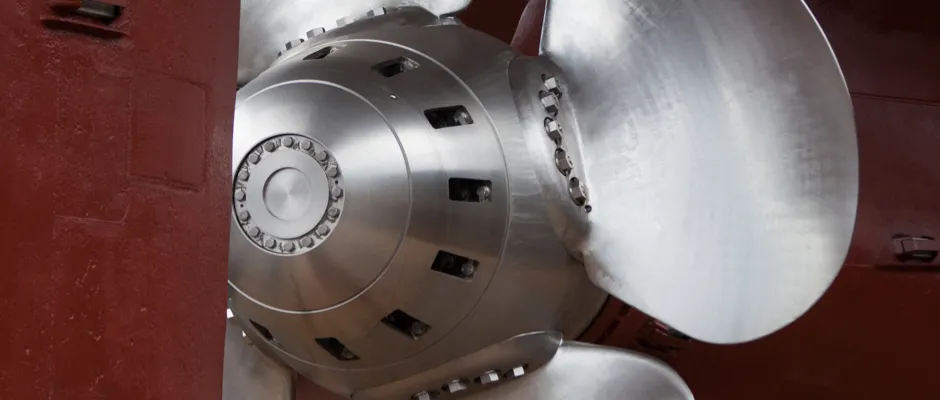
How Do CPP Blades Affect Load Distribution Within Your CPP System?
Author: Jeroen Berger • Publication date:
CPP blades affect load distribution within your CPP system by determining how power is absorbed by the propeller in practice, not only how much thrust is ultimately delivered. This distinction is technically relevant because system load originates in the way the blade takes in water, loads, and accelerates it. At that point, load behaviour shows whether an installation builds load in a stable and proportional manner or responds more sensitively than required for the vessel’s operating profile.
The core of the question therefore does not lie only in power or control, but in the way the CPP blade generates system load. For shipping companies, shipowners, technical managers, and superintendents, this becomes particularly relevant when the load pattern becomes less stable, less predictable, or more difficult to explain, for example under variable loading, manoeuvring conditions, or an operating profile that differs from the original design basis. The relevant technical question is then not only how much load the system can handle, but how the blade builds that load within the propulsion line.
The CPP Blade Determines Not Only How Much Load Is Absorbed, but How That Load Develops
CPP blades affect load distribution by determining how system load forms hydrodynamically when pitch, rotational speed, and power demand interact. Within a CPP system, load distribution develops through the way the blade geometry takes in, accelerates, and deflects the water.
Their influence therefore lies not only in maximum thrust or power uptake, but in the shape of load development. A blade profile that corresponds with the configuration allows load to increase in a gradual, proportional, and traceable manner. A profile that is less well matched can make the same system more sensitive to instability, uneven load distribution, or a narrower usable operating range.
The technical boundary is therefore not limited to visible damage or clear faults, but present in how the blade governs load development within actual system behaviour. This distinguishes a system that processes load in a controlled manner from one that accumulates stress more rapidly.
Pitch Adjustment Determines Not Only Thrust, but How Sharply Load Develops
Within a CPP system, pitch adjustment determines not only thrust, but also how directly and how sharply load increases within the propulsion line. Load is defined by the combination of rotational speed and blade angle.
This relationship is not necessarily linear. A small pitch adjustment can result in a gradual and manageable load increase in one part of the operating range, while under different conditions the same adjustment can lead to a sharper or less stable response. The CPP blade therefore functions as a determining factor in how load develops within the system.
Sensitivity lies in how the blade profile responds to pitch adjustment under varying operating conditions. This defines whether power uptake remains consistent with system behaviour or begins to deviate.
Blade Geometry Determines How Load Is Distributed Across the Vessel’s Operating Range
The geometry of CPP blades determines not only whether load can be absorbed, but how evenly that load is distributed across the vessel’s operating range. Load distribution within a CPP system cannot be assessed on the basis of a single operating point.
Assessment must take place across the full operational range in which the vessel operates. Within that range, blade geometry determines how load is distributed across pitch settings, load levels, and operating conditions. This makes geometry more relevant than whether the system can absorb sufficient power at a single design point.
A blade must therefore correspond with power demand at a specific design condition and continue to function consistently under representative operating conditions. A profile may appear adequate locally, while across a broader range it becomes less stable, less efficient, or less predictable in load behaviour. This defines whether load distribution remains manageable over time.
Inflow Conditions Influence How CPP Blades Experience and Process Load
CPP blades do not operate under uniform inflow conditions. The actual inflow at the stern influences how uniformly or unevenly the blade is loaded, and therefore how stable load distribution remains within the system.
The same blade can behave differently under varying inflow conditions without any change in geometry. Load is determined not only by profile and pitch, but also by the quality of the inflow the blade processes. As inflow becomes more diffuse, asymmetric, or unstable, the way the system absorbs load changes accordingly.
Load distribution within a CPP system is therefore a hydrodynamic interaction in which the blade responds directly to variations in inflow. A load deviation may appear as a control or power issue, while the initial disturbance is already present in how the blade processes inflow.
The Relationship Between Blade, Hub, and Control Determines Whether Load Absorption Is Robust or Sensitive
CPP blades operate within a mechanical and control system that determines how load is generated, absorbed, and regulated. Load distribution requires alignment between blade behaviour, hub geometry, pitch mechanism, and system control.
If that interaction becomes less coherent, load distribution may still appear feasible in principle, while actual behaviour becomes less consistent or less predictable. In such cases, load response no longer results from a coherent system, but from a configuration in which profile, pitch response, and system behaviour are no longer aligned.
Relatively small deviations in this interaction can therefore affect overall load behaviour. This results from the interaction between components no longer functioning consistently. Load distribution within a CPP system is therefore both a hydrodynamic and a system-level question.
Load Distribution Becomes a True Assessment Point Only When It Remains Predictable and Repeatable
CPP blades become technically relevant for load distribution when they enable load absorption in a predictable and repeatable manner. The key question is whether the system continues to handle load consistently under comparable conditions.
When load distribution becomes less consistent under similar operating conditions, the basis for assessment shifts. The focus then moves from absolute capacity to the quality of load response. At that point, the CPP blade becomes more significant in the analysis, as it determines whether load behaviour remains within expected system response or begins to deviate.
The operational margin becomes smaller and less clearly defined. Load distribution then becomes an assessment point with direct implications for further decisions. The blade indicates whether load is still being processed in a controlled manner.
CPP Blades Ultimately Determine How Controlled Load Develops Within System Margins
CPP blades affect load distribution by determining how controlled load develops within the available system margins. Their influence lies in how load develops, is distributed, and remains manageable across the vessel’s operating profile.
For shipping companies, shipowners, technical managers, and superintendents, this becomes relevant when the load pattern becomes less consistent, less stable, or more difficult to explain within the existing configuration. If the role of the blade remains implicit, there is a risk that system behaviour is interpreted too narrowly. The appropriate next step is to determine whether the existing CPP blade continues to support load distribution in a manner that remains technically consistent, operationally usable, and defensible across the vessel’s operating profile.
This defines the practical distinction. The issue is whether the CPP blade enables load to develop in a controlled, proportional, and repeatable manner in practice. This determines whether the blade continues to function within the propulsion configuration or contributes to load distribution falling outside system margins.
This Article Within the Series
Within Technical Design and Configuration of CPP Blades, this article follows directly after the opening article on the technical decision point and develops the question through the mechanism by which an existing CPP blade begins to lose its technical neutrality within the propulsion configuration. Where the previous article defines when further analysis becomes too limited without explicit blade evaluation, this article shows how this is first observed in how load develops, distributes, and remains repeatable within the vessel’s operating profile. It therefore holds an early and structurally defining position within the cluster: the focus is not on visible blade condition, but on whether the blade continues to generate system load in a technically consistent manner.
From that position, it connects directly to How Does the Blade Geometry of CPP Blades Affect the Manoeuvring Behaviour of Your Vessel. After load distribution establishes whether blade logic remains proportional and traceable, the series shifts to how the same geometric and hydrodynamic basis influences controllability, propeller slipstream, and vessel handling during manoeuvres. The cluster therefore progresses from identifying technical relevance to understanding how that relevance is expressed in load behaviour and subsequently in manoeuvring behaviour.