

When Does an Energy-Efficiency Objective Shift the Choice Between a Propeller Nozzle and a Pre-Duct?
Author: Jeroen Berger • Publication date:
The choice between a propeller nozzle and a Pre-Duct only shifts under the influence of an energy-efficiency objective when fuel consumption is no longer assessed at a single design speed, but across the vessel’s total energy profile within its dominant operating profile. The tipping point lies where a reduction in required shaft power over the hours that determine annual consumption begins to outweigh traditional criteria such as maximum thrust or manoeuvring characteristics.
For shipping companies, shipowners and technical managers, this consideration typically arises when fuel consumption or energy performance becomes an explicit operational or strategic objective. The question then shifts from which system can theoretically generate the highest thrust to which concept reduces energy consumption per nautical mile within the vessel’s actual operating pattern.
A meaningful assessment therefore begins with explicitly defining the vessel’s annual operating profile in terms of speeds, loading levels and operating hours. The propeller nozzle and the Pre-Duct are then compared within the same hull, ship propeller and ship rudder configuration and under identical assumptions. Only within such a fixed reference can it be established which concept actually influences energy consumption across the relevant operating profile.
Where Energy Savings Occur Within the Flow Field >
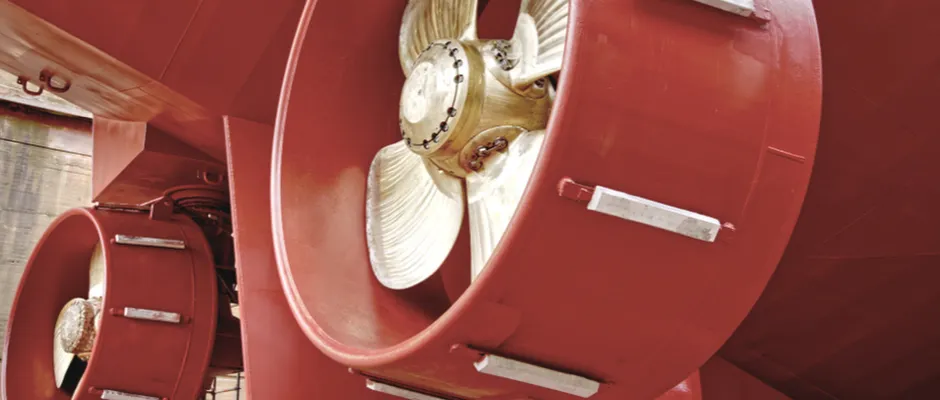
A propeller nozzle modifies the flow field in and around the propeller plane and directly affects pressure distribution, thrust development and interaction with the rudder. A Pre-Duct acts in the inflow region of the propeller and is intended to reduce losses caused by inflow non-uniformity before blade loading develops.
Both concepts therefore address different parts of the flow field. An energy-efficiency objective shifts attention to where, within the specific vessel configuration, the dominant losses arise.
What is decisive is not the system label, but whether the dominant loss mechanism originates from uneven inflow upstream of the propeller or from interaction around the propeller plane itself. Only once that mechanism is clearly identified does the configuration choice gain direction.
When Low Speed and High Load Dominate the Annual Profile
In operating profiles with many hours at low speed and relatively high propeller loading, for example in working vessels or heavily loaded routes, the decisive factor becomes how effectively power is converted into thrust under those conditions.
When comparison within the same configuration shows that a propeller nozzle consistently supports lower required shaft power across multiple load points in this regime, and these hours form the dominant share of annual consumption, the choice may shift towards a nozzle.
The decisive factor is not an isolated advantage, but reproducible energy savings across a substantial number of operating hours.
When Cruise Speed and Inflow Quality Are Leading
When a vessel operates mainly at a stable cruising speed with limited peak loading, energy losses are more likely to be linked to inflow quality than to thrust generation.
In such configurations, a Pre-Duct can have a measurable effect on the inflow field toward the propeller plane. When comparison within the same vessel arrangement shows that the system requires less shaft power across the dominant speed range as a result, the choice may shift towards a Pre-Duct.
What remains decisive is the stability of the effect across the relevant speed range and not a pronounced difference at a single design point.
When Energy Efficiency Has Financial and Regulatory Impact
The assessment gains additional weight when fuel consumption is directly linked to emissions indicators and cost frameworks such as the Carbon Intensity Indicator (CII), the European Union Emissions Trading System (EU ETS) or FuelEU Maritime.
In that context, a structural reduction in fuel consumption carries not only technical relevance, but also economic and strategic consequences. The choice between concepts is then determined by the solution that delivers the most consistent reduction across the annual profile under identical assumptions regarding speed and loading.
An advantage that only appears under specific conditions has less value than a stable, reproducible effect that demonstrably improves the vessel’s energy profile.
Geometry and Retrofit Constraints as Practical Boundaries
An energy-efficiency objective may theoretically point in one direction, but existing installation space, rudder position and aft ship geometry define what remains technically achievable.
In retrofit projects, one concept may be more structurally intrusive than the other. The comparison therefore only becomes relevant when the intended energy gain can be realised within actual geometric constraints without introducing new sensitivities in load distribution, rudder interaction or maintenance behaviour.
Energy improvement loses meaning if it introduces instability elsewhere in the system.
Stability of the Difference Pattern as the Decisive Criterion
Ultimately, the choice only shifts when the difference in required power between a propeller nozzle and a Pre-Duct appears as a stable and reproducible pattern across multiple representative operating points.
A pronounced advantage that is only visible at one speed and diminishes quickly with small variations in loading is less robust as a basis for investment than a more moderate but consistent effect across the annual operating profile.
An energy-efficiency objective therefore only shifts the configuration choice when comparison within the same vessel arrangement demonstrates that one of the two systems structurally supports lower required power and more stable fuel consumption across the dominant operating profile.
This Article Within the Series
Within Propeller Nozzle: Configuration Choice, Economics and Strategic Considerations, this article shifts the focus from nozzle optimisation to the comparison between different energy-efficient propulsion concepts.
The preceding article, When Does an Optimised Propeller Nozzle Justify the Additional Investment, described under which conditions project-specific optimisation becomes technically and economically justified. This article takes a further step by examining when an energy-efficiency objective can influence the choice between different concepts such as a propeller nozzle or a Pre-Duct.
The series concludes with When Should You Not Choose a Propeller Nozzle for Your Ship or Operating Profile, in which the conditions are brought together under which a nozzle configuration is not the most logical choice within the vessel’s operating profile.
For shipping companies, shipowners and technically responsible parties who want to translate these strategic considerations into a concrete vessel arrangement, the page Propeller Nozzle for Ships forms a logical continuation. There, operating profile, geometric constraints, system interaction and project-specific analysis come together in a traceable propulsion configuration for both newbuild and retrofit.