

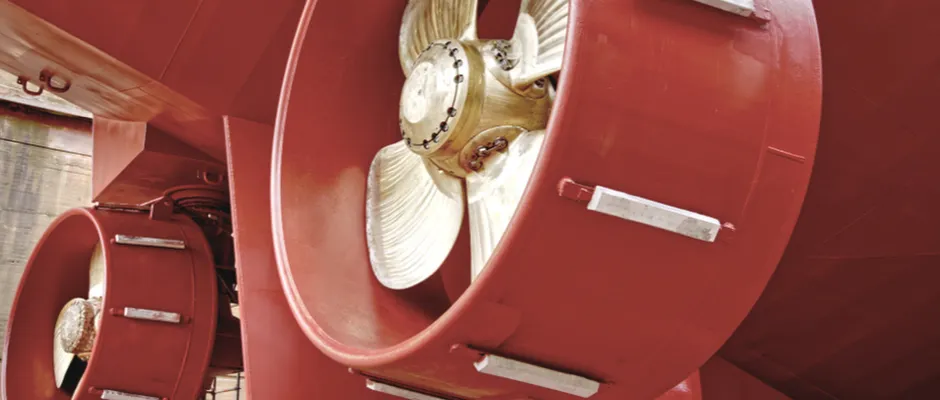
When Are EEXI, CII, EU ETS or FuelEU Maritime Relevant When Modifying a Propeller Nozzle?
Author: Jeroen Berger • Publication date:
A propeller nozzle does not in itself fall under the Energy Efficiency Existing Ship Index (EEXI), the Carbon Intensity Indicator (CII), the EU Emissions Trading System (EU ETS) or FuelEU Maritime. Even so, a nozzle modification may have indirect consequences for all four.
These frameworks do not assess the nozzle itself, but what the vessel demonstrably consumes and has to report. The question is therefore not whether a nozzle is modified, but whether that modification has a measurable effect on recorded power or fuel-consumption data.
That is where the core issue lies. As soon as a modification demonstrably influences required power or fuel consumption, for example through changed interaction between propeller nozzle, ship propeller and ship rudder, that modification indirectly feeds through into frameworks that are formally monitored and financially weighted.
In practice, that moment often begins with a simple question in a project meeting: “What does this mean for EEXI, CII, EU ETS or emissions costs?” From that point onwards, the perspective shifts from hydrodynamics to documented performance indicators.
Where EEXI Becomes Relevant
EEXI is linked to fixed design parameters such as installed power, reference speed and any engine-power limitation. If a nozzle replacement remains within the same power regime and the intervention does not change registered limits, no reassessment is required.
The decisive variable therefore lies not in the nozzle itself, but in whether effective propulsion power, or the way in which power limitation is demonstrated, changes structurally.
If the nozzle becomes part of a package of measures that affects the vessel’s formal energy-efficiency position, EEXI acquires substantive relevance and reassessment comes into play within the framework of the recorded energy data.
When CII Is Affected
CII is based on actual fuel consumption in relation to transported capacity. Here, the focus shifts from design to operation.
Relevance arises when the nozzle modification is intended to reduce fuel consumption per nautical mile structurally within the dominant operating profile. What matters is not a calculated advantage at one operating point, but a reproducible reduction in consumption across representative speeds and loading conditions within the annual profile. Only then does the effect feed through visibly into the actual CII score.
When EU ETS Has a Financial Effect
Within EU ETS, CO2 emissions are accounted for financially. The nozzle is not a separate regulated object; what matters is the effect on fuel consumption and therefore on the quantity of emission allowances that must be surrendered.
That threshold is reached when the modification leads to a structural reduction in fuel consumption on voyages that fall within the system. For example, when a power reduction of a few percent translates across EU-related voyages into demonstrably fewer tonnes of CO2 per year and therefore into a lower need for emission allowances. What matters here is the share of EU voyages in the annual profile and the extent to which the power reduction actually translates into lower consumption under operational conditions.
In a project context, this means in practical terms that an apparently limited hydrodynamic optimisation becomes financially relevant as soon as the effect translates into measurably lower annual fuel consumption on EU voyages. The assessment then shifts from purely technical efficiency to direct cost impact.
When FuelEU Maritime Becomes Part of a Broader Energy Assessment
FuelEU Maritime focuses on the greenhouse-gas intensity of the energy used. A nozzle does not change the fuel itself, but it may influence the total energy demand per transport work.
The regulation becomes relevant when reduction of energy consumption per transport work becomes an explicit steering criterion within fleet strategy. Any measure that structurally reduces required shaft power then gains significance within the applicable energy and emissions framework, because that measure contributes to the vessel’s overall energy profile.
In all cases, the boundary lies at measurable effect on formally recorded energy or emissions parameters.
When Regulation Does Not Form an Independent Design Trigger
In many projects, a nozzle modification remains first and foremost a technical optimisation. As long as no change takes place in recorded power parameters and energy reduction is not explicitly used as a compliance instrument, regulation remains primarily a context rather than a direct design driver.
The technical assessment of flow behaviour, load distribution and integration therefore remains leading as long as the intervention has no demonstrable effect on formally registered energy or emissions data.
Only when the modification has a measurable effect on recorded power data or on structural fuel consumption across the dominant annual profile do EEXI, CII, EU ETS and FuelEU Maritime become substantively relevant. From that point onward, the nozzle modification is no longer assessed only hydrodynamically, but also as part of the vessel’s formally reported energy and emissions profile.
This Article Within the Series
Within Propeller Nozzle: Service Life, Retrofit and Regulations, this article forms the conclusion of the third cluster. Where the preceding articles focused on geometric verification, system interaction, damage development, inspection and material behaviour, the focus here is on the circumstances under which a technical modification to the nozzle feeds through into formal energy and emissions frameworks.
The perspective therefore shifts from maintenance and retrofit to a broader strategic assessment. Once a nozzle modification demonstrably affects fuel consumption, emissions or energy reporting, the technical configuration also touches on economic and policy-related decision-making within the fleet.
The series therefore continues with the next cluster, Propeller Nozzle: Configuration Choice, Economics and Strategic Considerations. Its first article, When Does the Operating Profile Justify a Propeller Nozzle Instead of an Open Propeller Configuration, shifts the focus from service-life management to the question under which operational and economic conditions a nozzle remains the most logical propulsion configuration.
For shipping companies, shipowners and technically responsible parties who want to translate this technical and strategic assessment into a concrete vessel arrangement, Propeller Nozzle for Ships forms a logical continuation. There, geometric analysis, operating profile, configuration choice and project execution come together in a traceable nozzle arrangement for newbuild and retrofit.