

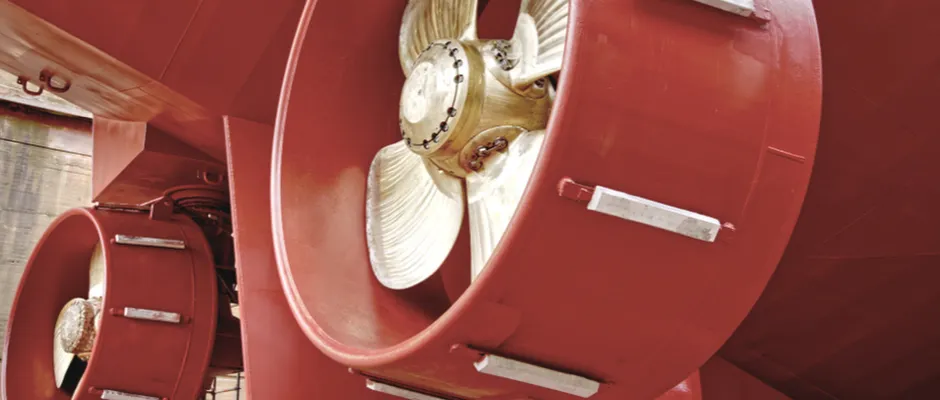
Propeller Nozzle: Service Life, Retrofit and Regulations
Author: Jeroen Berger • Publication date:
Propeller nozzles rarely operate under the static design condition for which they were originally specified. Over a vessel’s service life, propeller loading, operating profiles and material wear change, while maintenance decisions determine whether the propulsion system of hull, propeller and rudder continues to retain its original behaviour.
This creates a different question in the operational phase than in the original design stage. The issue is no longer only how a nozzle was once designed, but whether the combination of nozzle, propeller and rudder continues to function within the same system boundaries under changing conditions, or whether operating point, clearances or damage pattern shift to such an extent that a new assessment under the same technical principles becomes necessary.
Within the management of ship propulsion, service life is therefore rarely a component question, but the result of geometric verifiability, load development and degradation mechanisms across multiple docking cycles.
This cluster focuses on that practical phase of the propulsion system. It addresses the service life of a nozzle, the technical assessment required in retrofit and the circumstances under which regulation indirectly becomes relevant to design or replacement decisions.
Within the series on nozzle configurations, this cluster forms the bridge between design decisions and operational use. The first cluster, Propeller Nozzle: Technology and Configuration, describes the geometric and system-level principles of a nozzle within the aft ship. The second cluster, Propeller Nozzle: Design and Performance Validation, addresses how variants are compared methodically and when a difference is robust enough to serve as the basis for a design decision. This third cluster shifts the perspective towards use, wear and maintenance across multiple docking cycles, after which the fourth cluster, Propeller Nozzle: Configuration Choice, Economics and Strategic Considerations, connects these technical and operational insights to strategic configuration choices within the vessel’s operating profile, including the choice between a nozzle, an open propeller configuration, optimised nozzle variants and alternative concepts such as a Pre-Duct.
The central question remains the same throughout: does the system continue to function within manageable margins under changing conditions, or does the arrangement shift to such an extent that a new assessment becomes necessary?
The topics below describe the circumstances under which geometric verification, damage development, material selection and regulation play a role in service-life and retrofit decisions concerning a nozzle.
Geometric Verification When Replacing a Nozzle Without Reliable Drawings
In older vessels or craft with a long maintenance history, the actual geometry of the aft ship regularly deviates from the original design drawings. Plate replacement, repairs or local deformation may have had a subtle effect on the shape of the hull and the opening around the nozzle, creating differences between the design drawing and the actual installation situation.
Once that geometric uncertainty becomes greater than the design margin for fit, centring and tip clearance, verification changes from an option into a necessity. In such situations, 3D measurement or additional dimensional verification is used to establish the actual position of the shaft line, hull form and rudder arrangement before a new nozzle is designed or manufactured.
The measured geometry then forms the reference for the drawing package and fit-up verification.
The practical criteria for this assessment are elaborated in When Are 3D Measurement and Additional Dimensional Checks Necessary for Propeller Nozzle Replacement Where No Drawings Are Available.
When an Existing Nozzle Can Be Retained
Not every propulsion change automatically requires replacement of a nozzle. When the propeller is replaced or optimised, it may be technically justified to retain the existing nozzle, provided that the new propeller loading remains within the hydrodynamic and geometric margins within which the arrangement originally functioned.
Several factors interact here: the operating point remains within the same loading range, tip clearance and centring remain within safe tolerances and the condition history indicates sufficient structural reserve. When wear patterns remain stable and the new configuration does not introduce a clearly heavier pressure or velocity field, retention may be both operationally and technically logical.
The evaluation steps in this assessment are set out in When Can an Existing Propeller Nozzle Be Retained Following a Change in Propeller Loading.
When a Nozzle Modification Requires a System Redesign
A nozzle is never separate from the propeller and rudder. As soon as a modification means more than a like-for-like replacement, the flow and load pattern within the aft ship may change to such an extent that the original tuning no longer operates within the same design margin.
This may occur when the operating profile shifts to a different speed or loading regime, when the interaction between propeller and nozzle moves the propeller operating point, or when the structure of the propeller slipstream noticeably changes the inflow to the rudder. Changed clearances or centring may also influence the flow field.
In such situations, the question shifts from component modification to system alignment, and the combination must be reassessed for predictable behaviour across representative operating points.
The integrated assessment is further elaborated in When Does the Modification or Replacement of a Propeller Nozzle Require Redesign of the Propeller and Rudder.
Damage Patterns That Justify Structural Replacement
The service life of a nozzle rarely ends with one visible defect. The tipping point towards replacement usually arises when damage patterns recur or increase in extent and repair no longer has a stabilising effect.
Recurring cavitation erosion, accelerating material loss, crack formation around welds or distributed wall-thickness loss may indicate that structural reserve is diminishing. Loss of roundness or permanent deformation may also influence the flow pattern and tip clearance to such an extent that repair no longer provides sufficient certainty for the next maintenance period.
The criteria marking this transition are described in Which Damage Patterns in a Propeller Nozzle Indicate Structural Replacement Rather Than Repair.
Dry Dock Inspection as the Basis for Service-Life Management
In practice, service-life management begins with systematic inspection during dry dockings. What matters is not the extent of damage at one moment, but the pattern and its development across multiple docking cycles.
The inner side of the nozzle often forms the primary source of information. Cavitation erosion, abrasive wear caused by sediment and asymmetric loading often leave their first traces there. Coating condition, welds, transition zones and the performance of cathodic protection also deserve attention.
By carrying out inspections at fixed reference points and documenting findings consistently, a comparable basis is created through which trends become visible before damage becomes extensive.
The practical inspection points are set out in What Should You Look for in Dry Dock to Detect Wear and Deterioration of a Propeller Nozzle at an Early Stage.
Material Selection in Relation to Wear and Corrosion
In practice, the material selection of a nozzle is determined by the dominant degradation mechanism within the operating area. Cavitation loading, abrasive wear caused by sediment and corrosion under different water conditions each place different demands on material and protection.
In some operating profiles, cavitation erosion on the inner side is decisive, while in sediment-rich waters abrasive wear governs service life. At the same time, the nozzle forms part of an electrochemical system with hull, propeller, rudder and anodes, meaning galvanic interactions may also play a role.
Material selection is therefore rarely determined solely by hardness or corrosion resistance, but by the combination of base material, coating strategy and cathodic protection that keeps the damage pattern stable across multiple docking cycles.
The technical background to this material assessment is elaborated in Which Wear and Corrosion Considerations Determine the Material Selection of a Propeller Nozzle in Practice.
When Energy and Emissions Regulation Becomes Relevant
A nozzle is not in itself a regulated object under frameworks such as the Energy Efficiency Existing Ship Index (EEXI), the Carbon Intensity Indicator (CII), the EU Emissions Trading System (EU ETS) or FuelEU Maritime. Even so, a nozzle modification may become indirectly relevant when its effect demonstrably feeds through into the vessel’s energy or emissions profile.
Regulation does not assess individual components, but measurable parameters such as installed power, fuel consumption or emissions per transport unit. Once a nozzle modification has a noticeable effect on required propulsion power or structural fuel consumption, that effect may become visible in energy-performance indicators or emissions costs. At that point, the assessment shifts from purely hydrodynamic optimisation to a broader energy and emissions context.
That effect must be demonstrable in the relevant annual operating profile; otherwise, it remains administratively untraceable.
The circumstances under which this link arises are explained in When Are EEXI, CII, EU ETS or FuelEU Maritime Relevant When Modifying a Propeller Nozzle.
The Core of This Cluster
Service life, retrofit and regulation concerning a nozzle come together in one practical question: does the propulsion system continue to function in a controllable manner under the actual operating profile during the next maintenance period, or do geometric uncertainty, load shift or damage development create a need for redesign?
In practice, this means that service-life decisions are only convincing when geometry is verifiable, damage patterns have been assessed as trends and modifications demonstrably remain within the same system boundaries, with regulation only becoming a factor once effects become visible in energy and emissions parameters.
For shipping companies, shipowners and technical managers who want to translate this assessment into a concrete project framework, the page Propeller Nozzle for Ships also forms a logical continuation. There, it is elaborated how a nozzle configuration is defined in newbuild projects under conditions of design freedom and how the same logic is safeguarded in retrofit within the existing vessel arrangement of hull, propeller and rudder, with installation analysis, Computational Fluid Dynamics (CFD) comparison, material selection and, where relevant, coordination with classification societies brought together as a coherent implementation framework.
The decision logic therefore remains consistent: decisive is which choice keeps geometry, loading and wear predictable over the next docking cycle within the same physical system boundaries and the dominant operating profile.