

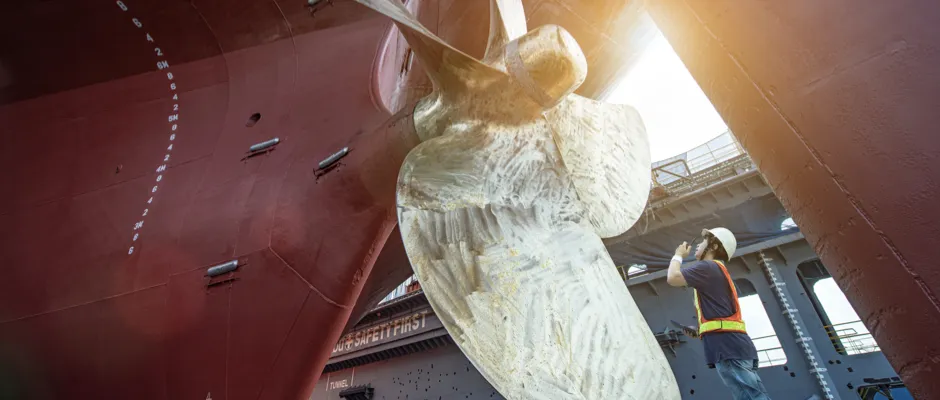
What Are Important Design Principles for an Efficient Ship Propeller?
Author: Jeroen Berger • Publication date:
Ship propeller efficiency largely determines fuel consumption, emissions and the service life of the propulsion system. Although the propeller is often viewed as a relatively fixed element within vessel design, in practice it is the result of a complex interaction between hydrodynamics, material properties and the operational conditions in which the vessel is deployed. Small design choices can therefore have major consequences for both energy efficiency and reliability over the vessel’s lifetime.
For shipping companies and shipowners, this means that selecting an efficient propeller affects not only direct performance, but also operating costs, maintenance needs and the extent to which the vessel can comply with increasingly stringent international energy and emissions frameworks. A sound design is therefore not a purely technical matter, but a strategic decision within the overall vessel concept. This framework is also relevant for technical managers, superintendents and directors who wish to assess design choices against operational profile, cavitation behaviour and life cycle costs.
This article sets out the key design principles for an efficient propeller. It covers hydrodynamic optimization of blade design, alignment of the propeller with the actual operational profile, control of cavitation and the role of material selection and structural strength. Finally, it places propeller design in the broader context of energy efficiency and regulation, in which indicators such as the Energy Efficiency Existing Ship Index (EEXI) and the Carbon Intensity Indicator (CII) play an increasing role in design and investment decisions.
Hydrodynamic Optimization
Blade geometry is one of the most decisive parameters for propulsive efficiency. Pitch, blade area, thickness distribution and blade section directly influence how water is accelerated and how effectively available power is converted into axial thrust. Suboptimal geometry quickly leads to additional vortex formation, increased losses and energy dissipation in the propeller slipstream.
Modern design processes increasingly use Computational Fluid Dynamics (CFD). CFD analyses numerically simulate the flow around and through the propeller under different operating conditions, such as varying rpm, speeds and inflow profiles. These simulations provide detailed insight into pressure distribution, velocity fields and local blade loading, enabling designers to tune the blade for efficiency, cavitation behaviour and structural loading.
In many current projects, CFD serves as the primary design tool, with a large number of variants evaluated digitally. Towing-tank tests are used more often as validation, for example to confirm critical cavitation phenomena, vibration behaviour or specific interactions with hull and stern. Measurements of thrust, torque, cavitation patterns and pressure pulses then verify numerical results and reduce remaining design uncertainties.
The ultimate goal of hydrodynamic optimization is to achieve high propulsive efficiency across the vessel’s relevant operating envelope, not only at a single design point. By limiting vortices, cavitation and unfavourable pressure distributions, energy efficiency increases and structural loading on propeller, shaft line and stern decreases. This directly supports longer propulsion-system life and smoother, more predictable vessel behaviour.
Alignment With the Operational Profile
No vessel operates under fully constant conditions. Speed, loading, water depth, resistance and deployment vary continuously in practice. A propeller cannot therefore be designed generically, it must be aligned explicitly with the vessel’s dominant operational profile. Propeller efficiency is determined not by a theoretical optimum, but by how efficiently it performs within the speed and loading range in which the vessel spends most of its operating time.
For ship types such as bulk carriers and oil tankers that sail largely at a steady cruising speed, optimization focuses on one clearly defined operating point. Blade design is then tuned so that hydrodynamic efficiency at this cruising speed is maximized, even if efficiency outside this point is less optimal. This results in low specific fuel consumption and a predictable emissions and operating profile.
For vessels with a highly variable deployment pattern, such as tugs, dredgers and offshore support vessels, the design challenge is different. These vessels often operate at low speed, under high loading and with frequent power transients. In such cases, a propeller configuration is required that remains stable and efficient across a wider operating range. This can lead to different choices in blade area, pitch distribution and sometimes the use of additional systems such as nozzles or controllable pitch propellers.
A precise analysis of the service profile is therefore essential. This considers time-at-speed distribution, average and peak loading, maneuvering requirements and operational constraints. Only when these factors are explicitly included can the propeller design truly match real-world use and deliver a durable balance between efficiency, reliability and operational flexibility.
Avoiding Cavitation
Cavitation is one of the most critical failure and loss mechanisms for propellers, because it directly affects both hydrodynamic efficiency and system life. When local pressure on the suction side of the blade falls below the vapour pressure of water, vapour bubbles form. As these bubbles are carried to zones of higher pressure they collapse, creating pressure spikes and microjets that damage the blade surface. This can lead to erosion, increased vibration, pressure pulses and a measurable reduction in propulsive efficiency.
A cavitation-resilient design starts with controlling pressure distribution over the blade and avoiding unfavourable angles of attack. Pitch distribution, blade section, thickness distribution and tip shape largely determine where low-pressure zones occur and how quickly cavitation develops. By distributing loading more evenly over the blade, cavitation can be delayed or limited in intensity without sacrificing required thrust.
Beyond blade design, the local flow field aft is decisive. A non-uniform wake or pronounced rotating inflow can cause cyclic overloading of blade regions, triggering localized, pulsing cavitation. This is detrimental to efficiency and to comfort and structural loading in the shaft line and stern. In this respect, propeller-to-hull clearance, position relative to the afterbody and interaction with appendages such as rudder, struts, tunnels and other stern components play an important role. These elements influence inflow and can worsen or mitigate cavitation depending on geometry and integration.
Avoiding cavitation is therefore not a standalone propeller problem, but a system question in which propeller, afterbody and operating conditions together determine whether the vessel can remain stable, quiet and efficient across its operating envelope.
Materials and Structural Strength
Propeller material selection is decisive for mechanical reliability and behavior under long-term hydrodynamic loading. In addition to strength and stiffness, properties such as corrosion resistance, resistance to cavitation erosion and reparability are central. Because a propeller is exposed over its life to varying forces, pressure pulses and cyclic loading, the material must not only be sufficiently strong, but also exhibit predictable fatigue behaviour.
Nickel-aluminium bronze is the most widely used propeller material worldwide. It combines good mechanical strength with excellent corrosion resistance in seawater and relatively favourable behavior under cavitation loading. A practical advantage is that damage, such as cavitation erosion or impact damage, can often be repaired locally by welding and machining. This makes nickel-aluminium bronze attractive from a life-cycle cost and maintenance perspective, especially for vessels in continuous service.
Stainless steel is used where higher strength, more compact blade geometry or extreme loading is required, for example at high power density or under specific operational demands. The material offers greater mechanical reserves but requires more attention to corrosion control, particularly during lay-up, with varying water quality or under unfavourable electrochemical conditions. Repairs are also generally more complex and costly than for bronze alloys, which affects the maintenance philosophy.
Beyond base material, structural design is decisive. The propeller must withstand fatigue loading caused by varying blade forces, changing inflow and interaction with the stern. Insufficient attention to stress concentrations, transitions at the hub or local thickness increases can lead to cracking or premature damage. Modern methods therefore combine hydrodynamic analyses with structural calculations so that both efficiency and durability are safeguarded over the full service life.
Materials and structural strength are not secondary constraints, but integral parts of an efficient design. They largely determine whether theoretically achieved hydrodynamic gains are retained in practice without increasing maintenance burdens or operational risk.
Integration With Energy Efficiency and Regulation
Propeller optimization does not stand alone, it is an integral part of broader strategies for energy efficiency and emissions control. A well-aligned propeller directly influences required propulsion power and thus fuel consumption across the vessel’s entire operational profile. Because the propeller operates continuously, any structural efficiency gain impacts overall energy performance.
Within the current regulatory context, as of January 2026, this design choice has an increasingly explicit meaning. For existing vessels, energy efficiency is assessed in part via the Energy Efficiency Existing Ship Index (EEXI), which relates installed propulsion power to transport capacity and design performance. A more efficient propeller can reduce required power or improve use of available power, which directly affects the feasibility of EEXI compliance.
The Carbon Intensity Indicator (CII) focuses on actual operational behavior. It assesses annual CO2 emissions in relation to distance sailed and cargo carried. In this context, the propeller plays a structural role, an efficient design lowers specific fuel consumption across the profile and can support a more stable or favourable CII score, provided the vessel is operated within the intended design conditions.
At European Union level, the European Union Emissions Trading System (EU ETS) increases the financial relevance of energy efficiency. Every reduction in fuel consumption directly reduces CO2 emissions and thus exposure to emissions costs. Although the propeller is only one element within the onboard energy system, its continuous influence on power demand gives it a relatively large effect on the overall emissions balance.
Integrating propeller design with energy efficiency and regulation requires a coherent approach. Hydrodynamic optimization, material selection and alignment with the operational profile must be assessed technically and placed within the context of legal frameworks, operational deployment and economic consequences. In this context, the propeller becomes not only a mechanical component, but a strategic link within the broader energy and compliance policy of shipping companies and shipowners.
Strategic Value for Shipping Companies and Shipowners
A well-designed propeller is always the result of a balanced compromise between speed, thrust, durability and cost effectiveness. No design can maximize all factors simultaneously. Strategic value lies in choosing a balance that matches the dominant operational profile, deployment and economic objectives over the vessel’s full life.
Modern methods allow this compromise to be defined much more precisely than in the past. By combining hydrodynamic analyses, profile studies and in-service data, propeller design can be tuned to real use rather than generic assumptions. The propeller thus shifts from a standard component to a purpose-designed tool that directly influences fuel consumption, maintenance needs and operational reliability.
For shipping companies and shipowners, propeller selection cannot be separated from broader strategic considerations. A slightly higher initial investment in design quality or optimization can pay back through lower operating costs, more stable energy use and greater flexibility under changing regulation. At the same time, a well-aligned propeller increases predictability of performance, which is essential for planning, compliance and risk control.
In a market where fuel prices, emissions costs and regulatory pressure are structurally increasing, the propeller becomes an instrument of competitiveness. Not through maximum performance on paper, but through reliable, repeatable efficiency under the conditions in which the vessel actually operates. That consistency is what distinguishes a merely correct design from a strategically strong investment.
About This Article
This article forms part of the background information on the propeller as a product and falls within the cluster Ship Propeller Design and Optimization. Its core premise is that propeller efficiency is not determined by a single isolated design parameter, but results from the interaction between hydrodynamic design, alignment with the operating profile, cavitation control, and structural and material-related boundary conditions. Design choices only gain relevance when they are made on a project-specific basis and demonstrably align with the vessel’s actual area of operation. For a project-specific elaboration, the page Custom Ship Propeller logically builds on this context.
For a deeper look at flow phenomena and their impact on efficiency and damage, What Is Cavitation and How Does It Affect Ship Propellers connects directly. That article explains why cavitation control is a prerequisite for maintaining performance over the service life.
The role of computation and testing in the design process is elaborated in Can CFD (Computational Fluid Dynamics) Replace Model Tests in Ship Propeller Design, which explains how numerical analyses and physical testing complement each other in optimizing and validating designs.
How design choices are ultimately assessed objectively and linked to performance in service is addressed in How Is Ship Propeller Performance Measured and Validated. Together, these articles position propeller design not as an isolated technical exercise, but as a verifiable link in a coherent strategy for energy efficiency, reliability and future-proof operations.