

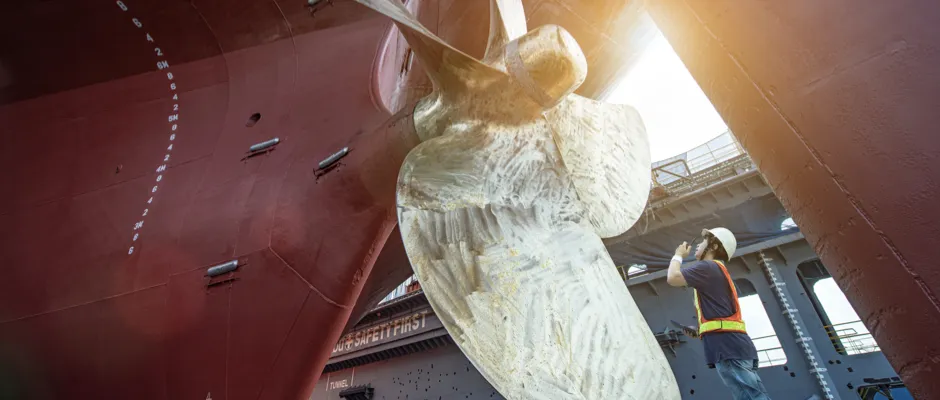
Ship Propeller Design and Optimization
Author: Jeroen Berger • Publication date:
The ship propeller is not a static end product, but the outcome of a design process in which hydrodynamics, mechanical constraints and operational reality converge. This page forms the second cluster within a series of four interrelated knowledge clusters on the ship propeller. Whereas the first cluster Ship Propeller Types and Propulsion Configurations describes which configurations are available and how they differ functionally, this cluster addresses how a ship propeller is designed, optimized and assessed within a specific project. The two clusters that follow build on this: Ship Propeller Validation, CFD and Performance Measurement explains how performance is measured and validated, and Ship Propeller Life Cycle, Retrofit and Regulatory Framework shows how performance carries through into maintenance, emissions and compliance, so that technology, verification and policy align.
In practice performance differences rarely prove to be explained by propeller type alone. What is often decisive is the extent to which the design matches the actual operational profile, the inflow aft of the hull and the way in which performance is demonstrably established and monitored. A carefully selected configuration can underperform when the design is insufficiently aligned with the operational context. Conversely, a seemingly conventional concept can prove highly effective when developed consistently and on a project-specific basis.
This cluster therefore follows a fixed line of reasoning. It starts with design principles and hydrodynamic optimization, then addresses cavitation and wear as limiting factors, and thereafter places supplementary devices and alternative concepts within the total propulsion system. The emphasis is not on maximum theoretical performance, but on demonstrable efficiency and predictable behaviour within the intended operational profile, over the vessel’s service life.
Design Principles as the Foundation for Efficiency
An efficient ship propeller does not result from optimizing a single parameter, but from carefully balancing blade geometry, loading, inflow and material selection. Blade pitch, diameter, blade area and thickness distribution act in concert. Together they determine how the available shaft power is converted into thrust and the extent to which the propeller is susceptible to cavitation, vibration and fatigue loading.
In modern design processes the focus therefore increasingly shifts from a single ideal design point to a broader operational range. Vessels rarely operate continuously under identical conditions. Variations in loading, speed, water depth and resistance are the rule rather than the exception. A design optimized solely for maximum efficiency at one service speed can lose predictability outside that point, for example because blade loading shifts and local low pressures occur earlier.
Hydrodynamic analyses with Computational Fluid Dynamics (CFD) make it possible to elucidate these effects in advance. By numerically simulating the flow around the propeller, including pressure distribution, velocity fields and local blade loading, the design can be tailored to both efficiency and durability before any material is produced. Depending on project risk and application area, these analyses are often supplemented in practice with model testing to verify critical phenomena such as cavitation patterns and pressure pulses under controlled conditions.
The design principles that govern this process and the way they are weighed against each other in practice are explored in technical depth in the article What Are Important Design Principles for an Efficient Ship Propeller. This makes clear that propeller efficiency is almost always the result of coherent choices, not of one dominant design variable.
Alignment with the Operational Profile as the Key Variable
Once the design principles are clear, the question follows where the propeller actually accrues operating hours in practice. Actual performance is ultimately determined by the degree to which the design aligns with the dominant operational profile. Distribution of operating time across speeds, average and peak loads, manoeuvring requirements and operational constraints together determine where the effective operating point lies and how often the vessel actually operates there.
For vessels with a relatively constant operational profile, such as many cargo ships on fixed routes, the design can be tightly tuned to one dominant operating point. In such cases the emphasis lies on maximum hydrodynamic efficiency and stable, reproducible performance behaviour. For vessels with a highly variable profile, such as tugs, dredgers or offshore support vessels, the design priority shifts to robustness and controllability across a broader loading range, because the system more often operates outside a single fixed service condition.
This trade-off carries through into blade geometry, pitch distribution and sometimes also into the choice of supplementary provisions or controllability. The optimal solution does not follow from a generic preference, but from an explicit link between design choices and operational reality. That link determines whether a theoretical efficiency gain holds up in practice or remains visible mainly in a limited part of the spectrum. This relationship between operational profile and design choices forms the common thread in the further elaboration of cavitation control and system optimization within this cluster.
Cavitation as a Design Guideline, Not a Side Effect
As soon as the design is aligned with the actual operating point, one boundary condition inevitably comes into sharp focus. Cavitation is among the most determining constraints within the design and optimization trajectory of the ship propeller. When local pressure drops on or near the blade lead to vapour formation and imploding bubbles, the result is not only a loss of efficiency, but also structural damage, increased vibration and a rise in noise levels.
A cavitation-resistant design is therefore rarely aimed at eliminating cavitation entirely, because in many applications this is not realistic. The core lies in controlling cavitation within functionally acceptable limits. By equalizing pressure distributions, reducing peak loads and limiting inflow non-uniformities, cavitation can be delayed, bounded or stabilized without compromising the required thrust.
Interaction with the afterbody plays a crucial role. The inflow aft of the hull, often referred to as the wake field, is rarely homogeneous in practice. Asymmetry, velocity gradients and rotating inflow components cause a blade to be loaded variably within a single revolution. This increases the likelihood of pulsating cavitation and thus of pressure pulses, vibration and fatigue loading in the shaftline. The underlying mechanisms, the various forms of cavitation and their influence on efficiency, wear and noise generation are further elaborated in the article What Is Cavitation and How Does It Affect Ship Propellers. This makes clear that cavitation control is not an isolated propeller issue, but an integral part of the total propulsion design.
Supplementary Devices and Their Place in the System
When cavitation, inflow and blade loading jointly bound the design space, it is logical that optimization does not always stop at the propeller itself. In practice supplementary devices are therefore increasingly deployed to limit specific flow losses. Nozzles, guide vanes and Propeller Boss Cap Fins each act on different loss mechanisms in inflow and outflow and can, under appropriate conditions, lead to a measurable improvement in propulsion efficiency.
The value of such devices rarely lies in their standalone effect, but in how they are integrated into the total system. A propeller nozzle can increase available thrust at low speeds and high loading, but introduces additional resistance at higher speeds. Guide vanes can correct an unfavourable inflow by conditioning the approach flow, but provide limited benefit when the wake is already largely uniform. A Propeller Boss Cap Fin, a hub cap with fins designed to reduce energy loss in the hub vortex, is particularly effective when this loss mechanism is actually dominant in the configuration concerned.
These devices are therefore not generic optimizations, but project-specific instruments. Their deployment calls for substantiation with numerical analyses, model tests or in-service measurements, so that the expected efficiency gain remains traceable and verifiable and is not confused with variations in measurement conditions or operational profile. The function, application limits and associated trade-offs are discussed in context in the article Can Devices Such as Propeller Nozzles, Fins, or PBCFs Improve Ship Propeller Efficiency. This article makes clear that supplementary systems add value only when they demonstrably fit within the total propulsion concept.
Alternative Propulsion as an Addition, Not a Replacement
When optimization of propeller and stern can already deliver substantial gains, it is logical that the question arises how far further improvements can reach. Growing attention to alternative propulsion technologies regularly raises the question to what extent the conventional ship propeller could be replaced in the longer term. In current practice, however, full replacement proves rare. The combination of high efficiency across a broad operational range, mechanical simplicity, robustness and global embedding in design, maintenance and certification frameworks makes the ship propeller a hard-to-match reference, particularly within the commercial fleet.
What is changing is the context in which the propeller operates. Wind-assisted propulsion, resistance reduction, electrification and hybrid energy systems are increasingly integrated into the total propulsion concept. In such configurations the ship propeller generally remains the central conversion point from power to thrust, while supplementary systems reduce power demand or expand the operating envelope, depending on route, operational profile and design choices.
The technical and economic reality of this development, and the reasons why alternative propulsion concepts in the commercial fleet primarily play a supplementary role, are further elaborated in the article Will Alternative Ship Propulsion Technologies Replace the Conventional Ship Propeller. This article shows why development in practice focuses less on replacement and more on integration and refinement within existing propulsion architectures.
How This Cluster Contributes to a Substantiated Choice
This cluster provides a framework for placing design and optimization choices in their proper context. It shows that efficiency is not an absolute given, but the result of alignment, validation and consistent use within the intended operational profile. Performance claims acquire meaning only when they are linked to measurement conditions, verification methods and representative deployment. Only then is it clear under which conditions an effect has been established and to what extent it is reproducible.
For shipping companies, shipowners and those with technical responsibility this insight provides a practical starting point for investment trade-offs and for underpinning performance expectations towards a client or yard. By first understanding design principles, hydrodynamic limits and system interactions, a logical line emerges towards operations, life cycle costs and the way in which performance must later be accounted for in a demonstrable manner.
For those who wish to translate these design principles to a concrete project situation, the page Custom Ship Propeller logically follows. There it is set out how hydrodynamic optimization, operational profile, inflow conditions and cavitation control converge in design decisions on blade geometry, diameter, pitch and material selection. It also explains how numerical analyses, installation constraints and operational requirements are brought together in practice into a realizable and verifiable propeller design.
In that role this cluster forms the bridge between configuration choice and performance assessment. It logically follows on from the first cluster on types and configurations and prepares the step towards the next clusters, in which measurement, validation and policy frameworks are further elaborated. Together the clusters position the ship propeller not as a standalone technical component, but as a verifiable and strategic choice within the overall ship design.