

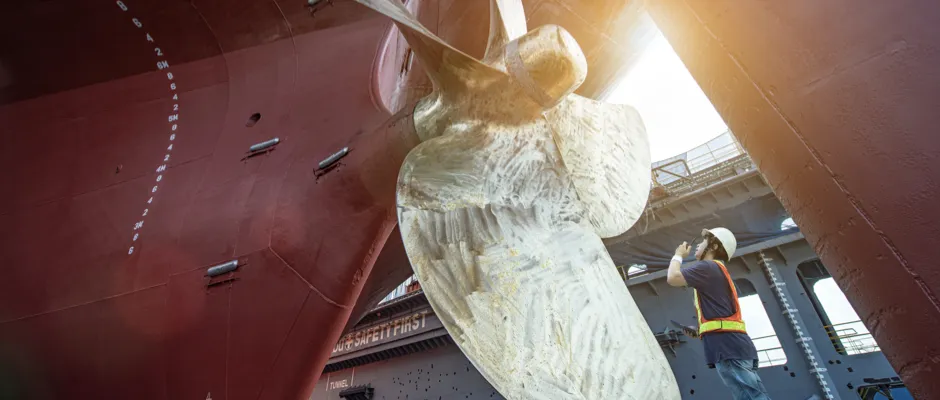
What Is the Best Material for a Ship Propeller: Bronze or Stainless Steel?
Author: Jeroen Berger • Publication date:
Selecting the material for a ship propeller is more than a technical specification. It is a strategic decision that can directly affect operational reliability, maintenance strategy, service life and total cost of ownership. In practice, two material families are used most frequently: nickel-aluminium bronze (CuNiAl, sometimes also referred to as NiAl bronze) and stainless steel. Both can perform well in suitable applications, but suitability depends strongly on operational profile, propeller loading, environmental conditions (such as temperature and water quality) and requirements for inspection and repair.
This article explains how CuNiAl and stainless steel compare in strength, corrosion behaviour, repair options and performance retention over the service life. It also clarifies why, in practice, material choice is almost always vessel- and deployment-dependent and linked to risk and maintenance cost. Finally, it describes how material selection can support more stable propeller performance, and how that can be weighed in substantiation towards the client and, where relevant, class and efficiency and emissions frameworks such as the Energy Efficiency Existing Ship Index (EEXI) and the Carbon Intensity Indicator (CII).
Bronze (CuNiAl): The Proven Standard
In propellers, bronze is almost always applied as nickel-aluminium bronze (CuNiAl). This copper alloy combines high mechanical strength with excellent corrosion resistance in seawater, making it suitable for long-term service across diverse operational profiles and conditions.
A key characteristic is the relatively high resistance to cavitation erosion. As a result, performance loss due to surface roughness and local damage generally remains limited, provided the propeller design, inflow and the operational loading regime stay within the intended range. Compared with many alternative materials, this bronze also shows favourable and predictable degradation behaviour, which supports stable performance over the service life.
From a maintenance and repair perspective, the alloy is often practical. Local damage, minor edge impacts or superficial cavitation erosion can in many cases be repaired by welding and machining, without full replacement of the propeller. Technical feasibility and acceptance of such repairs depend on the damage pattern, remaining dimensions, balance and the requirements of the client and, where applicable, the classification society involved.
For many commercial vessels, CuNiAl therefore remains the logical standard choice. Its value typically lies in the combination of performance retention, corrosion resistance and repairability, with relatively predictable maintenance and replacement costs over the full service life of the propeller.
Stainless Steel: Strong but More Susceptible
Stainless steel is applied increasingly in situations with high mechanical loading or unfavourable operating conditions, for example where there is high power density, intensive duty cycles or operation in (sub-)Arctic areas. The material generally offers higher mechanical strength than CuNiAl, enabling thinner blade sections. This can provide hydrodynamic benefit, but only where the overall design remains demonstrably controlled across the relevant loading range, including stiffness, vibration behaviour and cavitation behaviour.
Set against that potential are material-specific considerations. Depending on alloy, heat treatment and local conditions, stainless steel can be more susceptible to corrosion mechanisms such as crevice corrosion and stress corrosion cracking. In practice, this risk increases in chloride-bearing seawater, particularly at higher water temperatures and in zones with limited water exchange. The damage and repair profile is also usually more complex than with CuNiAl. Repair by welding and machining requires strict process control, appropriate post-treatment and targeted quality control to limit undesirable microstructural changes, residual stresses and local corrosion susceptibility. This often translates into higher repair costs and longer lead times, especially where acceptance by the client and, where relevant, class must be assured.
Stainless steel is therefore seldom an automatic “upgrade”. In practice, it is a targeted material choice where the higher strength and wear resistance demonstrably outweigh the associated corrosion and maintenance risks within the intended operational profile.
Strategic Choice for Shipping Companies and Shipowners
There is no single answer to which propeller material is “best”. In practice, the choice is a trade-off directly linked to vessel type, deployment profile and the desired risk margin. From that perspective, CuNiAl remains the standard for a large part of commercial shipping, precisely because of the combination of performance, corrosion resistance, repairability and predictable life-cycle costs.
At the same time, there are operating situations where priorities other than repairability and corrosion resistance carry more weight. Stainless steel can then be appropriate, particularly where mechanical strength, wear resistance or structural robustness are decisive. This applies, for example, to vessels with high power loading, operation in ice conditions or operations where mechanical damage is a dominant failure mode. In such cases, the higher strength of stainless steel can provide a technical advantage, provided risks around corrosion, inspection and repair are demonstrably controlled.
For shipping companies and shipowners, material selection is therefore ideally part of broader decision-making. The material itself is not decisive, but the extent to which it fits the intended operational profile, the maintenance strategy and the requirements that the client and, where relevant, class set for reliability and verifiability of performance.
Relationship with Regulation and Efficiency
Material selection does not stand apart from international regulation, because performance retention over the service life increasingly carries weight in practice. A material that is more resistant to cavitation erosion and wear can help keep propeller condition within acceptable limits for longer. This increases the likelihood that propeller performance remains stable and that performance loss due to rising roughness, edge damage or local erosion is limited, provided design, inflow and maintenance match the intended deployment.
That stability carries through into fuel consumption. Where propeller performance degrades more slowly, power demand at a given vessel speed is typically more predictable. This is relevant in a context where energy efficiency and emissions are tracked not only technically, but also administratively and economically. Indicators such as the Energy Efficiency Existing Ship Index (EEXI) and the Carbon Intensity Indicator (CII) are relevant in that regard, not because material choice in itself guarantees compliance, but because more stable performance makes it easier to document assumptions and effects consistently and to monitor them over time.
For shipping companies and shipowners, this means that investing in the right propeller material is more than a materials specification. The choice can contribute to reduced performance loss over time, a more predictable energy demand and, therefore, a stronger basis for decision-making and substantiation to the client and, where relevant, class, provided the contribution is demonstrated with appropriate inspection, condition and measurement data.
About This Article
This article forms part of the background information on the propeller as a technical component over its operational life cycle and falls within the cluster Ship Propeller Life Cycle, Retrofit and Regulatory Framework. Its core premise is that the material choice between nickel-aluminium bronze and stainless steel is not a standalone specification, but a determining factor for wear behaviour, repairability and performance retention over time. The suitability of both materials is directly linked to the operating profile, loading, maintenance strategy and the extent to which performance can demonstrably be kept within acceptable limits. For a project-specific elaboration, the page Custom Ship Propeller logically builds on this context.
For the hydrodynamic and design context in which material properties take effect, What Are Important Design Principles for an Efficient Ship Propeller connects logically. That article explains how blade loading, inflow and geometry relate to stress level, cavitation behaviour and surface wear, and thus to the practical suitability of different materials.
The consequences of degradation and damage mechanisms are explored further in What Is Cavitation and How Does It Affect Ship Propellers, which explains how cavitation erosion arises and why material behaviour determines performance loss, maintenance and repairability.
Where material choice forms part of a broader trade-off on efficiency and regulation, How Does a More Efficient Ship Propeller Contribute to MARPOL Annex VI, EEXI/CII, and NOx Reduction provides additional context. That article shows how stable performance retention over the service life can weigh within efficiency and emissions frameworks, without material choice in itself guaranteeing compliance.
Taken together, these articles position material selection not as an isolated specification, but as an integral part of substantiated design choices, risk management and future-proof fleet management.