

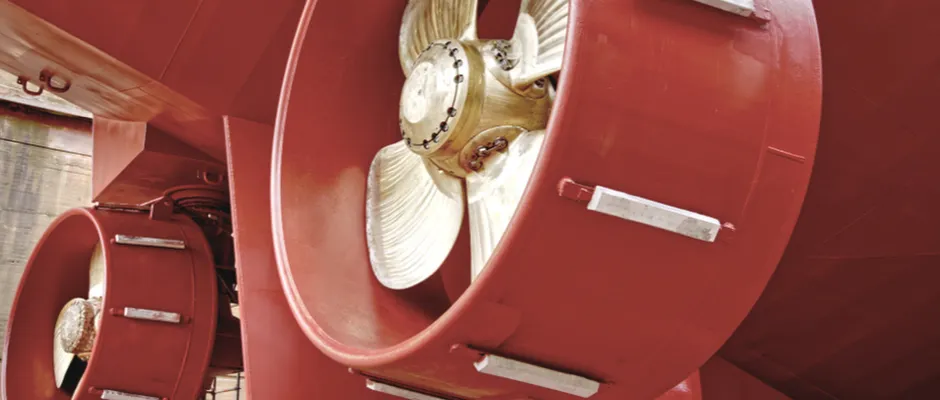
What Should You Look for in Dry Dock to Detect Wear and Deterioration of a Propeller Nozzle at an Early Stage?
Author: Jeroen Berger • Publication date:
A dry-dock interval is the moment when the propulsion system comes to a standstill and it becomes visible, without flow, what water, loading and use have left behind. Deviations in fuel consumption or vibration behaviour are often experienced on board as operational phenomena; in dry dock, it can be assessed whether the condition of the propeller nozzle plays a role in them.
If the inspection is limited to a general visual check, early signals can easily disappear into the background. It is precisely pattern, location and recurrence that provide the first indications that wear or degradation is developing. If that development is not recognised in time, repair shifts from a manageable correction to a structural intervention.
For shipping companies and shipowners, timely detection therefore means that a dry-dock inspection is not only a check, but also a comparison with earlier cycles. By working with fixed reference zones and recording findings in the same way, it becomes visible whether the wear pattern fits the operating profile or begins to deviate from it.
The Inner Side as the Primary Source of Information
The inner side of the nozzle, especially around the inner ring and in zones where the propeller slipstream accelerates, deflects or contracts, often forms the main source of information about loading.
This is where cavitation erosion and abrasive wear tend to concentrate. Cavitation erosion is usually recognisable by sharply defined pitting with a hammered surface appearance. Abrasive wear caused by sand or silt tends to show a more even, scoured pattern with rounded edges.
That distinction is technically relevant because it points to a different dominant mechanism. A locally concentrated erosion pattern is consistent with pressure fluctuations and interaction between propeller and nozzle. A broader wear pattern points more towards sustained particle loading in the operating area.
Timely detection here means that not only depth or extent is recorded, but above all that position and distribution around the circumference are documented systematically and compared with earlier dry-dock records. A shift in the pattern can be diagnostically more valuable than a single absolute measurement.
Asymmetry as a Warning Signal
A uniform wear pattern around the circumference generally corresponds to a stable flow field. When degradation becomes structurally more severe on one side or within one quadrant, that deserves additional attention.
This may be related to uneven inflow, slight eccentricity in the propeller shaft line or a changed loading regime. Asymmetry does not have to indicate an acute defect directly. The risk arises when the pattern is regarded as incidental while it continues to develop in the same direction over several docking cycles.
Consistent documentation of position and extent is therefore often more valuable than a one-off assessment.
Coating Condition and Early Corrosion
The coating system on and around the nozzle often acts as an early indicator of elevated flow loading or electrochemical activity.
Local coating loss in highly loaded zones may fit the operating profile, as long as the underlying steel is not deteriorating at an accelerated rate. If pitting corrosion or undercutting appears at the edge of the coating at the same time, the picture changes from surface degradation to active attack.
Transitions deserve specific attention here. It is precisely where coating ends or repair zones join that the first signs of undercutting become visible. A recurring pattern at the same locations carries more weight than an apparently sound overall surface without a clear trend.
Welds and Connection Details Require Additional Attention
Transitions to the aft ship and welds form structurally sensitive points where hydrodynamic pressure fluctuations, fatigue loading and corrosion may come together.
Hairline cracks or unusual discolouration around welds are therefore not cosmetic details, but possible signals that loading and degradation are reinforcing one another. When repair returns to the same location over successive docking cycles, the interpretation shifts from incidental to structural.
Dry dock offers the opportunity to relate this recurrence to operating conditions and assess whether the configuration has sufficient margin to make it through the next cycle.
Measurements That Make Deformation and Material Loss Visible
Visual inspection alone is rarely sufficient. Wall-thickness measurements at fixed reference points show whether material loss remains within the design margin or is accelerating.
Checks on roundness may become relevant when there are indications of deformation or unexplained asymmetry in wear patterns. Tip clearance between propeller blade and nozzle wall also deserves attention, because deviations may indicate changes in loading or centring.
By carrying out these measurements at the same positions each time, reliable trend information is created. This prevents each dry-dock interval from beginning without a comparable measurement basis.
Corrosion in Relation to Cathodic Protection
The nozzle forms part of the electrochemical system of hull, propeller, rudder and anodes. Unexpected corrosion patterns or degradation near connection points may therefore indicate changes in cathodic protection or reduced electrical continuity within the structural system between nozzle and hull.
Corrosion should therefore not be assessed in isolation, but in relation to anode condition and electrical continuity. Only in that way does it become visible whether local material loss forms part of a broader electrochemical process.
From Observation to Decision-Making
The purpose of a dry-dock inspection is not only to establish damage, but also to assess its development towards the next maintenance period.
Does the current wear and corrosion pattern fit the operating hours until the next dry-dock interval, or does the trend point to acceleration? Is local repair sufficient to stabilise the pattern, or does the development call for additional protection or an adjusted maintenance strategy?
The decisive factor rarely lies in one individual observation. It lies in the combination of location, asymmetry, development over time and coherence with loading and protection.
Conclusion
Wear and degradation of a nozzle become visible in time when inspection focuses on pattern, location and development across successive docking cycles, so that deviations in erosion, corrosion, deformation or coating condition are recognised at an early stage and maintenance or replacement decisions can be based on trend information rather than on an isolated snapshot.
This Article Within the Series
Within Propeller Nozzle: Service Life, Retrofit and Regulations, this article shifts the focus to the practical inspection of the nozzle during dry-dock intervals.
The preceding article, Which Damage Patterns in a Propeller Nozzle Indicate Structural Replacement Rather Than Repair, describes when damage patterns indicate that repair no longer provides sufficient certainty for the next maintenance period. This article addresses an earlier stage in that development: recognising wear and degradation patterns in time before they grow into structural damage.
The series then continues with Which Wear and Corrosion Considerations Determine the Material Selection of a Propeller Nozzle in Practice, which elaborates how different degradation mechanisms, such as cavitation erosion, abrasive wear and electrochemical corrosion, feed through into the choice of material and protection strategy.
For shipping companies, shipowners and technically responsible parties who want to connect inspection and maintenance findings to concrete configuration or retrofit choices, the page Propeller Nozzle for Ships forms a logical continuation. There, geometric verification, load analysis, material selection and coordination with classification societies come together in a traceable nozzle configuration for newbuild and retrofit.