

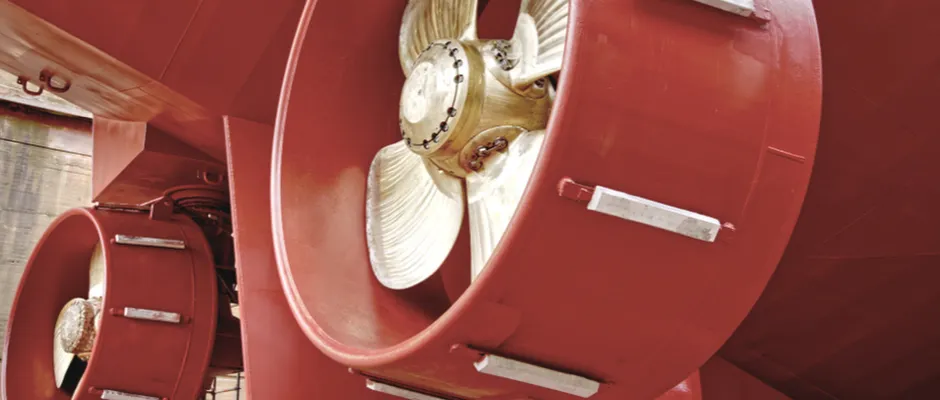
Which Damage Patterns in a Propeller Nozzle Indicate Structural Replacement Rather Than Repair?
Author: Jeroen Berger • Publication date:
A propeller nozzle is rarely replaced on the basis of one visible defect alone. In practice, the tipping point towards replacement develops gradually, when the damage pattern can no longer be regarded as incidental or local, but points to structural degradation of geometry, wall thickness or load path. A dry-dock interval therefore does not represent an isolated snapshot, but an assessment of the remaining integrity within the vessel’s actual operating profile.
This also shifts the question itself. The issue is no longer whether repair is technically possible, but whether the nozzle will still function predictably after repair until the next docking cycle, without maintenance frequency, risk or power behaviour deteriorating unnoticed. For shipping companies, shipowners and technical managers, this means that not only repairability matters, but above all the controllability of risk until the next scheduled maintenance interval.
Recurring Erosion with Increasing Material Loss
Cavitation erosion or abrasive wear is not in itself a direct reason for replacement. It becomes critical when the same zones are affected again during successive docking intervals and the material loss per cycle increases.
The risk lies not in one local repair, but in the acceleration of the pattern once earlier repairs no longer have a stabilising effect. As soon as the remaining wall thickness or the extent of the repaired area leaves insufficient margin for the next maintenance period, the assessment shifts from repair to replacement.
Crack Formation and Fatigue Indications
Cracks in welds, transition zones or connections to the aft ship are a serious signal, especially when they reappear after repair.
Repeated grinding-out and rewelding may increase local stress concentrations and affect the fatigue behaviour of the material. When crack indications increase in length or number, or when new cracks appear in adjacent zones, it becomes clear that the issue is no longer a local defect being repaired, but an active structural loading mechanism.
At that stage, replacement generally offers more predictability than continued local repair.
Loss of Roundness and Permanent Deformation
A nozzle may appear visually restored and yet have lost its original geometry. Deviations in roundness, local indentations or permanent deformation directly affect tip clearance and centring relative to the propeller shaft line.
When roundness can no longer be restored within acceptable tolerances without major correction, the assessment changes. The issue is then no longer only material being repaired, but the geometric basis of the flow pattern being structurally disturbed.
Irregular tip clearance may lead to asymmetric loading, accelerated wear and unpredictable power behaviour. Structural replacement becomes rational when such deviations recur after repair or cannot be corrected in a durable way.
Widespread Corrosion with Relevant Wall-Thickness Loss
Surface corrosion and coating degradation normally remain manageable as long as material loss is local and limited. The picture changes when thickness measurements show that wall thickness in several zones has fallen below the design margin, or when pitting spreads over larger areas.
In that situation, the issue is no longer local attack, but diminishing structural reserve across a larger part of the nozzle. As soon as repair can no longer be limited to a defined zone and several sections have to be addressed, the damage loses its incidental character.
The assessment then shifts from repairability to the predictability of remaining strength.
Escalation of Repair Scope per Docking Cycle
A practical signal for structural replacement arises when the scope of repairs clearly grows from one docking interval to the next.
What begins as local weld build-up or limited plate replacement may develop into broader reconstruction in which adjacent parts also have to be included to maintain sufficient strength. When the repair scope increases per cycle and no stabilisation occurs, this points to diminishing structural margin.
Repair then no longer acts as a correction, but as a continuation of gradual degradation.
Insufficient Margin Until the Next Maintenance Period
Ultimately, it is not the current damage pattern that is decisive, but the expectation for the next maintenance period.
When inspection data show that after repair only limited residual thickness, reduced weld integrity or persistent geometric uncertainty remain, replacement becomes operationally more rational than repairing again. In such cases, the risk increases that the same zones will have to be addressed again before the next docking interval.
Conclusion
Damage patterns indicate structural replacement rather than repair once erosion, cracking, corrosion or deformation recur with increasing intensity and repair no longer has a stabilising effect on the damage pattern, making the remaining geometric and structural margin insufficiently predictable to support the operating and maintenance profile until the next docking cycle within the same vessel configuration.
This Article Within the Series
Within Propeller Nozzle: Service Life, Retrofit and Regulations, this article shifts the focus from configuration and loading questions to the physical condition of the nozzle during its operational service life.
The preceding article, When Does Modification or Replacement of a Propeller Nozzle Require Redesign of the Propeller and Rudder, describes when changes in loading or system interaction make an integrated reassessment of the propulsion system necessary. This article addresses a different boundary: the point at which material condition, geometry or damage development indicate that repair no longer offers the same predictability as replacement.
The assessment therefore shifts from system behaviour to the structural integrity of the component itself.
The series then continues with What Should You Look for in Dry Dock to Detect Wear and Deterioration of a Propeller Nozzle at an Early Stage, which elaborates how inspection during docking intervals can be used systematically to identify damage patterns at an early stage and to support maintenance decisions more effectively.
For shipping companies, shipowners and technically responsible parties who want to connect these inspection and maintenance findings to concrete configuration and retrofit choices, the page Propeller Nozzle for Ships forms a logical continuation. There, geometric verification, load analysis, material selection and coordination with classification societies come together in a traceable nozzle configuration for newbuild and retrofit.