

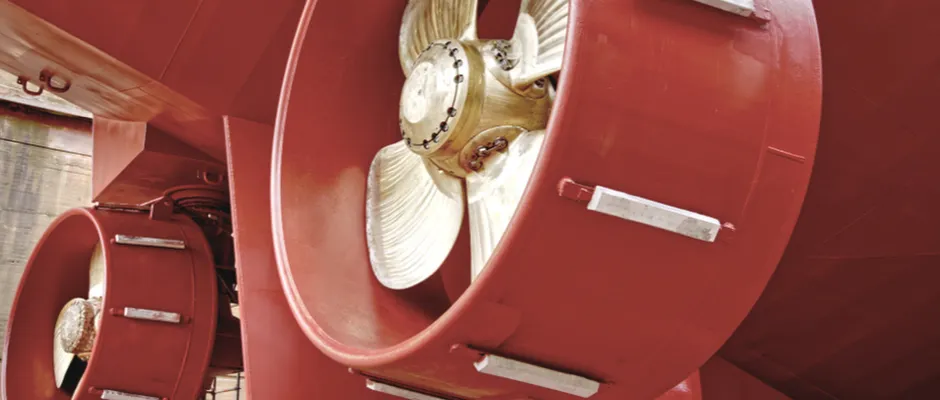
What Should You Consider When Selecting a Propeller Nozzle for Your Vessel and Operating Profile?
Author: Jeroen Berger • Publication date:
The selection of a propeller nozzle rarely begins with the profile itself. In practice, the question typically arises when something becomes noticeable in operation: a power demand that varies more than expected, a vessel that behaves differently under heavy loading than in transit, or a wear pattern around the propeller zone that develops more rapidly than in previous cycles.
Such signals rarely occur in isolation. They generally originate from the behaviour of the propulsion system as a whole around the aftbody. When operating profile, propeller loading and flow pattern no longer align with the original design assumptions, a configuration may remain technically intact while operating less consistently in practice.
For shipping companies and shipowners, selection therefore does not concern identifying the “best” profile in isolation. The central question is which configuration delivers stable and reproducible behaviour within the existing vessel arrangement and the actual operating profile across the dominant speed and loading range.
Begin With the Actual Operating Profile
The operating profile forms the technical starting point of the selection. How many hours does the vessel operate at low speed and high loading? How large is the variation in loading condition and draught? How frequently does manoeuvring occur relative to longer transit segments?
These questions determine how the interaction between hull, ship propeller, ship rudder and propeller nozzle manifests itself in practice.
A vessel that operates for extended periods under high thrust at limited forward speed places different demands on load distribution and cavitation behaviour than a vessel operating predominantly within a stable speed window. In such cases, the assessment shifts from optimisation at a single design point to stability across the operating range.
The relevant question therefore is not only which efficiency a configuration achieves, but how predictably the system responds when loading, speed or manoeuvring conditions vary.
Consider the Nozzle as Part of One Integrated System
A nozzle never functions in isolation. It conditions the inflow toward the propeller plane and thereby influences blade loading and the outflow pattern toward the rudder.
Its behaviour therefore depends on the complete aftbody configuration: hull form, propeller geometry, rudder configuration and the relative positioning of these components.
Even small differences in hull form or rudder distance can cause the same nozzle to behave differently in otherwise comparable vessels. Selection should therefore take place within one fixed vessel arrangement.
When the propeller or rudder is modified at the same time, the question shifts from profile selection to recalibration of the propulsion system as a whole.
Verify What Is Physically Accommodable
The geometry of the aftbody determines which variants remain hydrodynamically reproducible. Distance to the hull, tip clearance between propeller blade and nozzle wall, axial distance to the rudder and structural integration define the boundary conditions.
In newbuild projects, this spatial framework can be developed as an integrated whole. In replacement situations on existing vessels, the configuration is largely fixed.
Selection therefore does not concern which profile appears theoretically most attractive, but which variant can operate stably within these physical limits. A solution that only performs under narrow tolerances may prove more sensitive in practice to small deviations in alignment or execution.
The available geometry thus becomes a selection criterion in its own right.
Compare Variants Under Identical Assumptions
A robust choice emerges only when variants are compared under identical assumptions. Hull form, propeller and rudder remain unchanged, while positioning and representative operating points are defined in advance.
Only under these conditions can differences be attributed to nozzle geometry.
When numerical analysis is applied, its value lies not in a single optimal outcome, but in behaviour across the full relevant speed and loading range. If the ranking between variants remains consistent when operating points shift realistically, the outcome gains decision value. If the ranking reverses under limited variation, sensitivity dominates the result.
The stability of the difference pattern therefore outweighs the magnitude of a single peak value.
Explicitly Include Maintenance and Wear
Selection directly affects the maintenance logic of the vessel. How does cavitation erosion develop within the operating area? How does the system respond to sand or silt loading? Does the expected wear pattern align with the planned docking interval?
Not every hydrodynamic advantage translates into operational benefit. A configuration that appears slightly less optimal in theory may prove more effective in practice if it results in less variation in wear and more predictable maintenance behaviour.
The assessment therefore shifts from maximum performance to manageability over multiple maintenance cycles.
Keep Energy and Assessment Frameworks in View
When fuel consumption or internal efficiency objectives play a role, the annual operating profile must be explicitly considered. That profile determines in which regimes gains or losses actually occur.
A nozzle may contribute to a more favourable power profile within that framework, but only when analysis is conducted consistently within the same configuration and under identical assumptions.
When the outcome must be substantiated externally, for example for classification review or project documentation, the emphasis shifts to traceability. The selected configuration must remain explainable based on operating profile, geometric boundary conditions and a consistent comparison between variants.
The selection of a nozzle is therefore not a choice between profile shapes in isolation, but an assessment of system behaviour within the specific operating profile of the vessel. What ultimately becomes decisive is which configuration delivers stable and reproducible load progression across the representative operating points of the annual profile within the geometric limits of the aftbody.
Within nozzle configurations, a robust choice emerges when geometric installation space, system interaction and operating profile are evaluated as one coherent technical framework.
This Article Within the Series
Within Propeller Nozzle: Technology and Configuration, the selection of a nozzle represents the transition from analysis to design decision.
Where the preceding article How Does a Modified Operating Profile Affect the Technical Basis of a Propeller Nozzle explains how changes in operating conditions can shift load progression within the same configuration, this article focuses on how variants can be compared systematically under identical assumptions.
The next step in the series examines a concrete reference framework for such comparisons. In Under Which Operating Conditions Does a 19A Propeller Nozzle Perform Better Than a 37 Nozzle, and Vice Versa, it becomes clear how two widely used reference profiles respond differently to speed, loading and operating area within the same vessel arrangement.
For shipping companies, shipowners and technical managers seeking to translate these principles into a concrete project implementation, the page Propeller Nozzle for Ships provides a logical continuation. There, geometry, system interaction and operating profile converge in a traceable configuration for both newbuild and retrofit.