

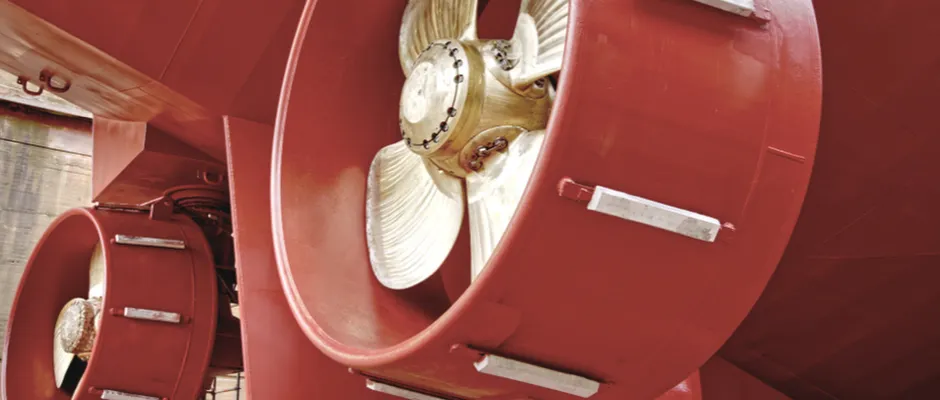
Under Which Operating Conditions Does a 19A Propeller Nozzle Perform Better Than a 37 Nozzle, and Vice Versa?
Author: Jeroen Berger • Publication date:
The comparison between propeller nozzle 19A and propeller nozzle 37 rarely originates as a purely design-driven question. In practice, it typically emerges when a vessel begins to respond differently than expected within its actual operating profile. This may become visible in a power demand that varies more strongly during comparable voyages, a rudder that requires more frequent minor corrections in specific regimes, or a wear pattern around the inner ring and tip zone that concentrates within particular operating hours.
In such situations, profile selection is no longer a theoretical exercise, but an attempt to restore stability, predictability and operational margin to the propulsion system within the existing aftbody geometry. The difference between 19A and 37 is therefore not determined at a single design point, but across the speed, loading and manoeuvring range in which the vessel accumulates most of its operating hours.
For shipping companies and shipowners, it is therefore technically sound to assess both profiles strictly as reference profiles within the same hull, ship propeller and ship rudder configuration. Once the propeller or rudder is modified concurrently, the question shifts from profile selection to system redesign and a direct comparison loses its meaning.
The next step lies in explicitly defining the dominant operating area and comparing both reference profiles under identical assumptions regarding speed, loading and manoeuvring conditions within the same vessel arrangement.
The Operating Area as the Defining Context
A nozzle profile does not change its geometry when a vessel is deployed differently, but the loading conditions under which it operates do shift. A vessel that spends most of the year in working service at low speed and high propulsion loading places different demands on load distribution and cavitation behaviour than a vessel operating within a stable speed window with limited variation in resistance.
In the first case, behaviour during load build-up and variation becomes decisive. In the second, consistency within a relatively narrow speed range carries more weight. This clarifies why it is of limited value to categorise propeller nozzle 19A or 37 as fixed low-speed or transit profiles. What matters is where the vessel approaches its system margins within the dominant operating area, for example in power reserve, vibration level, cavitation sensitivity or maintenance pressure.
High Thrust at Low Speed as the Dominant Regime
Prolonged power delivery at limited forward speed places emphasis on the interaction between nozzle and propeller. In heavy-duty service, towing, dredging or stationary bollard pull, the decisive factor is not performance at a single operating point, but how the profile supports pressure and velocity development around propeller and nozzle as loading increases.
This becomes critical when power demand must remain proportional as resistance varies. Within such a regime, propeller nozzle 19A may prove favourable when tolerance for load variation and damping of disturbances in the propeller zone outweigh optimisation around a fixed speed.
The relevant question is therefore not which profile delivers the highest theoretical effect, but which profile maintains the most controllable load pattern within the low-speed domain across the hours in which the system operates near its loading limit.
A Stable Speed Window as the Reference Framework
When a vessel operates predominantly within a stable speed range, with limited variation in loading condition, resistance and manoeuvring, the emphasis shifts to predictability within that window. In such configurations, propeller nozzle 37 may produce more consistent behaviour in the range where the vessel accumulates most of its operating hours, provided that inflow quality and available installation space do not constrain its function.
The profile designation itself does not guarantee performance. What remains decisive is how the profile structures inflow towards the propeller plane within the specific aftbody configuration, and how this translates into blade loading and slipstream structure within the dominant regime.
What determines the outcome is therefore not the profile name, but the extent to which it stabilises load progression within the speed range that defines the annual operating profile.
Inflow Quality and Load Distribution as the Distinguishing Factor
Hull form and aftbody geometry determine how uniformly water reaches the propeller plane. Uneven inflow leads to non-uniform blade loading and increased pressure fluctuations. In practice, this rarely appears as an abrupt change, but rather as increased sensitivity, where small variations in operating condition become more visible in power demand and vibration behaviour.
Within the same hull, propeller and rudder configuration, differences between propeller nozzle 19A and 37 often become most apparent in this load distribution. One reference profile may equalise the distribution more effectively, while the other remains more sensitive to the same inflow deviation.
For that reason, profile differences tend to become more pronounced in vessels with variable loading, changing draught or operation in shallow water than in vessels operating under nearly constant conditions.
Cavitation and Wear as Practical Boundaries
When cavitation or erosion patterns occur repeatedly within the operating area, attention shifts towards pressure levels, vibration behaviour and maintenance load. In that context, marginal efficiency gains are secondary to the stability of the pressure field at critical loading points.
The technical reference therefore lies not in a single observation, but in the progression of damage over time. Does the pattern stabilise after repair across multiple docking cycles, or does it reappear under comparable conditions? Only when operating hours are explicitly linked to inspection findings does the triggering condition become clear.
Within that context, a profile that performs slightly less optimally at a single operating point may still be the more rational choice if cavitation or wear behaviour remains more predictable across the dominant operating profile.
Rudder Interaction in Manoeuvre-Intensive Operation
When manoeuvring forms a significant part of the operating pattern, rudder loading becomes a defining system variable. The nozzle influences the structure of the propeller slipstream and therefore the inflow reaching the rudder. Differences between 19A and 37 become visible in the reproducibility of rudder response under varying loading and small rudder angles, particularly at low speed where the rudder depends strongly on the slipstream.
In this context, the emphasis lies not on maximum rudder force, but on predictable steering behaviour under changing load. Frequent corrections within the operating profile indicate that slipstream structure towards the rudder should be explicitly included in the comparison.
The rudder often reveals earlier than the propeller whether the flow field remains stable within the same operating profile or becomes more sensitive to small variations.
Geometry as the Dominant Boundary Condition
The installation situation defines what remains hydrodynamically reproducible. In newbuild projects, profile selection can still be aligned with positioning and available clearances. In retrofit projects, rudder distance, hull connection and available space are largely fixed. The difference between propeller nozzle 19A and 37 is therefore partly determined by what can function consistently within those constraints.
A profile that appears favourable under ideal assumptions may become sensitive in a constrained installation, where inflow and outflow have limited space to stabilise. Hydrodynamic suitability must therefore always be assessed against structural feasibility.
The comparison loses validity when a profile only performs under narrow tolerances while the actual configuration allows limited margin in fit, alignment or flow development.
Comparing Without Shifting Assumptions
A robust choice requires comparison within a fixed vessel configuration under identical assumptions for speed, loading and manoeuvring conditions. This requires defining in advance which parameter remains constant and applying that basis consistently across representative operating points.
When numerical analysis is used, decision value lies not in a single peak, but in the pattern across operating conditions. If the ranking between propeller nozzle 19A and 37 remains stable under realistic variation, the result becomes actionable. If it reverses under limited variation, sensitivity dominates.
Verification through model testing or sea trials should therefore confirm behaviour under identical boundary conditions, not produce isolated results that cannot be compared.
The choice between 19A and 37 only gains technical meaning when both reference profiles are assessed within the same operating area, geometry and system configuration on the stability of their load progression.
Within nozzle configurations, the decisive factor is not the profile designation, but how geometry, system interaction and operating profile combine into a stable and reproducible load pattern.
This Article Within the Series
Within Propeller Nozzle: Technology and Configuration, the comparison between propeller nozzle 19A and 37 forms the concrete translation of earlier system analysis into reference profiles within one fixed vessel arrangement.
Where the preceding article What Should You Consider When Selecting a Propeller Nozzle for Your Ship and Operating Profile explains how selection emerges from geometry, system interaction and operating area, this article clarifies under which operating conditions two widely used reference profiles behave differently within that same configuration.
The next step in the series shifts from profile comparison to concept comparison. In In Which Situations Is a Pre-Duct Technically an Alternative to a Propeller Nozzle Within the Same Propulsion Concept, it becomes clear when the dominant sensitivity lies not at the propeller plane, but in the upstream inflow.
For shipping companies, shipowners and technical managers seeking to translate these principles into a concrete project implementation, the page Propeller Nozzle for Ships provides a logical continuation. There, geometry, system interaction, operating profile and profile selection converge in a traceable configuration for both newbuild and retrofit.