

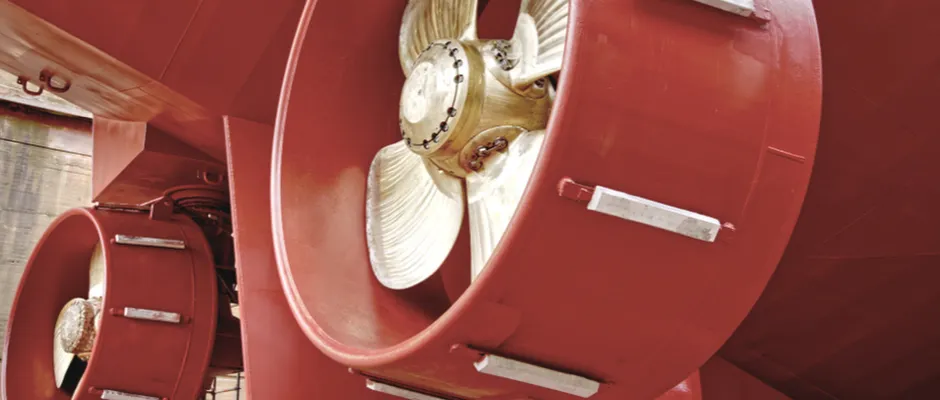
Propeller Nozzle: Technology and Configuration
Author: Jeroen Berger • Publication date:
Once installation space, shaft line position and rudder distance have been fixed, these geometric boundaries define which propeller nozzle configurations can be accommodated and within which margins the propulsion system can continue to operate predictably. For shipping companies, shipowners and technical managers, this becomes particularly relevant when a selection is made implicitly based on profile designation or tradition, while the physical system boundaries and the actual operating profile remain undefined. In such cases, project risk emerges not only in hydrodynamic behaviour, but also in the feasibility and traceability of the selected geometry within the existing vessel arrangement. The next step is therefore always the same: explicitly define the geometric framework and representative operating points, so that variants can be compared under identical assumptions.
This first cluster forms the foundation of the series on propeller nozzle configurations. It describes where the geometric and system boundaries lie, how nozzle, propeller and rudder interact within those boundaries, and under which conditions design and selection variants become technically meaningful for the propulsion behaviour of the vessel. Within this series, the focus is therefore not on profile type, but on reproducible load progression within the physical system boundaries: first establish a clear understanding of the fixed geometry and interaction in the aftbody, and only then compare or optimise variants.
In this series, a nozzle refers to the hydrodynamic duct surrounding a ship propeller (ducted propeller), whose effect only becomes meaningful through interaction with hull inflow, propeller loading and rudder loading within a single fixed installation situation. Within the hydrodynamics of ship propulsion, a nozzle is therefore not assessed as an isolated component, but as an integral element of the flow field around hull, propeller and rudder within one fixed geometric configuration.
The structure of the series follows a consistent logic. This first cluster establishes the technical basis of the propulsion system. Propeller Nozzle: Design and Performance Validation addresses how variants can be compared under identical assumptions and when a difference is sufficiently robust to support a design decision. Propeller Nozzle: Service Life, Retrofit and Regulations extends the same logic to management, wear and modification across multiple docking cycles. Propeller Nozzle: Configuration Choice, Economics and Strategic Considerations connects these technical principles to investment decisions and energy profiles within fleet strategy, and examines under which operating profiles a propeller nozzle, or alternatively an open propeller configuration, forms the most traceable starting point, and when an optimised variant or an alternative concept such as a Pre-Duct becomes the more logical solution.
The sections below describe the fundamental technical conditions under which nozzle variants within the same geometric configuration can be compared under identical assumptions.
Geometric Installation Space as a Fixed System Boundary
Every nozzle is bounded by the radial distance to the hull, the axial distance to the rudder, the vertical clearance around the propeller zone and the actual position of the shaft line within the existing opening. These parameters determine not only whether the nozzle physically fits, but also within which margins the system can operate in a stable and predictable manner.
In newbuild projects, this interdependence can be addressed as an integrated design problem. In retrofit situations, the geometry is largely fixed, and the existing configuration defines the framework within which adjustments remain feasible. Even minor deviations in centring, roundness or rudder distance can produce measurable shifts in inflow and load distribution.
The technical elaboration of these radial, axial and vertical constraints is discussed in Which Geometric Installation Space Limits the Positioning of a Propeller Nozzle in Relation to the Hull and Stern.
System Interaction Between Nozzle, Propeller and Rudder
Propulsion behaviour arises from the interaction between inflow quality, blade loading and rudder loading. The nozzle governs how water approaches the propeller plane and how the propeller slipstream develops towards the rudder. Observable effects in power uptake, vibration behaviour or steering response can therefore rarely be attributed to a single component, but follow from the interaction within the existing arrangement.
From a hydrodynamic perspective, the nozzle functions as a transition zone between hull inflow and propeller slipstream, in which pressure distribution, velocity profile and blade loading are directly coupled. Any modification to one element redistributes loading elsewhere in the same system, which means that comparability is only preserved when identical assumptions are maintained for speed, loading and manoeuvring conditions.
A detailed analysis of this interaction is presented in How Does the Interaction Between a Propeller Nozzle, Propeller and Rudder Affect the Ship’s Propulsive Behaviour.
Operating Profile as a Shifting Assessment Framework
A change in operating profile does not alter the geometry of the nozzle, but it does change the loading conditions under which the system must perform. When the dominant use shifts to different speed or loading regimes, the existing tuning may fall outside its original operating window without any structural deviation.
Reassessment therefore requires renewed evaluation of inflow, blade loading and rudder loading at representative operating points of the revised operating profile, always within the same installation situation. The technical question is thus not whether the profile itself changes, but whether the load progression across the relevant operating hours remains reproducible.
The influence of changes in operating profile is further explained in How Does a Modified Operating Profile Affect the Technical Basis of a Propeller Nozzle.
Selection as System Tuning
Selecting a nozzle is fundamentally a matter of comparing system behaviour within a fixed hull, propeller and rudder configuration. What determines the outcome is the stability of the load progression across the relevant speed and loading range, rather than performance at a single design point.
Installability, maintenance logic and manageability over multiple docking cycles form an explicit part of this assessment. A robust selection emerges when variants are compared under identical assumptions and when the chosen operating points accurately reflect the actual annual operating profile. In certain vessel configurations, that same comparison may lead to the conclusion that a nozzle does not provide a stable advantage within the dominant operating profile, and therefore does not constitute a logical starting configuration.
The full assessment framework for selection is elaborated in What Should You Consider When Selecting a Propeller Nozzle for Your Ship and Operating Profile.
19A and 37 as Reference Profiles Within One Vessel Arrangement
Propeller nozzle profiles 19A and 37 function as reference profiles and only acquire meaning within the same operating range and the same geometric boundary conditions. The profile designation itself is not decisive; what matters is how the profile supports load progression within the vessel’s actual operating range.
At low speed and high propulsion loading, a profile may respond differently than within a stable speed window. These differences manifest in inflow quality, blade load distribution, cavitation behaviour and rudder interaction across multiple representative operating points. The methodology depends on fixed starting assumptions, ensuring that the comparison does not shift unintentionally due to altered assumptions.
How this comparison is carried out methodically without shifting assumptions is explained in Under Which Operating Conditions Does a 19A Propeller Nozzle Perform Better Than a 37 Nozzle, and Vice Versa.
Pre-Duct as an Alternative Within the Same Propulsion Concept
When system sensitivity arises in the inflow region approaching the propeller plane, a Pre-Duct may constitute a technical alternative within the same propulsion concept. The distinction lies in where the flow field is influenced, and therefore in which interaction is primarily addressed.
A nozzle operates in and around the propeller plane and influences the propeller slipstream towards the rudder. A Pre-Duct, by contrast, conditions the inflow before blade loading develops. The assessment therefore centres on where in the propulsion system the dominant sensitivity occurs and where, within the available installation space, it can be most effectively corrected.
The technical comparison between both solutions is described in In Which Situations Is a Pre-Duct Technically an Alternative to a Propeller Nozzle Within the Same Propulsion Concept.
The Core of This Cluster
This cluster shows that the technology and configuration of a propeller nozzle ultimately resolve into system behaviour within fixed geometric boundaries and an explicitly defined operating profile. Geometric installation space defines the physical margins, while the interaction between nozzle, propeller and rudder determines the load progression within those margins.
Hydrodynamic performance can therefore only be assessed reliably when analysis, geometric configuration and operating profile are considered in conjunction, and when comparisons are conducted under identical assumptions. For shipping companies, shipowners and technical managers seeking to translate this foundation into a concrete project specification, the page Propeller Nozzle for Ships follows logically. There, the series is connected to practical feasibility within the actual vessel arrangement, with reference profiles such as 19A and 37, an optimised variant or an alternative concept such as a Pre-Duct as options within a single traceable decision framework.
The guiding principle is that a nozzle variant within the fixed installation situation demonstrates stable load progression across representative operating points, without the comparison shifting due to geometric constraints or altered assumptions.