

In Which Situations Is a Pre-Duct Technically an Alternative to a Propeller Nozzle Within the Same Propulsion Concept?
Author: Jeroen Berger • Publication date:
The question of whether a Pre-Duct can serve as an alternative to a propeller nozzle rarely arises as a purely design-driven topic. In practice, it typically surfaces when the propulsion system behaves less consistently than expected in operation. Over one period, power demand remains stable and predictable. In another, a measurable spread in torque or fuel consumption appears. Relatively small changes in draught, loading condition or resistance then translate disproportionately into variation in propeller loading.
In such situations, it is of limited value to approach the issue immediately as propeller nozzle versus Pre-Duct. The first step is to establish where sensitivity actually originates: in the inflow pattern reaching the ship propeller or in the interaction around and downstream of the propeller towards the ship rudder within the existing aftbody configuration.
For shipping companies and shipowners, a Pre-Duct therefore becomes a technical alternative primarily when this sensitivity can be reproducibly traced to the inflow approaching the propeller. The objective is not to alter the propulsion concept, but to stabilise system behaviour within the relevant operating bandwidth.
The evaluation therefore begins with a project-specific comparison of inflow quality, blade loading distribution and rudder loading across representative operating points. Only when these factors are assessed under identical assumptions does it become clear whether an inflow correction within the existing configuration contributes to system stability.
Where in the Flow Chain the Intervention Occurs
The fundamental distinction between a nozzle and a Pre-Duct lies in the location within the flow field where intervention takes place.
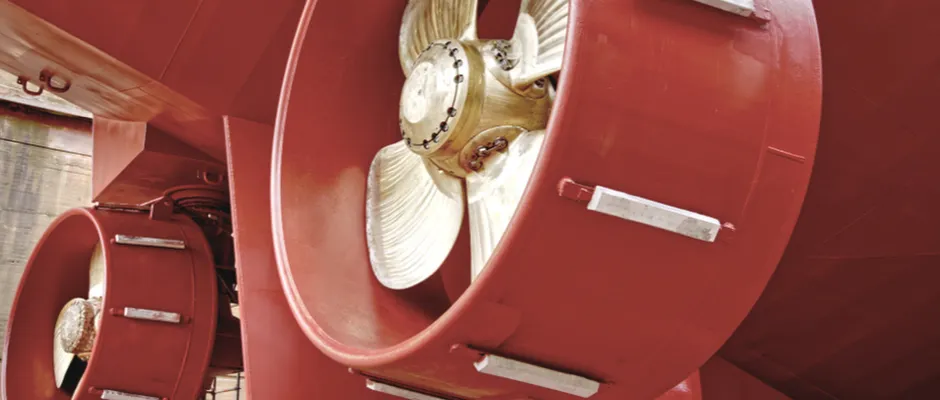
A nozzle operates directly in and around the propeller plane. This changes not only blade loading, but also the formation and contraction of the propeller slipstream towards the rudder. Propulsion behaviour and steering response therefore become more closely coupled.
A Pre-Duct acts earlier in the flow chain. As a pre-conditioning device, it organises the inflow field before blade loading develops. The intervention therefore takes place upstream of the propeller, rather than in the slipstream behind it.
The distinction between both solutions lies less in a single efficiency figure than in the location of intervention. With a nozzle, the effect is centred around the propeller plane. With a Pre-Duct, it lies in the inflow region approaching the propeller.
This difference also influences energetic behaviour. In certain regimes, a nozzle may increase effective thrust through changes in interaction around the propeller plane. A Pre-Duct acts more indirectly: by homogenising inflow, local losses and peak loads in blade loading are reduced. The difference therefore lies not in a single efficiency value, but in how the system handles power across the operating bandwidth.
When Inflow Non-Uniformity Is Dominant
A Pre-Duct becomes relevant when variation in propulsion behaviour can be directly linked to inflow variability. This may occur with aftbody forms that produce a non-uniform wake field, with skeg and rudder arrangements that introduce asymmetry, or with operating profiles in which loading condition and draught vary frequently.
In such cases, propeller geometry remains unchanged while the character of inflow shifts. Improvement then lies in reducing that variation at the source.
A more uniform inflow can equalise blade loading over the propeller rotation and reduce sensitivity to small disturbances in the flow field. In that context, an upstream correction may be more effective than an enclosing element around the propeller that structurally alters the slipstream towards the rudder.
When Rudder Interaction Is Part of the Objective
A nozzle influences not only propeller loading, but also the structure of the slipstream reaching the rudder. This can be desirable when steering response, course stability or manoeuvring behaviour are explicit optimisation targets, for example in working vessels or prolonged low-speed operation.
With a Pre-Duct, the outflow pattern remains more strongly governed by the propeller and rudder themselves. This can be advantageous when steering behaviour must remain predictable or when additional rudder loading from a more concentrated slipstream is not desired.
The evaluation then shifts from maximising rudder force to controlling inflow sensitivity without further altering the slipstream.
When Installation Space Defines the Boundary Conditions
In retrofit projects, available space often determines feasibility earlier than hydrodynamic preference.
A nozzle requires radial space around the propeller and imposes constraints on clearances to hull, rudder and structural elements, including centring and tip clearance. When these conditions cannot be secured with sufficient margin, the question shifts from whether installation fits to whether it will remain stable under varying load.
A Pre-Duct introduces a different integration problem because intervention occurs upstream. In certain configurations, this can be implemented without major modifications around the stern and rudder, provided positioning is accurate and the inflow field is not disturbed further.
Comparing Within One Fixed System Boundary
Both concepts influence the same propulsion system, but at different locations in the flow chain. A robust choice therefore requires comparison within one fixed vessel configuration and under identical assumptions for speed, loading and manoeuvring.
What is corrected upstream may produce different interactions downstream. Relative differences must therefore be assessed within the same hull, propeller and rudder configuration and across the same representative operating points.
Only then does the comparison reflect system behaviour rather than a shifting evaluation basis.
Within the same propulsion concept, a Pre-Duct therefore becomes a technical alternative to a nozzle when dominant sensitivity originates in the inflow field approaching the propeller, when additional influence on rudder loading is not required, and when available installation space makes a nozzle less predictable than an upstream inflow correction.
Within propulsion systems, the choice between both solutions is ultimately determined by where in the flow chain sensitivity arises and where it can be corrected most effectively within the existing geometry.
This Article Within the Series
Within Propeller Nozzle: Technology and Configuration, this article concludes the first cluster on nozzle configurations. Where the preceding articles addressed geometric installation space, interaction between nozzle, propeller and rudder, the effect of a modified operating profile and the selection of reference profiles such as propeller nozzle 19A and 37, this final article shows when dominant system sensitivity lies upstream of the propeller rather than around it.
This completes the first cluster conceptually. The central principle remains that nozzles, reference profiles and alternative concepts such as a Pre-Duct only gain meaning within the same vessel arrangement of hull, propeller and rudder and within a clearly defined operating profile.
The next step follows in Propeller Nozzle: Design and Performance Validation. In that second cluster, the focus shifts from system logic to methodological validation: how variants can be compared under identical assumptions, which operating points are representative and when a difference becomes robust enough to support a design decision.
The first article in that cluster, Which Manoeuvring and Loading Conditions Are Relevant for Assessing Propeller Nozzle Behaviour Using CFD, explains under which controlled variations in operating point differences between configurations become visible.
For shipping companies, shipowners and technical managers seeking to translate these principles into a concrete project implementation, the page Propeller Nozzle for Ships provides a logical continuation. There, geometry, system interaction, operating profile and design alignment converge in a traceable configuration for both newbuild and retrofit.