

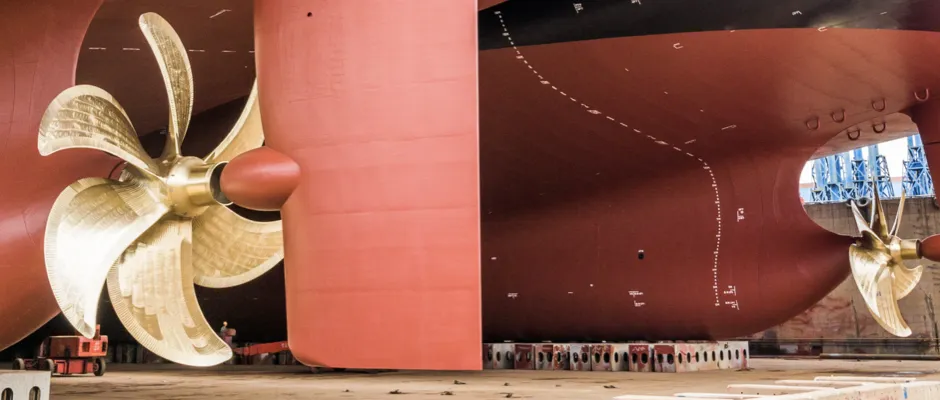
When Does Asymmetric Propeller Wake Flow Cause Steering Loss in a Rudder System?
Author: Jeroen Berger • Publication date:
Within rudder systems, asymmetric flow behind the ship propeller often develops without immediately becoming visible in vessel manoeuvrability. The rudder continuously corrects small differences in velocity, rotational flow and inflow direction, allowing asymmetry to remain part of normal operational behaviour for extended periods.
The situation changes once that asymmetry can no longer be absorbed temporarily by the rudder, but instead begins to consume structural capacity within the steering process itself. Rudder systems then use part of their available steering force not for course generation, but for continuously compensating an unevenly distributed flow field behind the propeller.
As a result, the problem shifts from a local flow disturbance towards a system condition in which steering force no longer remains fully available under the same operating conditions.
When Asymmetric Inflow Structurally Consumes Capacity Within Rudder Systems
Rudder systems can process a considerable degree of uneven inflow as long as differences within the slipstream continuously move or remain temporary. The rudder then adapts dynamically without one side of the profile remaining under persistently dominant loading.
Under structural asymmetry, however, that distribution changes fundamentally. One section of the rudder continuously operates within a more energy-dense or more strongly rotating flow zone than the opposite side. As a result, part of the available rudder capacity becomes permanently occupied with maintaining neutral vessel behaviour.
Steering force remains available, but the effective reserve for course correction and manoeuvrability decreases because rudder systems internally commit capacity before any new steering input is applied.
How Asymmetric Flow Creates Uneven Steering Response
Rudder systems respond less predictably once flow behind the propeller no longer remains distributed evenly across the rudder profile. Small variations in loading condition, speed or inflow angle then directly alter local force generation around individual sections of the rudder.
This does not create fully random behaviour, but it does produce steering response that may vary slightly between otherwise comparable conditions. The vessel may respond more strongly towards one side, require greater correction around neutral rudder position or develop turning moment less evenly during similar manoeuvres.
Asymmetry therefore becomes not only a characteristic of the flow itself, but also of how rudder systems generate steering force within an unevenly distributed flow structure.
The Role of Propeller Rotation in Asymmetric Flow Within Rudder Systems
Rudder systems become more sensitive to asymmetric flow once propeller loading increases. Higher loading intensifies rotational flow within the slipstream, causing differences in energy density and angle of attack to influence the rudder more strongly.
Once that rotational flow becomes distributed unevenly across the rudder surface, zones develop that continuously operate under different flow loading from surrounding sections of the profile. Some areas receive concentrated energy flow while other zones operate within a more diffuse flow region.
Total steering force therefore develops progressively less from one uniform force distribution and increasingly from local differences that rudder systems must internally compensate.
How Geometry Determines How Much Asymmetry Rudder Systems Can Absorb
Rudder systems differ significantly in how much asymmetric flow they can absorb before steering loss becomes noticeable. That margin directly depends on profile area, positioning and the relationship between rudder and propeller jet.
A larger or more favourably positioned rudder can distribute local inflow differences longer before they become visible within steering response. More compact configurations reach that limit sooner because smaller sections of the profile must process proportionally larger loading differences.
As a result, the same asymmetric slipstream may produce little operational consequence in one rudder system while directly reducing available steering capacity within another configuration.
When Rudder Systems No Longer Maintain Neutral Steering Response
Rudder systems operating continuously under asymmetric flow often first lose their neutral steering characteristic around centre position. The rudder continues functioning, but no longer responds as though both sides of the flow structure contain the same energy balance.
As a result, small yet recurring differences in corrective action develop during straight-line course-keeping. The system increasingly requires subtle counter-corrections while speed, loading condition and rudder angle appear largely unchanged.
Steering capability remains operationally available, but the rudder system no longer reaches a fully neutral distribution in which steering force remains freely and evenly available for new course generation.
What Asymmetric Flow Reveals in Practice
In practice, rudder systems usually reveal asymmetric flow indirectly. The vessel responds differently to port than to starboard, neutral rudder position feels less stable or course corrections require more continuous attention than previously under similar operating conditions.
As the effect develops further, differences also emerge in required rudder angle, force generation and steering feel during comparable manoeuvres. In some situations, vessel response becomes delayed, while under other conditions steering reactions become more abrupt.
The repeated appearance of these differences under similar operating conditions ultimately reveals that asymmetric flow is no longer a temporary disturbance, but has become part of the operational flow structure within rudder systems.
When Asymmetric Propeller Wake Flow Causes Steering Loss in a Rudder System
Asymmetric propeller wake flow causes steering loss in a rudder system once flow analysis shows that rudder systems must structurally use part of their available steering capacity to compensate for an unevenly distributed slipstream, preventing steering force from remaining fully available for unrestricted course generation and causing steering response to remain persistently uneven under comparable operating conditions within the same configuration.
This Article Within the Series
Within Technology and Configuration of Rudder Systems, this article forms the starting point of the cluster and opens directly from operational steering behaviour rather than from general flow theory. The focus therefore lies not on mechanical limitation of the rudder itself, but on the point at which rudder systems begin internally committing capacity to correct asymmetric flow behind the propeller. This introduces a first technical layer in which steering loss develops before maximum rudder angle or mechanical limits have been reached.
From that foundation, the series continues with How Does Low Inflow Velocity Affect Rudder Heading Response, in which the central issue shifts from flow distribution towards the amount of available flow energy. Where asymmetric flow demonstrates how steering capacity becomes internally divided within rudder systems, the next article examines when insufficient inflow velocity causes total available steering force itself to decrease.
For shipping companies, shipowners and technical managers, this distinction becomes operationally relevant because steering loss within rudder systems does not always begin with visible system limits or mechanical restriction. Once asymmetric flow continuously consumes structural capacity within steering behaviour itself, the assessment shifts from incidental course correction towards the question of how much free steering reserve actually remains available within the same configuration.