

Technology and Configuration of Rudder Systems
Author: Jeroen Berger • Publication date:
Rudder systems determine how vessels convert propeller-driven flow energy into controllable heading response under varying operational loading conditions. Their technical relevance does not emerge at the first deviation, but once steering response becomes less reproducible, heading development begins flattening or energy consumption gradually increases without a clear external cause. For shipowners, operators and technical managers, the operational risk therefore does not initially lie in immediate loss of control, but in continuing operation with a configuration in which the underlying flow regime has already shifted.
The next technical step lies in evaluating inflow behaviour, force build-up and system interaction within the existing configuration. Only then does it become visible whether rudder systems under real operating conditions still respond logically to the energy transferred from hull flow and propeller loading towards the rudder profile.
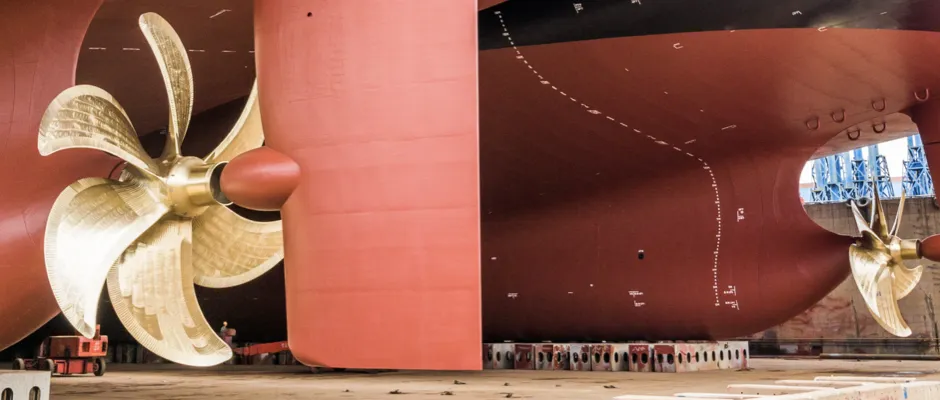
Within the broader framework of Rudder Systems and Rudder Blades for Newbuild and Retrofit, this cluster page forms the technical foundation layer. The rudder does not operate in isolation, but inside a flow field generated by hull wake, propeller slipstream and loading distribution, after which the rudder determines how that energy becomes usable for heading development, steering stability, manoeuvrability and directional control.
From this technical foundation emerges the need to later validate deviations within Design, Validation and Performance Assessment of Rudder Systems. Once steering behaviour changes over time, the focus shifts towards durability and intervention within Lifecycle, Retrofit and Regulation of Rudder Systems. Only after that does the balance between optimization, replacement and investment gain practical relevance within Economics, Subsidies and Strategic Decision-Making for Rudder Systems.
This page therefore positions itself as the starting point of the technical assessment chain. The hydrodynamic behaviour of rudder systems inside their configuration must first be understood before validation, retrofit or strategic decision-making can be developed on a technically defensible basis.
The underlying articles examine individual mechanisms such as asymmetric inflow, low inflow velocity, turbulence, profile behaviour and energy consumption. In isolation, those effects often appear limited, yet they gain technical significance once they begin influencing steering force, slipstream stability, flow quality or energy balance within the same rudder system.
This technical layer makes visible how rudder systems distribute inflow energy, steering force and slipstream stability within the same configuration. As a result, deviations are not merely observed, but interpreted within the system logic that determines where stable hydrodynamic behaviour ends and technical assessment begins.
When Does Asymmetric Inflow Begin Determining Steering Behaviour?
Rudder systems can often absorb small inflow differences without the vessel immediately displaying abnormal steering behaviour. The operational threshold emerges once asymmetric flow behind the propeller is no longer temporarily absorbed by the rudder, but instead continuously consumes steering capacity simply to maintain heading stability.
Under those conditions, the vessel remains controllable, but part of the available steering force is permanently used to compensate for an unevenly distributed slipstream. Effective steering reserve decreases even though the mechanical limits of the rudder appear unchanged.
The origin of the problem develops upstream of the rudder itself. Uneven hull inflow becomes amplified by propeller loading and reaches the rudder as a slipstream in which velocity, rotational flow and inflow direction vary across different sections of the rudder profile. Rudder systems therefore no longer generate one uniform steering response, but a combined force pattern built from multiple local flow regions.
The underlying flow mechanisms are analysed further in When Does Asymmetric Propeller Wake Flow Cause Steering Loss in a Rudder System, which examines when asymmetry within the slipstream begins consuming effective steering capacity.
When Does Inflow Velocity Begin Determining Heading Response Effectiveness?
Inflow velocity becomes critical once the available flow energy is no longer sufficient to generate an effective pressure difference across the rudder blade. Rudder angle remains available, but steering force decreases because dynamic pressure within the inflow becomes too low to maintain stable force build-up.
Rudder systems depend on both vessel speed and propeller contribution. When both decrease, water still flows along the rudder, but with limited energy density. The rudder therefore continues responding, although less directly and with increasingly flattened heading development during manoeuvring and course-keeping.
The propeller often determines where this transition becomes visible. Under sufficient loading, an energetic slipstream supports the rudder profile, whereas under lighter loading that contribution decreases and the rudder becomes more dependent on natural hull flow. Rudder position relative to the propeller slipstream therefore determines how early this limitation becomes operationally noticeable.
The interaction between inflow velocity and steering force is analysed further in How Does Low Inflow Velocity Affect Rudder Heading Response, which examines when low inflow begins structurally affecting steering behaviour within the same configuration.
When Does the Slipstream Lose Coherence and Energy Begin Dissipating?
Turbulence only creates meaningful energy loss once the propeller slipstream loses directional coherence and no longer transfers energy efficiently towards the rudder profile. As long as the flow remains sufficiently concentrated and can still be redirected in a controlled manner, the available energy continues contributing to propulsion efficiency and steering force.
The transition occurs once the slipstream becomes increasingly diffuse and vortex structures begin retaining energy within local rotational motion. That energy still physically exists inside the flow field, but is no longer effectively converted into directed flow around the rudder.
Rudder systems often first display this effect inside the boundary layer around the profile geometry. Local flow separation generates vortices that expand and disturb surrounding flow regions. Once those structures no longer disappear under stable operating conditions, turbulence ceases to be a temporary phenomenon and instead becomes part of the permanent hydrodynamic regime.
The interaction between turbulence, slipstream stability and steering resistance is analysed further in When Does Turbulence Around a Ship Rudder Cause Extra Drag in the Slipstream, which explains how diffuse flow generates additional hydrodynamic resistance.
When Does Rudder Profile Geometry Determine Available Steering Force?
Profile geometry becomes decisive once steering force no longer depends primarily on rudder angle, surface area or positioning, but increasingly on how the profile maintains attached flow and converts that flow into usable steering force. This becomes most visible when seemingly similar rudder systems respond differently under identical operating conditions.
At small rudder angles, the distinction appears in the initial steering response. Some profiles rapidly generate pressure difference and react immediately, whereas others build steering force more progressively. As long as loading remains limited, this mainly appears as a difference in steering character around the neutral position.
At larger rudder angles, the meaning changes. Profiles that maintain attached flow longer retain a more stable force curve under increasing loading. Profiles that trigger earlier local flow separation lose effective steering force more quickly as rudder angle increases. At that point, steering force is no longer determined by rudder angle alone, but by the operational limit of the profile geometry within the existing inflow regime.
Under real operating conditions, this effect becomes amplified by variations in propeller slipstream structure and inflow direction. Rudder systems with profiles that process such variation more effectively maintain predictable force build-up for longer during manoeuvring and heading control.
The interaction between profile geometry, flow attachment and steering force is analysed further in When Do Profile Differences Between Rudders Affect Steering Force, which examines this behaviour in greater technical detail.
When Does Disturbed Inflow Translate Into Structural Energy Loss?
Disturbed inflow increases energy consumption once flow is no longer distributed as one coherent field across the rudder blade. Part of the available energy is then consumed compensating for local differences in velocity, inflow direction and pressure before effective steering force can develop.
Rudder systems continue functioning under those conditions. The vessel remains controllable and steering response remains available, but the conversion of flow energy into heading moment becomes less efficient.
The propeller slipstream plays a central role here. Variations in propeller loading or inflow become transferred directly towards the rudder, causing the energy distribution across the profile to fragment. Some sections contribute less effectively to steering force, while other zones become more heavily loaded.
Once this condition repeatedly returns under comparable operating conditions, energy loss changes from occasional behaviour into a structural property of the rudder configuration itself.
The interaction between disturbed inflow, energy balance and steering efficiency is analysed further in When Does Disturbed Inflow Increase Energy Consumption in a Rudder System, which explains how this structural shift in energy distribution develops.
How This Cluster Contributes to a Technically Defensible Foundation
Rudder systems can only be reliably evaluated once inflow behaviour, profile geometry, slipstream structure and steering force are interpreted together as one interacting hydrodynamic system. This cluster prevents deviations from being prematurely explained solely through operation, loading or one isolated component.
For shipowners, operators, technical managers and superintendents, this forms the technical layer in which it is first determined whether the rudder system behaves logically within its configuration. Only after that can further validation, retrofit assessment or strategic decision-making be justified.
Ultimately, the technical foundation of rudder systems only remains technically defensible when the system maintains a coherent and reproducible flow regime under representative operating conditions within the same configuration.