

Will Alternative Ship Propulsion Technologies Replace the Conventional Ship Propeller?
Author: Jeroen Berger • Publication date:
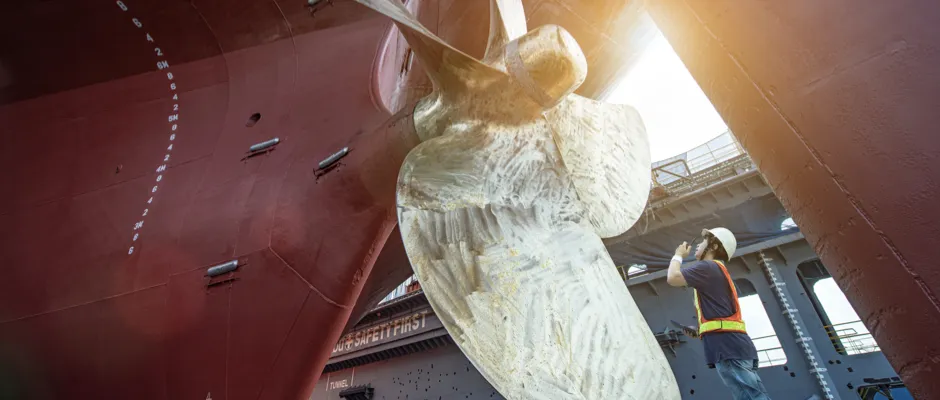
The conventional ship propeller has been the dominant propulsion principle in international shipping for more than a century. Owing to its relatively simple construction, high reliability and broad applicability, the propeller has become the standard for ship design, operation and certification. At the same time, pressure to reduce fuel consumption and emissions is increasing, which has intensified interest in alternative ship propulsion technologies and supporting systems. For shipping companies and shipowners this raises the question whether these alternatives can, in time, replace the conventional propeller, or will mainly be deployed as supplements within existing propulsion concepts.
This article examines the extent to which alternative propulsion technologies can technically and operationally replace the conventional propeller. It addresses the applicability of different concepts, the technical and economic constraints that limit deployment, and the reasons why full replacement has, in practice, remained limited to date. It then explains how hybrid configurations, in which alternative systems support the propeller, are developing across the current fleet. Finally, it places this in the context of reliability, scalability, regulation and life-cycle costs, which together shape the future role of the conventional propeller.
Innovations And Alternative Concepts
Alternative propulsion technologies and supporting systems can be grouped into four broad categories: wind assistance, resistance reduction, alternative propulsion units and experimental concepts. In many designs these solutions do not directly replace the conventional propeller, but under specific conditions can reduce power demand and thereby influence overall system efficiency.
Wind-assisted systems, such as wing sails, rotor sails and kites, provide a propulsive contribution that is strongly dependent on route, wind window, operational constraints and deck configuration. In favourable profiles, wind assistance can reduce main-engine loading, but deployability is less predictable than with a conventional propeller because the available energy is external and variable.
For resistance reduction, air-lubrication systems (air-bubble injection or an air film along the hull) attract particular attention, as do biomimetic surface structures and fin-type add-ons that can locally influence flow behaviour. Feasibility and effect remain highly project specific and depend on hull form, surface condition, speed profile, maintenance regime and sensitivity to disturbance from fouling and operational conditions.
Within the propulsion unit, electrically driven pods and related configurations are widely applied and further developed, particularly where manoeuvrability, integration with a (hybrid) electric power system or space arrangement is decisive. Pods still, in many cases, work with a propeller, but system integration and hydrodynamic interaction with hull and inflow can differ materially from a classical shaft line. Waterjets form a distinct niche, notably where high speed, shallow draught, reduced sensitivity to appendages or specific manoeuvring requirements are paramount; for many conventional cargo ships, application is less obvious due to efficiency profile and scalability.
More experimental is magnetohydrodynamic propulsion, in which an electrically conductive fluid (such as seawater) is accelerated directly by strong magnetic fields and electric currents, without moving parts such as propellers or jets. The principal limitations at present lie in low overall system efficiency, the very high electrical power and magnetic field strengths required, and limited scalability to a robust, economically viable maritime application.
Taken together, these examples show that many “alternatives” are, in practice, primarily complementary, and that added value only arises when technical integration, operational profile and cost structure demonstrably align. This brings the technical and economic reality of deployment clearly into view.
Technical And Economic Reality
Despite progress in alternative propulsion technologies, the conventional propeller remains the dominant propulsion principle in commercial shipping for the foreseeable future. Its hydrodynamic efficiency, mechanical simplicity and robustness are difficult to match in practice, particularly across a broad operating envelope and varied service profiles. In addition, performance behaviour, wear mechanisms and performance development over the service life are well known and manageable, which supports predictability in operation and maintenance.
A key explanatory factor is that the global infrastructure for design, manufacturing, inspection, maintenance and certification is built around the conventional propeller and associated shaft line. Design standards, class rules, calculation methods, test procedures and repair capacity align seamlessly with this. Alternative systems often require additional design validation, specific maintenance expertise and adapted certification routes, which make implementation more complex and costly.
Economically, investment level, payback time and risk are decisive. Many alternative concepts entail higher initial costs, while realized efficiency gains depend strongly on route, operational profile and discipline in deployment. Additional system complexity can also lead to higher maintenance burdens, longer downtime in case of failures and greater reliance on specialist suppliers. In a sector with tight margins and high availability requirements, these factors weigh heavily in the decisions of shipping companies and shipowners.
In practice this results in a clear preference for solutions that fit within existing technical and organisational frameworks. Optimization of the conventional propeller, possibly combined with supporting systems, often offers a more predictable balance between investment, risk and achievable benefit than a complete shift to alternative propulsion. This reality explains why many innovations are investigated and trialled, but have so far seen limited large-scale adoption across the current commercial fleet.
Hybrid Applications And Support
In practice, alternative propulsion technologies and supporting systems are increasingly deployed as supplements to the conventional propeller rather than as full replacements. The starting point remains that the propeller is the primary, broadly deployable propulsion device. Supporting systems can, under suitable conditions, lower the required propeller loading or temporarily provide part of the effective propulsive contribution.
Wind assistance (wing sails, rotor sails or kites) can, on routes with a favourable wind window and compatible operating behaviour, contribute meaningfully to fuel reduction. The realized benefit remains highly dependent on route choice, speed, operational constraints and deck configuration. The effect is therefore less uniform and less predictable than with propeller propulsion. Resistance-reduction concepts follow a different pathway: they primarily reduce hull resistance, so that less propulsive power is needed for the same service speed. Examples include air-lubrication systems (air-bubble injection or an air layer along the hull). Here too, outcomes are project specific and sensitive to hull form, speed profile, surface condition, maintenance and disturbance from operational conditions.
When such systems are designed integrally and applied in a controlled manner, a hybrid propulsion concept emerges in which the propeller and supporting techniques together can reduce average power demand. In many cases this translates into lower fuel consumption and thus lower CO2 intensity per unit of transport work, without relinquishing the basic functionality and robustness of the propeller as the main propulsion.
In policy terms, this approach aligns with frameworks in which performance over time must be substantiated, such as the Energy Efficiency Existing Ship Index (EEXI) and the Carbon Intensity Indicator (CII). Within Europe there is also the linkage with the Emissions Trading System (EU ETS) and FuelEU Maritime, where fuel consumption and emission intensity have more direct impacts on costs and operational constraints. Not because hybrid support automatically ensures compliance, but because a demonstrably lower fuel and power demand can make it simpler to document performance development consistently, traceably and reproducibly.
Outlook
The likelihood that the conventional propeller will be fully replaced on a large scale in the short term is low. The combination of proven reliability, high efficiency across a broad operating range and global embedding in design, maintenance, class and certification frameworks makes full replacement unlikely in practice. The context in which the propeller functions is, however, changing.
Increasingly, the propeller forms part of an integrated propulsion system in which techniques such as wind assistance, alternative fuels, electrification and energy-saving devices (ESDs) are deployed in combination. In such configurations, the propeller typically remains the central conversion point from power to thrust, while supporting systems reduce power demand or extend operational limits, depending on profile and conditions.
For specific ship types and applications the balance can differ. Cruise ships, icebreakers, naval vessels and demonstrator projects often impose additional requirements on manoeuvrability, redundancy, emissions or noise levels. In such cases, alternative propulsion solutions can play a larger role within the overall design, without the propeller as a core component necessarily disappearing.
Across the broader commercial fleet, the conventional propeller is expected to remain the backbone of propulsion. Development lies less in replacement than in refinement and integration: improved propeller design, deployment of increasingly advanced ESDs and closer alignment with hybrid and electric power systems. The propeller does not move out of the propulsion concept; rather, the configuration evolves with the technical, operational and policy requirements that will guide shipping over the coming decades.
About This Article
This article forms part of the background information on the propeller as a product and falls within the cluster Ship Propeller Design and Optimization. Its core premise is that alternative ship propulsion technologies in practice rarely lead to full replacement of the conventional propeller, but primarily function as supplementary systems that can influence power demand or energy use under specific conditions. For a project-specific elaboration, the page Custom Ship Propeller logically builds on this context.
For a broader overview of propeller configurations and their areas of application, What Types of Ship Propellers Are There and What Are Their Characteristics connects logically. It distinguishes between main propulsion and manoeuvring solutions and shows why the conventional propeller remains the starting point in many segments.
Because many alternative concepts in practice aim to lower power demand or improve overall propulsion efficiency, Can Devices Such as Propeller Nozzles, Fins, or PBCFs Improve Ship Propeller Efficiency is also relevant. This article places supporting measures in relation to integration, complexity and achievable benefit, and shows why less intrusive interventions are often more scalable.
For the policy context in which efficiency improvements must be substantiated, What Do the European Union Emissions Trading System (EU ETS) and FuelEU Maritime Mean for Ship Propeller Investments is pertinent. It explains how fuel consumption and emission intensity impact costs and constraints, and why propulsion choices are increasingly assessed against a verifiable investment and compliance framework.