

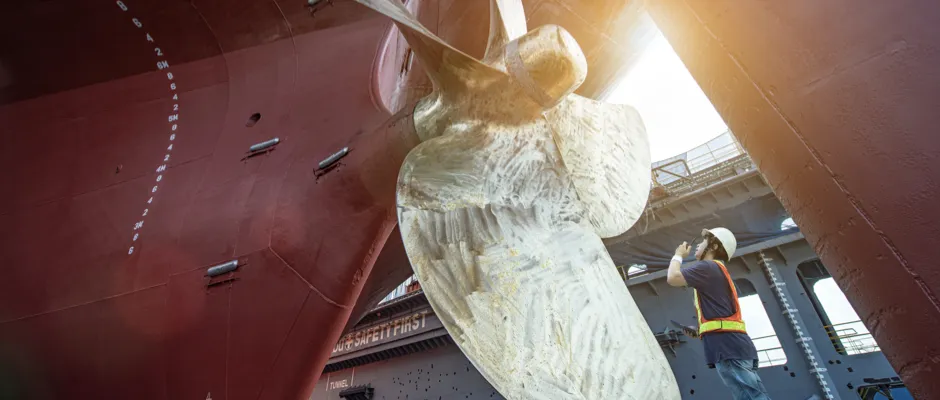
How Often Should a Ship Propeller Be Polished or Cleaned?
Author: Jeroen Berger • Publication date:
The performance of a ship propeller depends to a large extent on the condition of its blade surface. Fouling, deposits, incipient corrosion and local pitting can degrade the surface condition. As a result, resistance increases and hydrodynamic behaviour becomes less favourable. In practice, this can lead to higher power demand at a given vessel speed and therefore additional fuel consumption. For shipping companies and shipowners, periodic cleaning and, where technically appropriate, polishing is not a cosmetic intervention, but a management measure that directly supports performance retention and predictable propulsion behaviour.
This article explains how fouling and increased surface roughness affect propeller efficiency and which factors determine a suitable maintenance frequency in practice. It sets out the distinction between cleaning and polishing, including the influence of operating area, water quality, time alongside or at anchor, and operational profile. It then describes key considerations for execution and assessment, such as dimensions, balance, tolerances, documentation and, where relevant, class requirements. Finally, propeller maintenance is placed in the wider context of life-cycle management, fuel consumption and the reproducible substantiation of performance retention over time.
Impact of Fouling on Efficiency
Even a thin layer of fouling or a modest increase in surface roughness due to corrosion can materially change the propeller’s hydrodynamic behaviour. Flow along the blade surface becomes less favourable, frictional losses increase and more developed vortices form in the propeller slipstream. At a constant vessel speed, more power is then required to deliver the same thrust.
In practice this often translates into higher power demand and increased fuel consumption. Deviations of several percent do occur, depending on the operational profile and the extent of fouling. Operational experience and measurements show that removing fouling and deposits can reduce these losses in many cases. After cleaning, the flow field typically improves, allowing the propeller to operate closer to its original efficiency and making propulsion behaviour more predictable.
Maintenance Frequency
How often a propeller should be cleaned or polished depends primarily on operating area, water quality and the vessel’s operational profile. Fouling generally occurs more quickly in warmer waters than in colder regions. Time alongside or at anchor also plays a clear role. Vessels that regularly remain idle in ports or anchorages tend to accumulate fouling and deposits faster than vessels that sail continuously.
In practice, the required maintenance frequency varies by deployment profile. For some vessels, cleaning or polishing mainly around a dry-dock visit is sufficient, while in other cases several cleanings per year are needed to maintain efficiency. To limit interim fouling, some operators choose periodic underwater cleaning during operation. Underwater cleaning can improve propeller condition without taking the vessel out of service, provided execution is controlled and the applicable safety frameworks and local requirements allow it.
Polishing Versus Cleaning
There is a clear difference between cleaning and polishing. Cleaning removes fouling and deposits so that the blade surface is clean again. Polishing goes a step further, deliberately smoothing the blade surface and reducing minor surface defects, such as pits or small blemishes, where possible. The objective is not “extra shine”, but the restoration of a favourable surface condition appropriate to the design and operational profile.
A smoother surface can improve the flow around the blades and limit frictional losses. Depending on inflow, loading and blade geometry, this can reduce the likelihood of cavitation phenomena in sensitive zones. At the same time, polishing requires care. Excessive material removal can affect dimensions, profile and balance. Classification societies and, where applicable, class requirements therefore define frameworks for acceptable surface roughness and for how condition is assessed and recorded, because this relates to efficiency, vibration behaviour and propulsion reliability.
Strategic Value for Shipping Companies and Shipowners
For shipping companies and shipowners, propeller maintenance is more than a recurring technical task. It is a management measure that directly affects fuel consumption, emissions performance and the predictability of the propulsion system. A propeller that better maintains its design condition generally requires less power at a given speed and thereby supports a more stable operational profile.
That stability carries added significance in a context where energy efficiency and emissions are increasingly monitored and assessed. A structured maintenance programme can help substantiate performance within frameworks such as the Energy Efficiency Existing Ship Index (EEXI) and the Carbon Intensity Indicator (CII). Not because propeller maintenance in itself guarantees compliance, but because a clean and smooth blade surface makes it easier to document assumptions, performance and deviations in a demonstrable, traceable and reproducible manner over longer periods.
In addition, the value of maintenance is shifting from incidental cost saving to controlled management of operational risks. By limiting fouling and roughness in time, unexpected performance losses, additional fuel costs and corrective interventions become more predictable and manageable. Propeller maintenance thus supports not only the vessel’s technical reliability, but also the stability of operating costs in an environment of increasing regulation and margin pressure.
In that light, periodic cleaning and, where appropriate, polishing is not a detail-level optimization, but a standard element of professional fleet management. It contributes to predictable propulsion behaviour and gives shipping companies and shipowners greater control over performance, costs and substantiation across the vessel’s operating life.
About This Article
This article forms part of the background information on the propeller in the operational phase and falls within the cluster Ship Propeller Life Cycle, Retrofit and Regulatory Framework. Its core premise is that cleaning and polishing are not cosmetic interventions, but management measures that directly affect power demand, fuel consumption and performance retention over time through surface condition. Maintenance frequency is project specific and relates to operating area, water quality, idle time and deployment profile, while dimensions, balance, tolerances and documentation must remain within applicable frameworks, including class requirements where relevant. For a project-specific elaboration, the page Custom Ship Propeller logically builds on this context.
For a better understanding of the mechanisms behind wear and performance loss, the article What Is Cavitation and How Does It Affect Ship Propellers logically connects. It explains how flow conditions, loading and surface condition relate to cavitation phenomena and how these can accelerate the need for maintenance.
Maintenance strategy cannot be viewed separately from material properties. In What Is the Best Material for a Ship Propeller: Bronze or Stainless Steel the response of different alloys to fouling, corrosion, cleaning and polishing is set out, and what this means for wear behaviour, repairability and inspection.
For the broader context of maintenance, wear and performance over time, What Is the Lifespan of a Ship Propeller and Does It Wear Over Time connects. This article places periodic maintenance in the perspective of life-cycle management, operational use and the point at which intervention remains technically and economically justified.
Together, these articles show that cleaning and polishing are not isolated maintenance actions, but part of an integrated approach to design, operation, inspection and performance monitoring within professional fleet management.