

What Is a Ducted Ship Propeller (Kort Nozzle) and What Are the Advantages and Disadvantages?
Author: Jeroen Berger • Publication date:
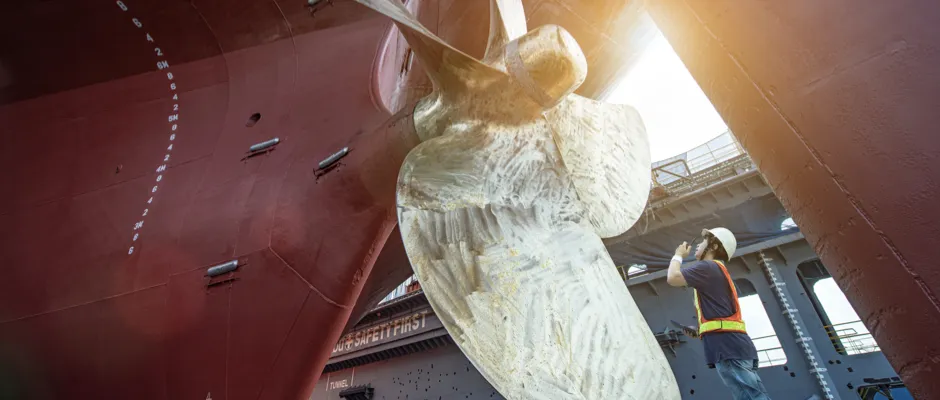
A ducted ship propeller, also referred to as a Kort nozzle, is a propulsion configuration in which the propeller is enclosed by an annular propeller nozzle. The nozzle influences inflow and outflow around the blades so that effective thrust at low vessel speed can increase. The concept was developed primarily for applications where thrust, control and predictable low-speed behavior weigh more heavily than maximum hydrodynamic efficiency at cruising speed, such as on heavily loaded or maneuver-intensive vessels.
This article explains how the ducted propeller functions and under which operating conditions it provides demonstrable added value. It discusses hydrodynamic advantages at low speed, as well as the disadvantages and limitations that arise at higher vessel speeds. It also addresses maintenance and wear considerations and the way modern design methods, such as numerical flow analyses and model testing, are used to align the application with operational profile, loading regime and the vessel’s strategic deployment.
Advantages at Low Speeds
The primary advantage of a ducted propeller lies in behaviour at low vessel speeds and high disk loading. Because the nozzle conditions inflow to the propeller, a larger share of the generated impulse can be converted effectively into thrust. In this speed range, available thrust can therefore increase relative to an open propeller of comparable diameter and rpm, without a proportional increase in engine power. This makes the ducted propeller well suited to vessels that frequently operate at low speed and high load, such as tugs, dredgers, supply vessels and workboats in offshore and inland navigation.
In addition to hydrodynamic benefits, the nozzle helps protect the propeller. Because the blades lie within the nozzle envelope, the likelihood of direct damage from floating timber, ice or occasional bottom contact is generally lower than with a free-running propeller. In operating environments where such risks are real, this can contribute to higher reliability and longer blade and hub life, provided design and installation are aligned with the intended use. At the same time, attention to wear and erosion remains necessary, particularly in shallow or sediment-rich waters.
Disadvantages and Limitations
Although a ducted propeller offers clear advantages at low vessel speeds, the system is not universally applicable. As speed increases, nozzle resistance becomes increasingly important. In this higher speed range, the added wetted surface area and form resistance of the nozzle can reduce overall propulsive efficiency compared with a conventional open propeller. The ducted propeller is therefore less suitable for vessels that spend most of their operational profile at cruising speed, such as container ships, tankers and other vessels on long, speed-driven routes.
The geometry of the nozzle also introduces specific maintenance and wear considerations. The limited clearance between propeller blade and nozzle can lead to elevated local loading, which increases sensitivity to cavitation, erosion and material fatigue. These effects depend strongly on the design of both propeller and nozzle, the selected rpm and the inflow conditions behind the hull.
In shallow water or operating areas with significant sediment, operation can also resuspend sand and silt. This can accelerate wear of blades, nozzle and coatings and calls for an appropriate inspection and maintenance regime. In such conditions, it is important to weigh the benefits at low speed explicitly against the increased maintenance burden and the potential impact on the service life of the propulsion installation.
Strategic Use in Shipping
In strategic terms, the ducted propeller comes into its own in operational profiles where thrust and control at low vessel speed are decisive and the vessel operates relatively often outside the cruising-speed domain. In such profiles, the additional thrust at low speed can directly support better maneuvering behavior, a more robust working capability and more predictable operations, provided design, installation and the propulsion train are matched to this operating region.
The application therefore remains particularly relevant for vessels in towage, dredging and offshore, as well as for other ships that frequently work at low speed under high load, for example during station-keeping, pushing and towing or operations in limited water depth. The potential added value is explicitly profile-dependent and relates, among other things, to the share of operation in the low-speed region, propeller loading, available diameter and local inflow conditions.
For vessels that spend most of their operating time on long transits at higher cruising speed, the trade-off generally shifts. In that case, the added resistance and associated efficiency penalty of the nozzle at higher speed weigh more heavily, so a conventional fixed pitch propeller often offers a more favorable overall efficiency and a simpler operating profile. The most responsible choice follows from an integrated assessment of the actual operational profile and the dominant loading region, rather than from a generic preference for one concept.
Relevance Within Modern Design Methods
With contemporary design methods, ducted-propeller performance can be quantified and substantiated more effectively in the design phase than before. Computational Fluid Dynamics (CFD) is used to analyze inflow to propeller and nozzle, load distribution over the blades and interaction with the hull, including wake and inflow angle, at representative operating points. This enables early assessment of the conditions under which the nozzle system provides real benefits and where efficiency or cavitation behavior may become limiting.
For verification and correlation, these calculations are often supplemented by model testing, such as open-water tests and, where relevant, cavitation testing, conducted in accordance with established procedures and guidelines. This creates a traceable basis to compare variants, optimize design choices and map sensitivities, for example for nozzle geometry, clearance, blade design and installation conditions.
This combination of numerical analysis and model testing enables designers and shipowners to avoid generic judgments and instead size the ducted propeller specifically to the intended operational profile and loading regime. In this way, the propulsion configuration can be aligned with the vessel’s strategic deployment, with explicit attention to the balance between low-speed thrust, higher-speed resistance and the maintenance and wear aspects inherent to the chosen concept.
About This Article
This article forms part of the background information on the propeller as a product and falls within the cluster Ship Propeller Types and Propulsion Configurations. Its core premise is that a ducted propeller (Kort nozzle) is not a generic efficiency solution, but a propulsion configuration that can deliver added value in thrust and control under specific low-speed operating conditions. At the same time, its field of application is bounded: performance is strongly determined by the dominant loading region, inflow conditions aft of the hull and the share of low-speed operation within the overall operating profile. For a project-specific elaboration, the page Custom Ship Propeller logically builds on this context.
For a broader overview of propeller concepts and their application areas, What Types of Ship Propellers Are There and What Are Their Characteristics connects directly. That article places the ducted propeller alongside fixed and controllable propellers, azimuth thrusters, pods and other configurations, and shows how the various concepts relate within diverse operational profiles.
When the choice for a nozzle system must be weighed against alternative main-propeller configurations, What Is the Difference Between a Fixed-Pitch and a Controllable-Pitch Ship Propeller provides additional context. It explains how design philosophy, controllability and efficiency translate into different areas of application, including implications for energy efficiency and operational reliability.
For technical substantiation of performance claims and assessment of design choices, How Is Ship Propeller Performance Measured and Validated connects. That article describes how model testing, numerical analyses and operational measurements are used together to document performance under representative conditions, which is also essential for nozzle systems.
Together, these articles position the ducted propeller not as a standalone solution, but as part of a coherent decision-making process in which operational profile, loading regime and demonstrable performance are leading.