

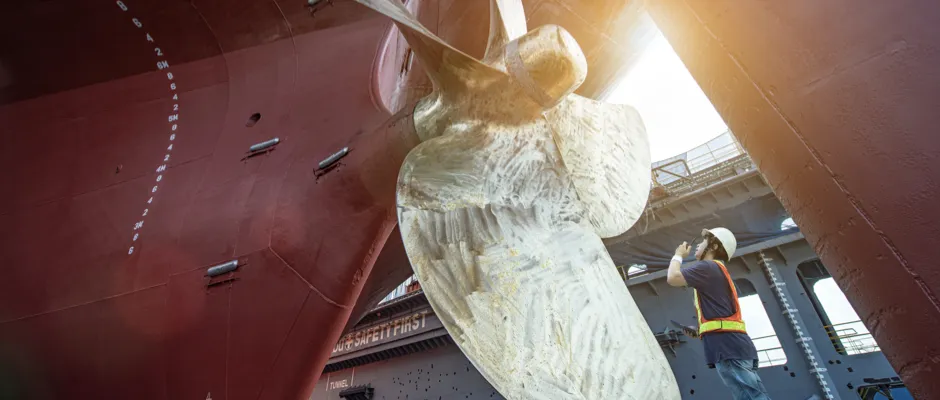
Ship Propeller Types and Propulsion Configurations
Author: Jeroen Berger • Publication date:
The ship propeller determines how the available shaft power is converted into thrust. It therefore influences how a vessel accelerates, manoeuvres and maintains speed under varying load and environmental conditions. In practice there is no universally “best” propeller. The most suitable configuration follows from the actual operational profile, the inflow conditions aft of the hull, the selected drivetrain and the operational requirements for manoeuvrability, maintenance and life cycle costs. Propeller selection is therefore not a standalone component decision, but a system choice that only gains meaning within the overall ship design.
Because that choice is always project-specific, this page follows a fixed structure, from the technical operation of different configurations, via their application in diverse operational profiles, to the implications for operations and maintenance. This coherence makes visible why a solution may be logical in one profile and show limitations in another. Comparison thus becomes possible on the basis of function and context, without implying a generic preference. This is the first cluster, focused on propeller types and propulsion configurations. The clusters that follow address Ship Propeller Design and Optimization, Ship Propeller Validation, CFD and Performance Measurement, and Ship Propeller Life Cycle, Retrofit and Regulatory Framework.
Within this first cluster the principal types of ship propellers and propulsion configurations are discussed step by step. Those seeking an initial overview will find in the article What Types of Ship Propellers Are There and What Are Their Characteristics the basic classification and key concepts that recur in the in-depth articles. For each concept the circumstances under which functional added value is plausible are indicated, as well as the limits that in practice are determined primarily by installation space, inflow quality, load variation and maintenance strategy. Where regulation or emission requirements play a role, the wording remains deliberately conditional. A contribution to energy efficiency or emission performance is defensible only when measurement conditions and data quality align with the intended use. In addition, acceptance by class and flag state must be assured and performance under representative conditions must be recorded in a verifiable manner.
What Is the Choice of a Ship Propeller Based On
A ship propeller does not function independently of the hull, the rudder and the drivetrain, but forms an integral part of the total propulsion system. The ultimate performance is determined by a combination of factors, including the wake field behind the hull, the rotational speed range in which the vessel operates, the available diameter and the disc loading. The extent to which speed and loading vary during the voyage also plays an important role. Together these factors determine the true operating point of the propeller and the extent to which that operating point can be kept stable across the operational range.
A design that operates close to the hydrodynamic optimum at a constant service speed may, at part load or during intensive manoeuvring, fall outside a favourable operating point. In such situations slip losses increase, the propeller becomes more susceptible to cavitation and specific fuel consumption generally rises. This makes clear that high efficiency at one design condition does not automatically lead to uniform and predictable propulsion behaviour across the vessel’s full operational profile.
When the operational profile is characterized by greater variation in load and speed, additional controllability or additional protection of the propeller can provide functional benefits. This applies for example to profiles with frequent manoeuvres, varying speeds or strongly varying loading. The condition is that the added system complexity and the associated maintenance burden fit within the intended operation. The trade-off then shifts from a purely efficiency-driven question to a broader balance between efficiency, controllability and robustness. Which balance is appropriate differs by vessel type and deployment profile and requires an explicit link between design choices and operational practice, as elaborated later in this cluster.
For a technical underpinning of this trade-off, validation is essential. In the design phase a hydrodynamic assessment with Computational Fluid Dynamics (CFD) can guide the sizing of the propeller and the expected operating point. Subsequently, sea-trial measurements, corrected in accordance with ISO 15016, make it possible to verify performance under defined and reproducible conditions. During the operational phase additional monitoring in accordance with ISO 19030 can provide insight into trends, degradation and deviations from the original design behaviour.
This measurement-and-assurance chain becomes especially relevant when configuration choices are substantiated with efficiency or emission effects. In that case decision-making concerns not only the expected effect but also its traceability. Consistent measurement conditions and verifiable results form the precondition for a defensible technical and operational assessment.
Fixed Pitch Propeller (FPP) and Controllable Pitch Propeller (CPP)
The choice between a Fixed Pitch Propeller (FPP) and a Controllable Pitch Propeller (CPP) is in many projects the first clear design decision within the propulsion configuration. This choice largely determines how the available power is used across the vessel’s operational profile and how predictable the propulsion behaviour remains in practice.
An FPP operates at fixed pitch and is characterized by mechanical simplicity, robustness and predictable behaviour. The design is usually optimized around one dominant operating point, typically the service speed. When the vessel predominantly adheres to this profile, the hydrodynamic efficiency can be high. In that case cavitation phenomena remain more manageable, drivetrain loading is more stable and propulsion behaviour remains readily reproducible. In profiles with long transits and limited variation in speed and loading, a fixed propeller therefore often remains a logical and economically efficient starting point.
A CPP adds pitch control, enabling pitch and blade loading to be actively adjusted during operation to changing load and speed. This creates a more broadly deployable propulsion system that can better respond to changing operating conditions. Especially at part load, with frequent manoeuvring or strongly varying loading, this can lead to a more favourable loading point for engine and propeller and to a faster, more controllable response of the propulsion system. The extent to which these advantages are actually realized remains dependent on the specific propeller design, the inflow conditions behind the hull and the applied control strategy.
Opposite this flexibility stand higher system complexity, a greater initial investment and a maintenance regime that must explicitly match the vessel’s operational profile. The choice between FPP and CPP is therefore not a generic preference but a project-specific trade-off between simplicity and controllability, in which efficiency, controllability and life cycle costs must be assessed in conjunction. For a technical deep dive and a direct comparison between both concepts, the article What Is the Difference Between a Fixed-Pitch and a Controllable-Pitch Ship Propeller logically follows.
Bow Thruster (Auxiliary Propulsion) and Its Limitations
A bow thruster delivers transverse thrust in the bow and thereby increases control at low speeds, when rudder effectiveness is often limited by insufficient longitudinal inflow. In the most common arrangement a relatively small propeller turns in a transverse tunnel. Depending on the vessel concept, retractable variants are also used, as well as bow units in pod or azimuthing configuration. In all cases the function is primarily supportive, the bow thruster improves accuracy during berthing and unberthing, in locks and in confined waterways, where small course and position corrections make the difference.
The limits of the bow thruster follow mainly from the speed range in which it can operate effectively. As vessel speed increases, longitudinal flow along the hull begins to dominate and the effective transverse thrust rapidly declines. It therefore remains in practice mainly an aid for port and low-speed manoeuvres. In addition, the required power calls for careful coordination with generator capacity and power management, especially when multiple auxiliary systems are used simultaneously. In shallow or sediment-rich water additional wear can also occur due to resuspension and erosion. Noise and vibration also become relevant when comfort requirements or underwater-acoustic constraints carry greater weight.
For a focused deepening on field of application and limitations the article What Is the Purpose of a Bow Thruster and What Are Its Limitations logically follows.
Ducted Propeller (Kort Nozzle) as a Low-Speed Configuration
A ducted propeller combines a propeller with an annular propeller nozzle that modifies inflow and outflow such that, at low vessel speed and relatively high disc loading, additional thrust can become available. This makes the concept particularly relevant in applications where control, predictable behaviour and low-speed thrust weigh more heavily than maximum efficiency at service speed. This explains why nozzles are often applied on tugs, dredgers and workboats, and also in parts of inland shipping where low speeds, limited draught or a heavily loaded operational profile occur regularly.
At the same time the principal limitations lie precisely in the higher speed range. The nozzle adds wetted surface area and form resistance, which can cause the total propulsion efficiency at service speed to be less favourable than with an open propeller. In addition the limited tip clearance between blade tip and duct can increase susceptibility to cavitation, erosion and wear, depending on design details, rotational speed, inflow quality and operating conditions. The technical trade-off, including application limits and typical design considerations, is elaborated in the article What Is a Ducted Ship Propeller (Kort Nozzle) and What Are the Advantages and Disadvantages.
Azimuth Thruster and Azipod as Propulsion Architecture
An azimuth thruster directs thrust by rotating the underwater pod around the vertical axis. This makes heading and lateral motion more directly controllable than with rudder action alone. This is particularly relevant at low vessel speed and during manoeuvres, when steering response is less dependent on longitudinal flow along a rudder blade. Azimuth thrusters are therefore widely used on vessels with high requirements for manoeuvrability and positioning, provided the configuration fits within the chosen maintenance and operational concept.
An Azipod is a specific variant in which the electric motor is located in the pod and drives the propeller directly. This eliminates long shaftlines and mechanical gear trains, which can reduce mechanical losses and sources of noise and vibration. At the same time this concept requires a suitable electric propulsion architecture and explicit attention to cooling, sealing, redundancy and maintenance strategy. The trade-off between an azimuth thruster configuration and an Azipod is therefore primarily a system choice, closely linked to the vessel’s energy architecture. The technical comparison, including application limits and principal considerations, is further elaborated in the article What Is an Azimuth Thruster and How Does an Azipod Differ From It.
Propeller Selection by Vessel Type
The most suitable propeller differs by vessel type and deployment profile, because vessel speed, loading regime and manoeuvring needs vary widely. For cargo vessels with long transits at a relatively constant speed, a configuration optimized around one dominant operating point often fits, because efficiency in daily use and predictable behaviour carry significant weight. For tugs and offshore support vessels the emphasis more often lies on direct response and high low-speed thrust, so controllable pitch propellers or steerable propulsion can provide functional added value in certain profiles.
In inland shipping fluctuating water levels, speed restrictions, frequent manoeuvring and variation in loading weigh explicitly. As a result, solutions that perform stably at lower speeds often align well, while additional controllability can also work out favourably in specific deployment profiles. In the cruise and ferry segment, comfort, noise and vibration become additional design criteria, so steerable and electrically driven propulsion is logical in certain designs. The segment-focused trade-offs, including the principal preconditions per profile, are detailed in the article How Does Ship Propeller Selection Differ by Ship Type.
Contra-Rotating Propellers (CRP) and Efficiency Gain
Contra-rotating propellers use two propellers in tandem on one shaftline that rotate in opposite directions. The aft propeller is designed to recover part of the swirl in the outflow of the forward propeller, so that rotational energy in the slipstream can be partly converted into additional thrust. In theory this can increase propulsion efficiency and better balance the turning moment, which can contribute to more stable course-keeping and a more favourable loading of the rudder.
In practice the principal hurdle lies in system complexity. Coaxial shaftlines or gear trains require additional bearings and seals, increase alignment sensitivity and bring a heavier maintenance and inspection burden. Hybrid variants, in which the aft propeller is electrically driven, can simplify integration in some vessel concepts, but the business case remains highly dependent on operational profile, power distribution and available installation space. Any efficiency gain is therefore only convincing when measurement basis, measurement conditions and verification method have been unambiguously defined and have been demonstrably evidenced under representative conditions. The technical trade-off and the principal preconditions are elaborated in the article What Are Contra-Rotating Ship Propellers and Do They Improve Efficiency.
How This Page Supports a Verifiable Choice
This hub is intended as a starting point for a choice that in practice always remains project-specific. The initial selection usually follows from the operational profile and the manoeuvring need. Design and installation constraints, the maintenance regime and life cycle costs then determine whether a preferred direction holds or must be adjusted. A configuration is demonstrably “better” only when the vessel actually operates within the intended operating point and when performance under representative conditions has been recorded in a traceable manner.
For shipping companies, shipowners and those technically responsible for fleet management who wish to move from this orientation towards a concrete project elaboration, the page Custom Ship Propeller logically follows. There it is set out how configuration choices are translated into design decisions on blade geometry, diameter, pitch and material, and how CFD analyses (Computational Fluid Dynamics), installation constraints and operational requirements come together in a design that can be realized.
When decision-making has a compliance or investment component, it remains prudent to formulate performance claims conditionally and to make measurement and assurance paths explicit. This creates a logical line, first technology, then operational deployment and operation, and only then compliance and strategy, always subject to acceptance by class and flag state. In that role this page is primarily a navigation and assessment framework, not a generic recommendation for one configuration.