

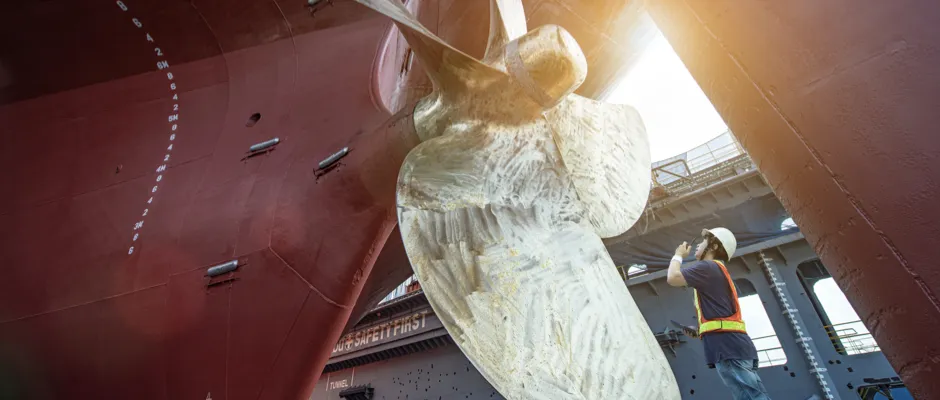
How Does Ship Propeller Selection Differ by Ship Type?
Author: Jeroen Berger • Publication date:
Selecting a ship propeller is not a generic design decision, but the result of an integrated assessment of operational profile, hull form and operational requirements. Vessels differ fundamentally in speed, loading regime, maneuvering need and area of operation, so a single uniform propeller configuration is rarely optimal in practice. The optimal propeller differs by ship type. For shipping companies and shipowners, the final selection is therefore always a compromise between hydrodynamic efficiency, operational reliability, maneuverability and investment and maintenance costs. This framework is also relevant for technical managers, superintendents and directors who wish to assess propeller choices against operational profile, load regime and life cycle costs.
This article explains how this trade-off differs by ship type. It addresses the dominant design criteria for a range of vessels, from cargo ships and inland vessels to tugs, offshore support vessels and passenger ships. By placing propeller selection explicitly within the actual operational profile and the vessel’s operational role, a technically substantiated framework emerges to evaluate propulsion configurations purposefully and justify them strategically.
Cargo Vessels: Efficiency at Cruising Speed
For bulk carriers, container ships and oil tankers, a stable cruising speed is generally the starting point for propulsion design. These vessels typically operate on fixed trade routes and cover long distances with relatively limited variation in speed and loading. Within this profile, maximizing hydrodynamic efficiency around one dominant operating point is decisive for the vessel’s overall energy performance.
A Fixed Pitch Propeller (FPP) generally fits best here. By matching blade geometry, diameter and rpm to the intended cruising speed, hull form and inflow conditions, propulsion can be optimized precisely for this design operating point. This results in high average propulsive efficiency, low specific fuel consumption per nautical mile and a stable, predictable emissions profile during operation.
The structural simplicity of the fixed propeller concept also contributes to high reliability and a straightforward maintenance regime. For cargo vessels designed primarily for continuous service at cruising speed, this combination of efficiency, robustness and favorable life-cycle costs generally outweighs the additional controllability that alternative propeller configurations can offer.
Tugs and Offshore Support Vessels: Maximum Maneuverability
Tugs, supply vessels and offshore support vessels have a fundamentally different operational profile from conventional cargo vessels. They operate predominantly at low vessel speeds, often under highly variable loading, and must be able to deliver high thrust at short notice. Maneuverability, rapid response and precise control of the thrust direction are functionally decisive in this segment for safety and operational effectiveness.
Within this profile, Controllable Pitch Propellers (CPPs) or azimuth thrusters are commonly applied. With a CPP, variable blade pitch enables efficient use of engine power across a wide operating range without large rpm variation. This allows a favorable and stable loading point to be maintained both at low speed and during pulling or pushing work, which increases controllability of the propulsion train.
Azimuth thrusters go a step further by actively controlling not only thrust magnitude, but also thrust direction. By vectoring the thrust, a very high degree of maneuverability is achieved, allowing course and position corrections to be executed immediately without reliance on conventional rudder action. In ports, during towage and in offshore operations where precision, rapid response and positioning accuracy are essential, this provides a decisive operational advantage.
The choice for these propeller and propulsion configurations is therefore determined primarily by the required working power and the dynamics of deployment. Efficiency at cruising speed plays a subordinate role in this segment compared with control, safety and reliable availability under highly variable operating conditions.
Inland Vessels: Flexibility in Variable Conditions
Inland vessels operate within a highly variable operational context. Changing water levels, limited fairway depths, speed restrictions and frequent maneuvering in ports and locks impose specific demands on propulsion. Loading also often varies significantly, which leads to changing resistance and variable inflow conditions at the propeller.
To maintain sufficient thrust and control under these conditions, inland shipping frequently employs propulsion installations with a ducted propeller. The propeller nozzle increases effective thrust at low speed and high disk loading, which is particularly relevant under laden conditions, against current and during maneuvers in confined space. In combination with a robust FPP, this yields a relatively simple, reliable and predictable propulsion concept that aligns with the traditional operational profile of many inland vessels.
At the same time, a development is visible in parts of inland shipping toward more controllable propulsion systems, particularly in newbuilds and major modernizations for vessels with a highly variable operational profile. In these cases, CPPs are considered more often. By adjusting blade pitch actively to varying load and speed, engine operation can be kept closer to a favorable working point across a wider envelope. This can contribute to lower fuel consumption and a more manageable emissions profile, provided the system is sized carefully and actually matches the vessel’s operational profile.
Propeller selection in inland shipping is therefore by definition a trade-off between simplicity and controllability. Where reliability, low investment cost and robustness were traditionally dominant, flexibility, energy efficiency and operational optimization gain importance as deployment variability increases and operational requirements tighten.
Cruise Ships and Ferries: Comfort and Precision
For cruise ships and ferries, comfort and safety play a decisive role in propulsion design in addition to energy efficiency and reliability. Noise reduction, vibration control and predictable maneuvering behavior are not only technical prerequisites in this segment, but directly affect passenger experience and the vessel’s operational availability.
To meet these requirements, steerable propulsion systems, such as azimuth thrusters and Azipod-type configurations, are widely used. By actively directing the thrust vector, course and position corrections can be executed with high precision, particularly at low speed and during berthing and unberthing. This reduces dependence on conventional rudder action and external assistance, while increasing control of the vessel under diverse conditions.
Integrating propulsion and steering also offers benefits for acoustics and vibration behavior. Especially with electrically driven variants, the propulsion train can be designed to minimize mechanical transmissions, which contributes to lower noise levels and smoother sailing. For passenger vessels, this translates into a higher comfort level, both in accommodation and in public areas.
The choice for these propulsion configurations is therefore not driven solely by maneuverability, but by a broader optimization in which comfort, safety, precision and energy management coincide. For shipping companies in the cruise and ferry segment, propeller and propulsion selection is a strategic component of the overall vessel concept, with direct impact on operations, reputation and passenger satisfaction. This becomes even more apparent for vessels with specialized task profiles, where propulsion and maneuverability must remain effective under exceptional conditions.
Special-Purpose Vessels and Niches
Specific vessel types and niche applications are subject to propulsion requirements that clearly deviate from mainstream cargo and passenger shipping. In these segments, the propeller is not selected primarily for average efficiency, but for robustness, reliability and performance under extreme or highly atypical operating conditions.
Icebreakers are a clear example. These vessels operate in heavy ice and impose exceptionally high demands on propeller strength and wear resistance. Blades must withstand ice impact, variable loading and high dynamic forces. Specially reinforced fixed pitch propellers with adapted blade geometry and material specifications are often selected. In some designs, contra-rotating configurations or multiple propellers are applied to maximize available thrust and maintain propulsion under variable ice conditions.
Dredgers also have a specific loading regime. They typically operate at low speed, under high disk loading and in water with a high concentration of sand, gravel or silt. This requires a propulsion concept that both delivers sufficient thrust and resists accelerated wear. Many dredgers are therefore equipped with robust fixed pitch propellers, often combined with a nozzle to increase low-speed thrust. Additional attention is paid to material selection, blade profile and protective coatings to limit erosion and damage from abrasive particles.
Naval vessels and other specialized ships present different requirements. In addition to reliability and maneuverability, aspects such as noise and vibration control, redundancy and operational flexibility play a major role. Depending on the mission, conventional propeller configurations may be selected, but also more complex solutions such as steerable propulsion units or hybrid systems, whereby propeller choice is closely aligned with tactical deployment and stealth requirements.
Across all these niches, propeller selection is highly context dependent and cannot be viewed separately from the overall vessel design and intended use. Propulsion does not function as a generic component here, but as a specifically tailored tool that must remain reliable under extreme or unusual conditions. In these segments in particular, a detailed analysis of loading, inflow and wear is decisive for a successful and durable design choice.
Strategic Relevance for Shipping Companies and Shipowners
Although the technical differences between propeller configurations are significant, the underlying message is clear, propeller selection is always a strategic design and investment decision. A configuration that demonstrably matches the vessel type, the dominant operational profile and operational deployment delivers structural benefits in terms of fuel consumption, reliability and predictable performance over the vessel’s lifetime.
Correct alignment of propeller type, blade design and operating point contributes directly to favorable energy use per unit distance traveled and to a stable operational profile. Propeller selection therefore affects not only technical performance, but also the vessel’s economic feasibility, for example through lower operating costs, a manageable maintenance regime and higher availability in service.
Regulation also plays an increasingly important role in this assessment. International frameworks such as MARPOL Annex VI, the Energy Efficiency Existing Ship Index (EEXI) and the Carbon Intensity Indicator (CII) emphasize demonstrable energy efficiency and emissions control across the actual operational profile. Although the propeller is only one element within the overall propulsion and energy system, a well selected and correctly sized configuration can make a measurable contribution to achieving these objectives, provided performance is substantiated in a traceable and consistent manner.
For shipping companies and shipowners, this means the propeller selection is ideally not approached in isolation, but as an integral part of the overall vessel concept. By considering propulsion, hull form, propulsion train and operational deployment in conjunction, there is scope for well-founded choices that are not only technically defensible, but also future proof within a changing regulatory and economic landscape.
About This Article
This article forms part of the background information on the propeller as a product and falls within the cluster Ship Propeller Types and Propulsion Configurations. Its core premise is that propeller selection differs fundamentally by ship type, because operating profile, loading regime, manoeuvring requirements and area of deployment determine the functional optimum. Performance, efficiency and operational reliability do not arise from the propeller type in isolation, but from the interaction between configuration, hull form, propulsion train and operational role. For a project-specific elaboration, the page Custom Ship Propeller logically builds on this context.
For a systematic overview of available propeller concepts and their characteristics, What Types of Ship Propellers Are There and What Are Their Characteristics connects directly. That article places fixed and controllable pitch propellers, ducted systems, azimuth thrusters and other configurations side by side and provides a reference framework to interpret differences by ship type.
When the trade-off between simplicity and controllability is central, What Is the Difference Between a Fixed-Pitch and a Controllable-Pitch Ship Propeller provides additional depth. It explains how design philosophy, operational range and life-cycle costs translate into different operational profiles, which is relevant for both seagoing and inland shipping.
For the technical substantiation of propeller choices across vessel types, How Is Ship Propeller Performance Measured and Validated is relevant. That article describes how model testing, numerical analyses and onboard measurements are applied together to document performance in a traceable way, a necessary precondition for assessing differences between vessel types objectively.
Together, these articles position propeller selection not as an isolated component decision, but as an integral part of overall vessel design, in which hydrodynamics, operations and regulation are considered in concert.