

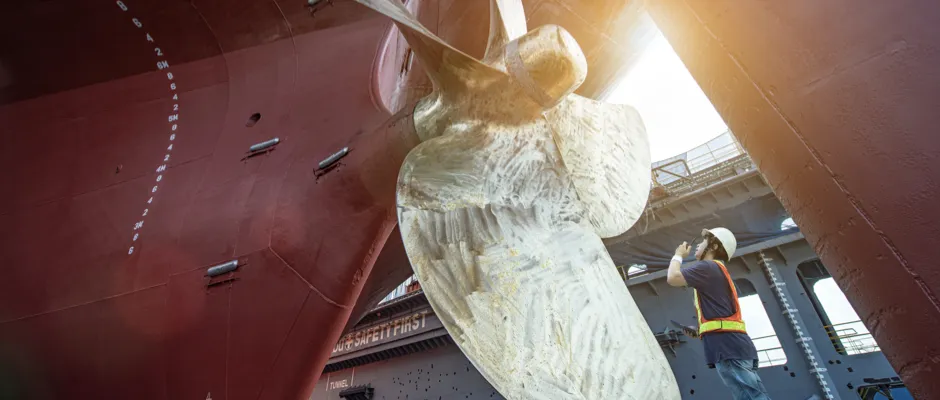
Ship Propeller Validation, CFD and Performance Measurement
Author: Jeroen Berger • Publication date:
The ship propeller is not an abstract design element, but a technical component whose performance must be demonstrated in practice. This page forms the third cluster within a series of four interrelated knowledge clusters on the ship propeller. The first cluster Ship Propeller Types and Propulsion Configurations describes which configurations are available. The second cluster Ship Propeller Design and Optimization shows how a selected configuration is developed into a concrete design. This cluster addresses how performance is then determined, assessed and validated.
This third cluster therefore forms the link between design choices and how performance is substantiated in a demonstrable manner. The fourth cluster, Ship Propeller Life Cycle, Retrofit and Regulatory Framework, elaborates on how validated performance carries through into emissions, efficiency indicators and compliance frameworks. Together the four clusters form a logical sequence from configuration and design, via validation, to verifiable performance and policy implications.
In practice, discussions on efficiency, fuel consumption or emission reduction are not only about design, but primarily about the demonstrability of performance. A carefully designed ship propeller can perform excellently under calculated conditions. Without valid measurement data and traceable substantiation it remains unclear to what extent those performance levels are also realized under representative operating conditions. Validation is therefore not the final step, but an integral part of responsible decision-making, in which both performance and its validity limits are explicitly established.
To make that role explicit, this cluster follows a fixed line of reasoning. First, the importance of validation is positioned within the total propulsion concept. It then explains how Computational Fluid Dynamics (CFD), physical model tests and operational measurements each have their own place within the validation chain. Finally, it sets out why the combination of these methods leads to verifiable and reproducible performance substantiation that also holds up better towards client, yard and class.
Why Validation Is Indispensable for Ship Propellers
A ship propeller always functions in conjunction with the hull, the afterbody and the drivetrain. Performance is therefore the outcome of coherence in the propulsion system, not of a single component in isolation. Design choices that seem logical at an early stage can work out differently in practice when inflow, load variation or operating conditions deviate from the assumptions on which the design is based.
Validation is needed to reduce these uncertainties. By assessing performance under defined and reproducible conditions, insight arises into the extent to which design expectations translate into measurable results. This applies to newbuildings as well as to retrofit or optimization projects. Without validation the risk remains that an expected efficiency gain occurs only within a limited part of the operational profile, or that the effect proves non-reproducible in practice.
That is precisely why validation forms the link between design intent and operational reality. Validation shows where assumptions hold, where corrections are needed and under which conditions outcomes are valid.
The Validation Chain: From Prediction to Demonstration
In maritime practice validation is rarely conducted with a single method. Instead, a chain of steps emerges in which different approaches complement one another. Numerical analyses provide direction in the design phase, model tests deliver controlled references and measurements on board demonstrate how the system behaves under actual operating conditions.
This chain is not a hierarchy, but a coherent whole. Each step has its own purpose and its own validity range. The strength of the validation chain does not lie in offering absolute certainty, but in consistently combining insights from different sources, with explicit attention to assumptions, measurement uncertainty and representativeness.
Computational Fluid Dynamics as a Predictive Instrument
Computational Fluid Dynamics is increasingly used as an important tool in the propeller design process. Numerical flow analyses provide insight into pressure distributions, velocity fields and vortex structures around the propeller and the afterbody. This enables design variants to be compared systematically and trends to be identified early.
CFD is particularly suitable as a comparison tool within consistent assumptions. Differences between blade geometries, pitch distributions or positioning relative to hull and rudder can be assessed without immediate recourse to physical tests for every variant. CFD can therefore shorten the development phase and support design choices within a bounded operational profile, provided input data, model choices and boundary conditions are explicitly aligned with that profile.
At the same time, interpretation of CFD results requires clear delimitation. The reliability of outcomes depends on modelling choices, mesh quality and assumptions on turbulence and inflow. Uncertainties remain in particular for cavitation and unsteady loads, because these phenomena are sensitive to local pressure fluctuations and time-dependent behaviour. The question to what extent CFD can replace physical tests, and where the practical limits lie, is explored further in the article Can CFD (Computational Fluid Dynamics) Replace Model Tests in Ship Propeller Design.
Model Tests and Cavitation Research as Verification
Physical model tests have formed an important reference framework in the maritime sector for decades. In towing tanks and cavitation facilities, scale models are tested under controlled conditions so that hydrodynamic behaviour can be recorded reproducibly. Predictions from CFD can thereby be verified and, where necessary, the chosen computational approach can be adjusted.
Cavitation research merits separate attention. The onset and behaviour of cavitation are strongly linked to local pressure variations and inflow non-uniformities. Numerical models can provide valuable indications. For cavitation, however, physical testing is often needed to better assess risks of erosion, vibration and noise across the intended condition spectrum. That sensitivity makes cavitation a determining theme within validation. More on the mechanisms behind cavitation and the implications for performance and reliability is set out in the article What Is Cavitation and How Does It Affect Ship Propellers.
Model tests do not provide absolute truth, but they do offer a controlled and widely accepted basis for further decision-making and substantiation towards the yard and class.
Onboard Performance Measurement and Operational Validation
Once a vessel is in service, validation shifts from controlled trials to operational practice. Measurements on board show how the propeller performs under varying loading, speeds, water depth and environmental conditions. This variability makes operational validation complex, but therefore indispensable. Only then does it become visible to what extent performance holds outside the test and computational framework.
By linking measurement data to defined conditions and applying corrections for external influences, a representative picture of actual performance behaviour emerges. The focus is not on incidental peak results, but on the degree of consistency across a relevant part of the operational profile. The methods by which performance is measured, normalized and interpreted are set out in the article How Is Ship Propeller Performance Measured and Validated.
Operational validation thereby completes the validation chain and links design and test results with the vessel’s day-to-day operation.
Why No Single Method Suffices
Each validation method has its own strength and its own limitation. CFD provides rapid insight into trends in practice, but requires calibration and an explicit delimitation of the validity range. Model tests deliver reproducible references, but remain scale-dependent and require extrapolation to full-scale conditions. Measurements on board show actual behaviour, but are sensitive to variable conditions, measurement uncertainty and data quality.
The added value arises only when these methods are applied coherently. By recording assumptions explicitly and cross-checking results, a substantiation emerges that is technically defensible and at the same time readily traceable for stakeholders.
Validation as a Bridge to Performance, Emissions and Compliance
Validated performance forms the basis for further interpretation within emission and efficiency frameworks. In that context, indicators such as the Energy Efficiency Existing Ship Index (EEXI) and the Carbon Intensity Indicator (CII) are applied, with outcomes that are highly sensitive to assumptions on power, speed and fuel consumption. Without reliable validation, it remains unclear to what extent calculated effects actually occur under representative operating conditions.
This cluster therefore prepares the fourth cluster, which elaborates how validated performance carries through into emissions, reporting and assessment within applicable frameworks. Validation does not guarantee compliance, but it does make performance verifiable and more comparable, precisely because conditions and assumptions are explicitly recorded.
How This Cluster Contributes to a Substantiated Choice
This cluster shows that performance assessment is not a standalone step, but a structured process in which prediction, verification and measurement follow and complement one another. For shipping companies, shipowners and those with technical responsibility this provides guidance for investment and retrofit choices, because assumptions and uncertainties are made explicit and are therefore more manageable.
Those who wish to translate these validation principles to a concrete project situation can proceed directly to the page Custom Ship Propeller. There it is set out how CFD analyses, model tests and operational measurements converge in design decisions on blade geometry, diameter, pitch and material selection. It also explains how technical optimization is embedded in a verifiable and realizable trajectory.
In that coherence, this cluster forms the bridge between design choices and demonstrable performance. It aligns with the preceding clusters and prepares the next step, in which validated performance is placed within emission, efficiency and compliance frameworks. Together the clusters do not position the ship propeller as a standalone technical item, but as a verifiable and strategic choice within the vessel’s overall design.