

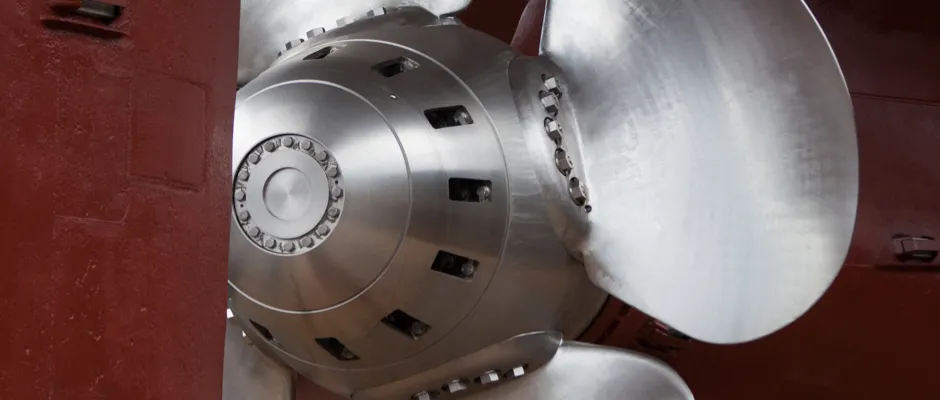
Design, Validation and Performance Assessment of CPP Blades
Author: Jeroen Berger • Publication date:
Within existing propulsion installations, Controllable Pitch Propeller (CPP) blades only become a true technical assessment point once performance behaviour not only deviates, but also ceases to be convincingly interpretable. This moment does not arise automatically when a vessel performs less convincingly. It emerges when load distribution, propulsion response, pitch behaviour, and operational deployment no longer align consistently enough to justify implicitly accepting the existing blade geometry as suitable. From that point onward, the question shifts from observation to validation. Not whether the system still functions, but whether the existing CPP blade still performs convincingly under the actual system conditions in which it must operate today.
Within the overall series, this cluster page therefore represents the validation and assessment layer. Where Technical Design and Configuration of CPP Blades defines the system framework within which a blade must be understood, and Service Life, Retrofit and Compliance of CPP Blades shifts towards reproducibility, replaceability, and technical feasibility within existing installations, this page focuses on the intermediate layer in which performance deviations must first be interpreted in substance. In relation to Strategic Decision-Making Around CPP Blades, this cluster serves a different function. It does not yet address investment direction or project selection, but rather determines when the existing blade profile, current system behaviour, and available technical explanations remain sufficiently robust to support further conclusions.
Within this context, CPP blades do not function as products or isolated design elements, but as hydrodynamically active components within an existing configuration. Performance only becomes meaningful when it remains interpretable, traceable, and technically defensible across representative operating conditions. In this context, not only the blade geometry is relevant, but above all whether that geometry continues to respond in a logically explainable way within current loading, inflow conditions, pitch logic, and operational variation.
Across this cluster page, the underlying logic progresses from performance deviation to assessability, system conditions, simulation, interpretation of behaviour, and the boundary between plausible optimisation and genuinely defensible improvement. The individual articles further elaborate these sub-questions. This page therefore adds something distinct: not a single deviation signal or analytical method, but the technical assessment framework through which CPP blade performance can be convincingly validated.
The coherence between these sub-questions defines how this cluster must be read. Performance, reproducibility, hydrodynamic interpretation, and operational representativeness do not stand as separate observations, but together form the assessment field within which CPP blades become testable as either technically suitable or technically limiting elements of an existing propulsion configuration.
When Do Performance Deviations Indicate a Limiting Blade Profile?
A performance deviation only substantively indicates a limiting blade profile once system behaviour not only deviates, but begins to present itself as a recognisable and technically coherent pattern. As long as a deviation remains incidental, driven by clear external influence, or only visible at a single operating point, its evidential value remains limited. Only when a similar performance pattern reappears under comparable conditions does the nature of the assessment change.
This transition is technically significant because the existing CPP blade is no longer merely present within the system, but begins to appear as a potential limiting factor of that system. The relevant question then shifts from whether the vessel still produces sufficient thrust, to whether load distribution, power behaviour, and propulsion response remain consistent within the same blade logic. Once that coherence weakens, the assessment shifts from observation to delimitation.
This shift defines the distinction between a general performance reduction and a substantively suspect blade profile. An existing blade does not need to be damaged or directly unusable for this to occur. More often, a limiting profile becomes visible in the way the installation responds less coherently across multiple operating points. The technical indication therefore lies not in a single absolute deviation, but in the weakening relationship between load demand and realised propulsion.
The detailed elaboration is provided in When Do CPP Blade Performance Deviations Indicate a Limiting Blade Profile.
How Do You Assess Whether CPP Blades Still Function Logically Under Current System Conditions?
A CPP blade only functions logically when it continues to behave within the existing configuration in a manner that remains proportional, explainable, and consistent with the conditions under which the vessel actually operates. Logical functioning therefore becomes a system judgement rather than a visual condition check. Not whether the blade still appears usable, but whether it still convincingly aligns with the relationship between pitch, load, propulsion, and operational use.
This distinction is decision-critical because the technical suitability of CPP blades often shifts without any visible fundamental change in the blade itself. A vessel may be deployed differently, operate more frequently under variable load, or have evolved beyond its original operational profile. In such situations, the blade itself does not necessarily change, but the technical logic within which it must function does. At that point, it becomes necessary to move beyond implicitly assuming continued suitability.
The first meaningful indication typically lies not in visible damage, but in declining system coherence. When an installation responds less predictably to pitch changes, builds load less consistently, or performs less coherently under representative operating conditions, the blade loses its status as an implicitly trusted component. It does not automatically become the cause, but it can no longer remain outside the technical assessment.
The detailed elaboration is provided in How Do You Assess Whether CPP Blades Still Function Appropriately Under Your Current System Conditions.
When Does CFD Make the Behaviour of Existing CPP Blades More Assessable?
Computational Fluid Dynamics (CFD) only becomes substantively relevant once the behaviour of an existing CPP blade can no longer be interpreted with sufficient clarity through practical observation, system behaviour, and conventional technical reasoning alone. As long as load, pitch response, and propulsion behaviour remain sufficiently coherent, additional flow modelling often adds limited value. Its value emerges when the question is no longer whether the system deviates, but where, how, and under which hydrodynamic logic that deviation develops.
This situation arises when multiple explanations remain simultaneously plausible. An existing blade may appear suspect, while it remains unclear whether the sensitivity lies within the profile itself, arises from inflow conditions, or becomes visible only through interaction between blade and system conditions. CFD gains value precisely at this point, as it enables hydrodynamic behaviour to be explicitly tested rather than inferred.
It is important to recognise that CFD is not a default refinement, nor a theoretical exercise for additional detail. It becomes relevant only when conventional assessment is too coarse to distinguish convincingly between explainable and non-explainable system behaviour. At that stage, simulation does not simply generate more data, but separates competing explanations.
The detailed elaboration is provided in When Does CFD Make the Behaviour of Existing CPP Blades Easier to Assess.
How Do You Distinguish a Blade Problem from a System Setting?
One of the most challenging assessment questions within existing CPP installations is distinguishing between a blade problem and a system setting issue. This difficulty arises because both often manifest within the same behavioural domain. Deviations in load response, pitch reaction, or propulsion behaviour may substantively point either to the blade or to control and regulation. For that reason, the visible effect is rarely the most reliable basis for assessment.
A system setting becomes technically plausible when the internal logic of the response remains intact. The system still reacts recognisably to input, but not in the correct proportion, timing, or magnitude expected under the current configuration. A blade problem becomes more likely when the hydrodynamic quality of that response begins to weaken. In such cases, not only the outcome deviates, but the translation from control input to propulsion behaviour loses coherence.
The distinction becomes clear only when behaviour repeats as a pattern across multiple operating points. At that stage, it becomes possible to assess whether the technical logic primarily fails in the translation of input, or in the quality and consistency of the hydrodynamic response itself. That distinction determines both the analysis and the validity of subsequent actions.
The detailed elaboration is provided in How Do You Distinguish a CPP Blade Problem from a System Setting.
When Does Optimisation of CPP Blades Remain Technically Defensible?
Optimisation of CPP blades is only technically defensible when an adjusted blade geometry not only demonstrates improvement at a favourable or dominant operating point, but remains explainable and stable across the representative operating conditions that define the vessel’s actual deployment. Almost any profile can appear advantageous at a single selected condition when a specific performance priority is emphasised. The real technical question arises when that improvement is evaluated against the broader operational range in which the vessel actually operates.
This makes representativeness more critical than peak performance. A profile that performs better hydrodynamically in one regime, but becomes more sensitive, less stable, or less predictable elsewhere, does not automatically constitute a more robust solution. Particularly within existing CPP installations, where the real load profile often exceeds the original design definition, a narrowly optimised profile may appear convincing on paper yet prove operationally inadequate.
The core assessment therefore does not concern whether a profile can be refined further, but for which conditions that refinement is intended and which operating conditions are accepted as governing. Once optimisation remains valid only by implicitly narrowing the operational reality, it loses its technical defensibility.
The detailed elaboration is provided in When Does Optimization of CPP Blades Remain Technically Defensible Across Representative Operating Conditions.
When Do Cavitation, Vibration, and Load Indicate a Blade Problem?
Cavitation, vibration, and abnormal load behaviour only substantively indicate a blade problem when they no longer appear as isolated phenomena, but emerge as a coherent, repeatable, and condition-dependent pattern. Individually, these signals are rarely decisive. Cavitation may result from inflow conditions, vibration from structural transmission, and load deviations from control or operational factors. Only when these phenomena begin to intersect does their technical meaning change.
The transition lies not only in simultaneity, but in repeatability and reinforcement. When the same combination of signals recurs under comparable load levels, pitch settings, or operational conditions, a pattern emerges that becomes increasingly difficult to explain without reference to the blade. At that point, the blade does not automatically become the proven cause, but it can no longer be safely excluded from the core analysis.
It is precisely this condition-dependent nature that strengthens the assessment. When cavitation, vibration, and load deviations are not random but concentrated within specific parts of the operating range, it becomes clear that the issue is not general system instability, but an interaction in which the blade may play a central role.
The detailed elaboration is provided in When Do Cavitation, Vibration, and Load Indicate a CPP Blade Problem.
The technical viability of CPP blades within an existing propulsion configuration is ultimately only convincing when performance behaviour remains traceable across representative operating conditions in terms of load distribution, propulsion response, and the reproducibility of system behaviour.
How This Cluster Contributes to a Technically Defensible Assessment
This cluster provides the substantive framework to not only observe performance behaviour of CPP blades, but to assess it rigorously. It shows that deviations in propulsion, load, pitch response, or hydrodynamic behaviour only gain decision value once it is clear whether they are reproducible, remain explainable within system context, and hold across representative operating conditions. In doing so, it prevents performance questions from prematurely shifting towards assumptions about replacement, optimisation, or redesign while the underlying technical explanation remains insufficiently defined.
For shipping companies, shipowners, technical managers, and superintendents, this does not represent theoretical refinement, but a practical validation layer between suspicion and intervention. It must first be established whether the existing CPP blade still functions logically under current system conditions, whether deviations genuinely indicate the blade profile, and whether observations are sufficiently robust to support further conclusions. Only once this validation layer is firmly established does a technically sound basis emerge for subsequent steps such as CFD analysis, optimisation, reproduction, replacement, or redesign.