

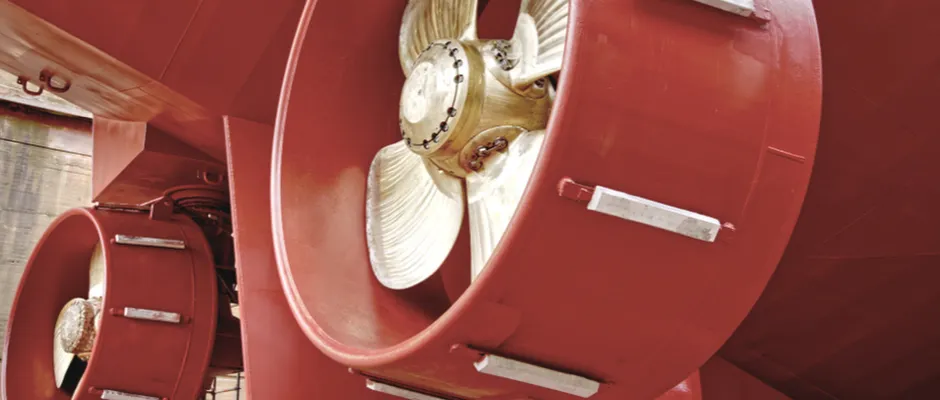
When Does Modification or Replacement of a Propeller Nozzle Require Redesign of the Propeller and Rudder?
Author: Jeroen Berger • Publication date:
A modification or replacement of a propeller nozzle only has technical consequences once the propulsion system no longer operates within the same flow and loading assumptions for which the ship propeller and ship rudder were originally designed. The risk arises as soon as the nozzle is treated as an isolated intervention, while in reality this component continues to influence both the pressure field around the propeller and the inflow to the rudder.
A meaningful assessment therefore begins by explicitly defining the objective of the modification. What problem must be solved, which operating profile must support that objective, and which operating points represent the vessel’s actual annual profile? Only once those boundary conditions have been clearly defined can it be assessed whether the existing propeller and rudder configuration still retains sufficient margin under those circumstances.
For shipping companies and shipowners, the core question therefore does not lie in the nozzle itself, but in the system behaviour of the combination of nozzle, propeller and rudder. Does this combination continue to function as a coherent and predictable propulsion system under the intended regime, or does the balance shift to such an extent that integrated coordination becomes necessary?
If the Operating Profile Shifts Permanently
A redesign question arises as soon as the modification aims at more than a like-for-like replacement within the same operating regime.
If, for example, the dominant operating area shifts towards more prolonged operation at low speed and higher thrust, or towards a different speed profile, the loading pattern on the propeller changes. Because the nozzle conditions the inflow to the propeller plane, a modification may lead to higher local blade loading or a different pressure distribution from that for which the propeller was originally matched.
The threshold is reached as soon as the new combination operates not incidentally, but structurally, outside the original design margin of the propeller. In that case, redesign is no longer an optimisation, but a necessary recalibration of the system.
If the Propeller Is Loaded Differently in Practice
A nozzle influences tip loading, pressure build-up and the velocity field around the blade passage of the propeller. If profile, diameter or positioning change, the operating point of the propeller may shift.
Propeller redesign comes into view when that shift translates into a different power curve, a different vibration pattern or accelerated erosion around the blade tip and inner ring. What matters here is not one deviating measurement, but a pattern that becomes visible across several representative operating points.
As soon as load distribution across the dominant regime differs from that for which blade geometry and pitch distribution were matched, integrated coordination of the propulsion system becomes necessary.
If the Outflow Pattern Towards the Rudder Changes
The nozzle influences not only the inflow to the propeller, but also the structure of the propeller slipstream behind the propeller plane. In that way, the inflow to the rudder changes as well.
When that interaction shifts, this may affect rudder loading, steering moment and course-keeping. Rudder redesign becomes relevant when the modified outflow pattern leads to higher local loading, less predictable response or greater sensitivity to small rudder angles within the dominant operating profile.
What is decisive here is not a deviation at maximum rudder angle, but a shift in everyday manoeuvring behaviour under normal operating load.
If the Physical Installation Conditions Change
Even without a change in operating profile, redesign may become necessary when clearances, positioning or installation space change.
A different tip clearance, a modified axial distance to the rudder or altered centring may influence the flow field to such an extent that the original hydrodynamic assumptions no longer apply. The change then lies not in the operating area, but in the geometric boundary conditions of the system.
In such situations, the issue is less one of additional efficiency than of restoring coherence between components within new physical system boundaries.
If Operational Data Shows That the Margin Is Limited
Historical operating and dry-dock data often provide the most direct indication of system margins.
Recurring erosion around the inner ring, asymmetric wear at the blade tip or repeated local repairs may indicate that the existing configuration is already operating close to its practical limit. When a nozzle modification shifts the loading pattern further, the likelihood increases that existing sensitivities will develop more rapidly.
At that point, the question shifts from “can the component remain?” to “does the system as a whole remain controllable?”. In that situation, an integrated revision of propeller and rudder often becomes the technically more stable solution.
If Verification Shows Deviations Within the Same Vessel Context
A redesign decision requires assessment within the same hull, propeller and rudder arrangement and under explicitly defined boundary conditions.
When Computational Fluid Dynamics (CFD) is used, the pattern must remain visible across several representative operating points and not only at one isolated operating point. Only once the analysis shows that load distribution, pressure fields and interaction between components shift structurally does a clear indication arise that redesign is necessary.
Where formal assessment forms part of the process, the substantiation must also demonstrably align with the requirements of the relevant classification society.
If Dimensions and Operating Load Must First Be Established
In some cases, the limiting factor lies not in the design itself, but in uncertainty regarding the actual dimensions or the real operating regime.
Previous repairs, limited documentation or an inconsistent wear pattern may mean that verification and additional measurement are first required before it can be established on substantive grounds whether redesign is necessary. Without a reliable geometric and operational reference, the assessment remains speculative.
Conclusion
A modification or replacement of a nozzle requires redesign of the propeller and rudder as soon as operating profile, load distribution or installation conditions change the flow and pressure field to such an extent that the existing configuration no longer shows stable and reproducible system interaction across representative operating points, making integrated coordination within the same vessel context the technically most defensible route.
This Article Within the Series
Within Propeller Nozzle: Service Life, Retrofit and Regulations, this article addresses the point at which retention of an existing nozzle can no longer be justified on the basis of the available margins. As soon as a change in nozzle geometry, loading pattern or installation condition measurably shifts flow and loading behaviour, the technical question moves from component retention to system coordination between nozzle, propeller and rudder.
This article therefore forms the substantive continuation of When Can an Existing Propeller Nozzle Be Retained Following a Change in Propeller Loading. That earlier article remains within the situation in which an existing nozzle can be retained within the available margins. Here, the focus is on the tipping point at which those margins become insufficient and an integrated reassessment of the configuration becomes technically more logical.
From there, the series continues with Which Damage Patterns in a Propeller Nozzle Indicate Structural Replacement Rather Than Repair. Whereas this article concerns redesign driven by shifting loading and system interaction, the focus there shifts to damage development, remaining margin and the question of when repair no longer offers the same controllability as replacement.
For shipping companies, shipowners and technically responsible parties who want to translate this assessment into a concrete maintenance or retrofit decision, the page Propeller Nozzle for Ships forms a logical continuation. There, geometric verification, load analysis, configuration choice and coordination with classification societies come together in a traceable nozzle configuration for newbuild and retrofit.