

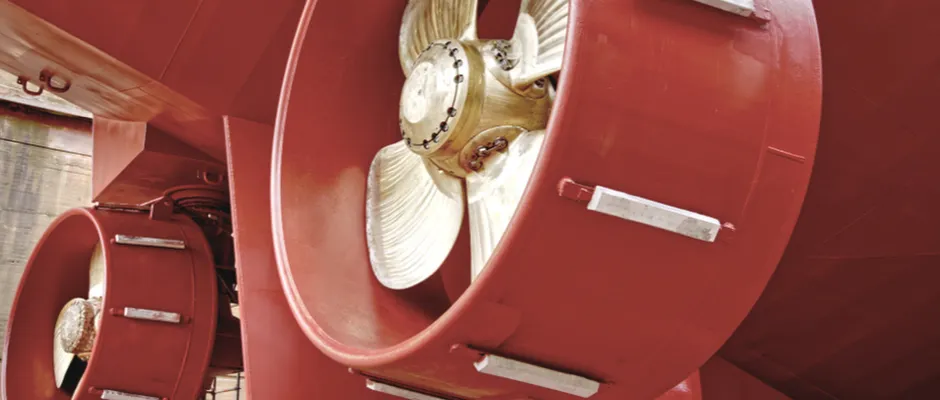
When Can an Existing Propeller Nozzle Be Retained Following a Change in Propeller Loading?
Author: Jeroen Berger • Publication date:
In practice, this question often arises when a propeller is replaced to reduce energy consumption, improve performance, limit wear or support a modified operating profile, for example in response to stricter efficiency or emissions targets. The temptation is then strong to leave the propeller nozzle unchanged as long as it remains structurally intact.
Technically, that can be justified, but only when the new propeller loading remains within the hydrodynamic and geometric bandwidth within which the nozzle has demonstrably functioned in a stable manner. As soon as the loading regime changes materially, it must first be established whether the existing configuration can absorb that change without introducing new sensitivities.
For shipping companies and shipowners, the issue is one of predictability. Do propeller nozzle, ship propeller and ship rudder continue to show the same stable behaviour across the relevant operating profile in terms of power uptake, energy consumption, wear pattern and steering response, or does the balance shift to such an extent that maintenance or availability risk increases?
Does the New Loading Remain Within the Original Operating Range?
An existing nozzle can generally be retained when the new propeller, in terms of diameter, pitch distribution, blade area and rotational speed, does not lead to a structurally higher loading level or a clear shift in the operating point. This means that the pressure and velocity field around the nozzle does not become materially more severe than under the historical operating condition.
In practice, this is reflected in consistent behaviour across several representative operating points. There is no noticeable increase in power uptake at equal vessel speed, no new vibration pattern and no indication that cavitation erosion or wear around the inner ring is increasing.
The risk lies less in a modest increase in power demand in itself than in the shift of pressure maxima towards zones that have historically proved sensitive. If such a shift does not occur and the change in propeller characteristics remains limited, retention can be technically well justified.
Geometry and Tip Clearance as Hard Boundary Conditions
The interaction between the propeller blade and the nozzle wall forms a direct geometric boundary condition. A modified blade shape or a limited increase in diameter may reduce tip clearance and raise local velocities.
As long as tip clearance, roundness and centring remain within a safe bandwidth and do not indicate an increased risk of cavitation or mechanical contact, the existing nozzle can remain functionally suitable.
The assessment changes as soon as the new propeller introduces smaller clearances or higher blade-tip loading than those for which the original configuration was assessed. In that case, the existing profile may begin to operate outside its earlier margins, even when it remains structurally in good condition.
Use the Condition History as a Technical Reference
A nozzle that has shown a stable and predictable wear pattern over several docking cycles provides a stronger basis for retention than an installation already showing signs of accelerated erosion, repeated weld repairs or local deformation.
Historical measurements of wall thickness, erosion development and tip clearance provide insight into the remaining structural margin.
When the existing configuration was already operating close to its maintenance limit, even a limited increase in propeller loading may disturb the balance. The question then shifts from “can it remain in place?” to “will it continue to function in a controllable manner until the next docking cycle?”
Does the Operating Profile Also Change?
A change in propeller loading often goes together with a modified operating profile. Longer working periods at low speed and high thrust, or conversely a shift towards higher cruising speeds, changes the loading pattern around nozzle and propeller.
If the vessel continues to operate within a similar speed and loading window as before, the existing nozzle can generally be retained.
If the dominant operating area moves into a regime in which increased erosion, pressure sensitivity or vibration indications had already been visible, reassessment becomes logical, even when the geometry itself remains unchanged.
Targeted Assessment in Case of Doubt
When the change in propeller characteristics is greater or historical margins appear limited, a targeted assessment within the same vessel configuration becomes logical.
The emphasis then lies not on maximum efficiency, but on the stability of system behaviour. Does power uptake remain manageable across several relevant operating points? Does pressure distribution remain free from pronounced peaks? Do no new critical zones arise around the inner ring or blade tip?
If such an assessment shows that the behaviour shifts only to a limited extent and remains within the existing margins, that supports the decision to retain the nozzle. If clear changes occur in pressure distribution, tip loading or rudder interaction, it becomes rational to include modification or replacement in the same project phase.
Practical Feasibility and Project Timing
Practical feasibility also plays a role. When replacing the nozzle would require major structural modifications without demonstrable benefit within the operating profile, retention may be operationally sensible.
Conversely, when the propeller replacement already requires alignment work, modification of attachments or other intervention in the aft ship, the same project phase may be suitable for reconsidering the nozzle as an integral part of the same intervention.
Technical and operational considerations often converge here.
Conclusion
An existing nozzle can be retained following a change in propeller loading when the new propeller and the operating profile remain within the original design margin, tip clearance and geometry remain stable, the condition history shows sufficient remaining margin and a targeted assessment confirms that the propulsion system continues to function predictably and in a controllable manner across the relevant operating profile.
This Article Within the Series
Within Propeller Nozzle: Service Life, Retrofit and Regulations, the focus shifts from design and performance validation to the functioning of the propulsion system during the vessel’s operational service life.
Where the preceding article When Are 3D Measurement and Additional Dimensional Verification Necessary for Propeller Nozzle Replacement Without Available Drawings describes when geometric verification becomes necessary before a new nozzle can be designed or installed, this article addresses another practical assessment: under which conditions an existing nozzle can be retained in a technically responsible manner when propeller loading changes.
The next step in this cluster shifts from retention to system interaction. In When Does the Modification or Replacement of a Propeller Nozzle Require Redesign of the Propeller and Rudder it is elaborated when a nozzle change can no longer be treated as a component adjustment, but instead requires reassessment of the entire propulsion system.
For shipping companies, shipowners and technically responsible parties who want to translate these retrofit and maintenance decisions into a concrete project assessment, the page Propeller Nozzle for Ships forms a logical continuation. There, geometry, load analysis, configuration choice and, where relevant, coordination with classification societies come together in a traceable nozzle configuration for newbuild and retrofit.