

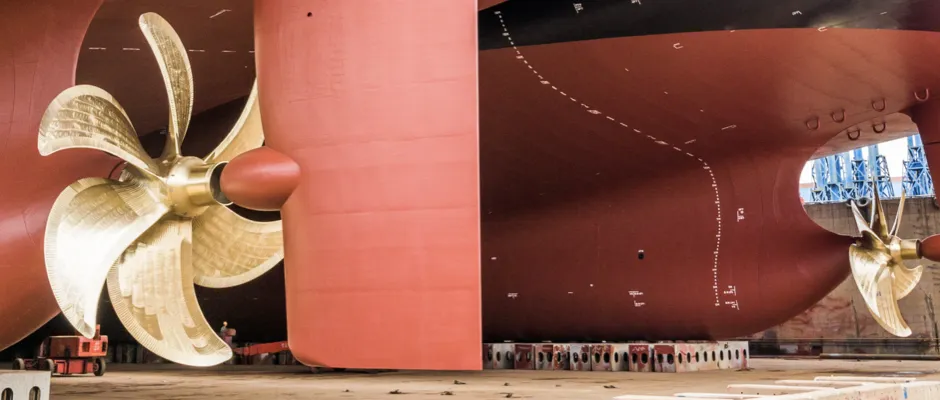
Lifecycle, Retrofit and Regulation of Rudder Systems
Author: Jeroen Berger • Publication date:
Rudder systems become a lifecycle and retrofit issue once behaviour not only changes over time, but also stops remaining reproducible under the same operating conditions. That point does not begin with the first signs of wear or deviation, but when the relationship between rudder angle, loading and course response loses stability across repeated operating conditions. For shipowners, operators and technical managers, the question then shifts from observation towards limitation: not whether the rudder still functions, but whether it still functions logically and defensibly within the same system arrangement.
Within the broader framework of rudder systems for newbuild and retrofit, this cluster page forms the durability and decision-making layer in which behaviour is assessed not only at one moment in time, but by how consistently it remains stable over time. Where Technology and Configuration of Rudder Systems defines the system framework within which the rudder operates, and Design, Validation and Performance Assessment of Rudder Systems reveals when behaviour can no longer be explained, this layer focuses on the point where that behaviour loses its technical foundation through wear, load build-up and shifting flow conditions. Once that boundary is reached, assessment shifts towards Economics, Subsidies and Strategic Decision-Making for Rudder Systems, where the question becomes whether continuation, optimization or replacement still remains economically defensible within the same arrangement.
The rudder is therefore not assessed as an isolated component, but as part of a hydrodynamic and mechanical system that changes during operation. Profile geometry, surface condition, inflow behaviour and mechanical transfer gradually shift, meaning the rudder’s operating range no longer remains static but moves within the same arrangement. Lifecycle therefore only becomes meaningful once the system no longer reaches a stable and reproducible force balance under representative operating conditions.
Throughout this cluster page, the technical line moves from deviation to structural loading, from operational use to degradation, and from wear to technical decision-making. The underlying articles examine when abnormal behaviour indicates structural loading, how cavitation accelerates wear, when predictability disappears and under which conditions retrofit still remains technically compatible within the existing system.
This is what allows the page to add something beyond the individual articles themselves. The focus does not lie on one wear mechanism or one intervention, but on the assessment framework through which rudder systems can be technically defined over time as either still functional or no longer sustainable within the same arrangement.
When Does Abnormal Rudder Behaviour Become a Structural Loading Issue?
Abnormal behaviour becomes meaningful once it keeps returning under similar conditions and no longer returns to a stable equilibrium. At that point, the loading on the rudder no longer fluctuates within the normal operating range, but has shifted structurally within the force distribution itself.
Interpretation then shifts from isolated incident towards system condition. The decisive factor is no longer the individual deviation itself, but the extent to which the system repeatedly returns to the same unstable behaviour under comparable loading conditions.
This creates a situation in which corrections may still have an effect, but no longer restore stable behaviour within the same arrangement. Loading therefore stops behaving as a temporary disturbance and becomes a reproducible characteristic of the operational profile itself.
Further analysis is developed within When Does Abnormal Rudder Behaviour Indicate Structural Load, where it becomes clear that the decisive factor is not the deviation itself, but the absence of lasting recovery.
When Does a Retrofit No Longer Fit Within the Existing System Arrangement?
A retrofit does not fail during installation, but during operation. The rudder may fit physically while still operating outside its effective hydrodynamic or structural range once inflow behaviour, available space or structural support no longer corresponds with the design.
At that point, physical fit becomes secondary to operational behaviour. The geometry of the new system may remain technically correct while flow distribution or load build-up can no longer be processed stably within the existing arrangement.
The limitation therefore shifts from component level towards system level. The retrofit component itself is not necessarily the problem. Instead, the limitation develops from the interaction between inflow behaviour, loading and the arrangement within which the system must operate.
Further analysis is developed within When Does Rudder System Retrofit Not Fit the Existing Configuration, where it becomes clear that retrofit only remains defensible once the complete system can absorb the new loading and flow conditions.
When Does the Rudder System Lose Predictability During Operation?
Predictability disappears once the same rudder input no longer produces the same course moment under similar operating conditions. Wear, mechanical play and changing flow behaviour then interact within a force field that no longer has a stable foundation.
What disappears is therefore not the rudder itself, but the relationship on which steering behaviour depends. The system still responds, but no longer from a reproducible hydrodynamic equilibrium.
Under repeated loading, the relationship between steering input and force build-up gradually shifts. Small variations in inflow behaviour, surface condition or mechanical transfer increasingly influence the final steering response.
Further analysis is developed within When Does a Ship Rudder Lose Predictability in Operation, where it becomes clear that predictability is not a property of the rudder alone, but of the stability of the complete system within which it operates.
When Does Cavitation Structurally Accelerate Rudder Degradation?
Cavitation accelerates wear once pressure drops and implosions repeatedly concentrate within fixed zones, increasing cyclic material loading while surface condition and flow behaviour continue reinforcing each other.
The effect does not lie in one individual event, but in repetition. Local damage alters the surface, after which flow behaviour becomes unstable again and creates renewed pressure differences within the same zones.
This creates a self-reinforcing degradation process in which flow disturbance and material wear continuously feed each other. Not only does the surface itself change, but also the way loading is distributed across the rudder.
Further analysis is developed within How Does Cavitation Accelerate Rudder Wear in a Rudder System, where it becomes clear that the decisive factor is not the presence of cavitation itself, but the repeatability of cavitation within the same loading zones.
When Does Rudder Optimization Influence the Energy Performance of the System?
Rudder optimization only becomes relevant for the Carbon Intensity Indicator (CII) and Energy Efficiency Existing Ship Index (EEXI) once a modification in the rudder system leads to a reproducible change in energy consumption per travelled distance across the operational profile.
At that point, system modification gains measurable impact beyond the technical domain alone. Flow behaviour changes, but so does the way energy consumption translates into operational performance and emission indicators.
This occurs once improvements in inflow behaviour, force build-up or flow stability begin affecting the vessel’s total power demand structurally. Energy efficiency then stops being a theoretical design property and becomes a measurable consequence of system behaviour under load.
Further analysis is developed within When Does Rudder Optimization Affect CII and EEXI Performance, where it becomes visible that energy performance is not determined by the design itself, but by the way energy is utilized throughout the system.
How This Cluster Contributes to a Technically Defensible Assessment
This cluster shows that lifecycle, retrofit and regulation are not isolated subjects, but together form the decision-making layer in which it is determined whether a rudder system still operates within its intended range over time. It prevents deviations from being assessed without understanding how often they return and whether they have become part of overall system behaviour.
For shipowners, operators, technical managers and superintendents, this forms the layer in which structural behavioural shift is established before intervention takes place. Only once loading, wear and flow behaviour no longer form a stable equilibrium does a technically defensible basis emerge for maintenance, retrofit, optimization or replacement decisions.
The technical sustainability of rudder systems ultimately only remains convincing once behaviour, loading and wear continue forming a stable and reproducible system condition under representative operating conditions within the same arrangement.