

When Does SCR Retrofit Become Technically Unviable on Existing Ships?
Author: Jeroen Berger • Publication date:
On existing ships, SCR retrofit rarely becomes technically unviable because one individual component fails or becomes unavailable. Far more often, the limit develops gradually once the vessel’s existing configuration no longer retains enough thermal, spatial or operational margin to keep exhaust aftertreatment stable under real operating conditions.
The SCR system may still continue achieving theoretical NOx reduction while becoming progressively less predictable during daily operation. Temperature losses increase. Maintenance pressure rises. Reactor stability deteriorates. Emission behaviour under fluctuating load becomes less reproducible.
For shipping companies, shipowners, superintendents and technical managers, the assessment therefore shifts away from component selection itself towards the long-term technical sustainability of the complete retrofit configuration. The central question is no longer whether an SCR reactor can physically be installed, but whether the existing installation still provides enough foundation to maintain emission stability, maintainability and operational reliability over time.
Sometimes a retrofit remains formally operational while the practical controllability of the emission system quietly begins slipping away. That moment is often recognized too late because the installation initially continues functioning reasonably well while the available reserve in temperature, space and maintenance flexibility has already started shrinking.
Why Technical Unsustainability Usually Develops Gradually
Technical unsustainability in SCR retrofits almost never develops abruptly. In most cases, the installation first becomes increasingly sensitive during daily operation long before the retrofit itself is considered problematic.
It often starts with small deviations.
Emission values fluctuate slightly more. Maintenance intervals shorten. Temperature stability reacts more sharply to load changes than originally expected during engineering. Meanwhile, the installation continues running normally, which is precisely why the technical limit often remains hidden for quite some time.
Crews compensate for temporary deviations. Technical teams perform additional cleaning rounds. Emission performance under certain load conditions remains largely acceptable.
The available margin continues shrinking anyway.
Existing vessels develop that sensitivity faster because engine room layout, exhaust gas routing and available installation space are usually already fixed before exhaust aftertreatment is introduced. Every retrofit therefore has to adapt itself around a configuration that was never originally designed for stable SCR integration.
Some retrofit projects remain manageable despite those limitations. Others gradually drift further away from stable thermal and flow conditions once the vessel returns to its real operating profile. Quite often, that only becomes fully visible after extended operation under the vessel’s normal duty cycle.
The reactor position itself did not become the problem. The available system reserve slowly disappeared.
How Limited Engine Room Space Reveals Retrofit Limits
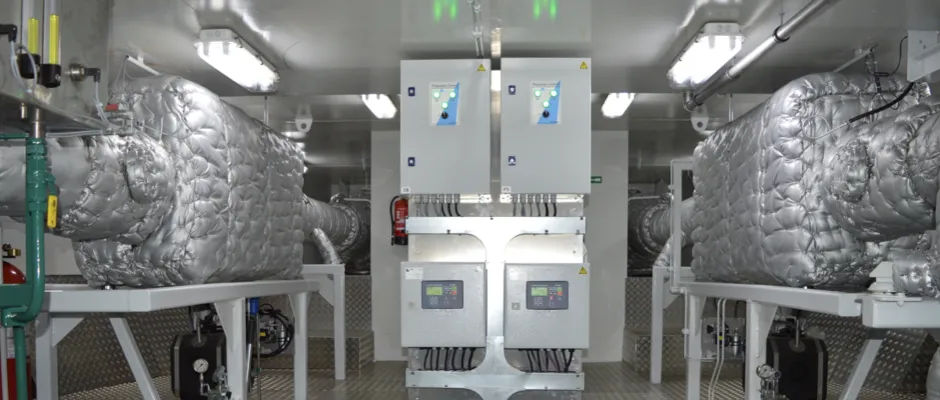
Engine room space forms one of the primary technical boundaries in SCR retrofit on existing ships. An SCR installation requires not only space for the reactor itself, but also for mixing sections, piping, insulation, sensors, maintenance access and exhaust gas temperature management.
Older vessels in particular become vulnerable there.
Compact engine rooms often leave little flexibility for favourable reactor positioning or sufficient mixing length between urea injection and catalyst surface.
The problem intensifies once existing structures, piping systems or maintenance routes become difficult to modify. The SCR installation then literally has to shape itself around the existing vessel configuration.
In theory, the reactor may still physically fit. Under daily operation, however, compromises increasingly begin creating instability later on. Every additional bend, longer pipe section or insufficiently insulated exhaust route raises the risk of heat loss, asymmetric flow behaviour and unstable NOx conversion under fluctuating load.
Retrofit installations where reactors are forced further away from the engine become especially thermally sensitive during low-load sailing or manoeuvring operation. The reactor still fitted inside the engine room physically. During operation, the available temperature window became progressively narrower.
Some crews only truly notice that during winter operation.
Warm-up procedures begin taking longer. Temperature recovery after manoeuvring slows down. Emission values stabilize noticeably later once engine load increases again.
Why Thermal Stability Ultimately Determines Feasibility
An SCR system only remains stable when the exhaust gas stream retains enough temperature to keep urea evaporation, ammonia formation and catalytic reaction inside their stable conversion range.
In retrofit installations on existing ships, that thermal stability often becomes the real problem.
Long exhaust gas routes between engine and reactor increase heat loss while limited insulation possibilities around existing structures intensify the effect further.
During low-load operation, harbour manoeuvring or prolonged standby conditions, the reactor can therefore fall outside its stable reaction window far more quickly. Under daily operation, the gap between theoretical engineering calculations and actual exhaust gas temperature often proves larger than originally expected.
Some installations still perform relatively stably during sea trials while developing increasingly frequent temperature fluctuations later during real operation. The reactor technically remains active. Its behaviour simply becomes less predictable.
Temperature margins shrink. NOx measurements react more sensitively to load changes. Maintenance pressure around injectors and mixing sections gradually increases.
Sometimes that instability remains hidden for long periods while the vessel mainly operates under higher load. Only during prolonged low-load cycles or winter operation does it become clear how limited the retrofit’s thermal reserve has actually become.
Some crews first notice it through a faint ammonia smell during extended low-load operation before measurement values visibly begin drifting. Small observations like that rarely happen by coincidence once they repeatedly return under the same operating profile.
The reactor capacity was not too small. The thermal stability was.
How Real Operating Conditions Reveal Retrofit Instability
Many SCR retrofits are technically evaluated using theoretical load curves or controlled trial conditions. Real operating behaviour often proves far more dynamic than originally assumed during engineering.
That is where many retrofit problems begin emerging.
Inland vessels operating under prolonged low load, offshore workboats during fluctuating standby conditions and tugboats during manoeuvring operation create duty profiles where the SCR system continuously shifts between different thermal states.
The reactor then receives insufficient time to stabilize thermally before the next load transition already arrives. Some systems remain sufficiently stable despite that dynamic behaviour thanks to compact layouts or limited heat loss. Others become increasingly sensitive to load changes, temperature fluctuations and flow disturbances.
That difference usually only becomes visible during prolonged operation. During commissioning, emission values may still remain fully acceptable while the same installation begins developing recurring emission deviations months later under its real operating profile.
The formal emission curve may still appear acceptable while maintenance pressure has already started rising noticeably underneath it.
For technical managers, that often creates a frustrating reality. Officially, the installation still operates within limits. Operationally, crews increasingly spend time correcting deviations, cleaning components or interpreting alarm behaviour during already demanding operational periods.
Why Maintenance Pressure Eventually Becomes a Technical Limit
In technically sustainable retrofit installations, maintenance generally remains predictable and manageable within normal service windows. Once maintenance pressure begins rising structurally, it often signals that the SCR system has started operating outside stable margins.
That becomes visible when injectors foul faster, mixing sections require more frequent cleaning or reactor zones become increasingly sensitive to deposit formation. Initially, such issues may still appear individually manageable.
Only later does it become clear that maintenance frequency, emission instability and thermal fluctuations are slowly reinforcing one another.
Cleaning intervals shorten. Alarm behaviour returns more quickly. Corrective maintenance begins consuming a growing share of technical management capacity.
Some crews only realize it once maintenance that originally remained occasional slowly becomes part of normal operation, or when service work only remains possible during short harbour rotations already operating under severe time pressure.
That is the moment when retrofit shifts from technically workable towards operationally burdensome.
The installation keeps running. The maintenance reserve does not.
How Combined Emission Chains Increase Retrofit Sensitivity
Retrofit projects combining SCR systems with particulate filters or additional emission technologies often become even more sensitive to technical limits.
Multiple emission technologies simultaneously influence temperature behaviour, pressure loss and flow distribution inside the same exhaust gas line. A temperature profile favourable for stable NOx conversion does not automatically remain optimal for stable particulate filter operation.
Regeneration cycles, additional pressure loss and limited installation space collectively begin influencing the stability of the complete emission system. Existing vessels with compact engine rooms become particularly vulnerable there.
Every additional emission component increases the complexity of thermal management, maintenance planning and emission stability under real operating conditions.
Some installations remain relatively stable during higher engine load while gradually developing growing thermal instability between different parts of the emission chain during fluctuating operation.
Under those conditions, behaviour during load transitions often becomes more decisive than nominal reactor capacity or theoretical emission reduction figures alone.
Which Signals Indicate a Technically Unsustainable Retrofit?
Technical unsustainability usually develops gradually and therefore often becomes visible relatively late. In many cases, the first signals appear long before a retrofit is formally considered unsuccessful.
Fluctuating emission values under comparable engine load often form one of the first indications. Rising pressure loss, recurring temperature warnings, more frequent contamination and unstable NOx conversion can also signal that the installation no longer retains enough operational margin structurally.
Differences also begin appearing between theoretical emission performance and long-term operational behaviour. An installation may still achieve acceptable values under controlled conditions while gradually losing stability during real operating cycles.
Some technical teams first notice it through maintenance behaviour. Others see emission performance becoming increasingly difficult to reproduce under fluctuating load profiles.
Operational pressure usually increases gradually as well. Crews face more corrective maintenance rounds, recurring warnings or emission deviations during critical operational periods.
Some crews eventually begin temporarily suppressing emission alarms during manoeuvring because the same warnings repeatedly return under low-load operation anyway. That does not necessarily indicate immediate system failure. It does indicate an installation becoming progressively less stable operationally.
When Emission Compliance Begins Falling Under Operational Pressure
Not every technically complex retrofit automatically becomes operationally unsustainable. The practical boundary usually develops once emission stability, maintainability and operational reliability collectively begin moving outside manageable limits.
That moment differs strongly per vessel, operating profile and installation configuration.
Some retrofit installations retain enough thermal reserve to function stably for years despite limited space or fluctuating load. Other systems become sensitive even to relatively small deviations in temperature, flow behaviour or engine load.
In practice, the greatest pressure often emerges once emission performance becomes linked directly to inspections, contractual requirements, sustainability criteria or emission-sensitive operating areas. At that point, theoretical emission reduction alone no longer matters. The decisive question becomes whether those emission values remain reproducibly stable under real operating conditions over the long term.
For shipping companies and technical managers, the situation then shifts away from technical optimization towards strategic operational risk.
Why Retrofit Must Always Be Assessed as One Integrated System
Within SCR retrofit on existing ships, no universal boundary exists where exhaust aftertreatment automatically becomes technically unsustainable. Reactor configuration, engine room layout, piping geometry, temperature behaviour, maintenance access and real operating profile collectively determine how much operational margin the retrofit actually retains.
Retrofit therefore always has to be assessed as one integrated system.
An SCR reactor may theoretically be selected correctly for the engine output while the complete installation still proves insufficiently stable under daily operation. Existing vessel configurations make that assessment especially sensitive.
In some retrofit trajectories, only extended operation reveals how strongly temperature behaviour, load transitions and maintenance pressure begin influencing one another.
The technical value of retrofit therefore does not arise solely from achieved NOx reduction itself, but from whether the complete emission system remains stable, maintainable and operationally manageable over the long term under real operating conditions.
That is where the true boundary ultimately lies between what is technically possible and what is technically sustainable.
This Article Within the Series
Within Emission Compliance, Retrofit and Degradation of SCR Systems for Ships, this article forms the first operational sustainability article of the third cluster. It follows on from When Does an SCR System on Ships Lose Emission Stability Under Fluctuating Engine Loads, which concluded the validation and emission-stability layer of the series. While that article showed how thermal instability and fluctuating load place reproducible emission performance under pressure, the focus here shifts towards retrofit reality itself: the point where existing vessel configurations no longer retain enough thermal, spatial and maintenance reserve to keep SCR systems sustainably manageable over the long term.
The next step within the series is How Do Older Engine Configurations Affect the Reliability of Marine SCR Systems. Once the operational sustainability limit of SCR retrofit has been defined, the analysis narrows further towards the engine installation itself: how older engine configurations, fluctuating temperature behaviour and slower load response can begin limiting the reliability of exhaust aftertreatment under real operating conditions.
For shipping companies, shipowners, technical managers and superintendents, that transition matters operationally because retrofit limits rarely become visible through reactor capacity or available engine room space alone. Only once thermal stability, maintenance pressure, load behaviour and emission compliance are assessed together does a realistic understanding emerge of the operational sustainability of SCR systems during daily vessel operation.