

What Is the Purpose of a Bow Thruster and What Are Its Limitations?
Author: Jeroen Berger • Publication date:
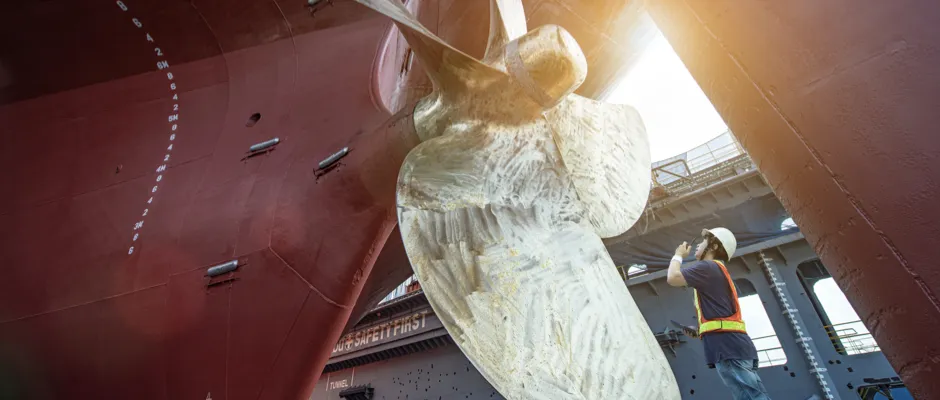
A bow thruster is an auxiliary propulsion device used in shipping to increase maneuverability at low speed by generating transverse thrust at the bow. In the most common configuration, the system comprises a transverse tunnel with a small ship propeller; alternatives include retractable bow thrusters and podded or azimuth thruster configurations in the bow. By expelling water perpendicular to the longitudinal axis, the bow can be moved sideways in a controlled manner, without main propulsion or rudder action being decisive. This enables precise positioning where maneuvering space is limited, such as during berthing and unberthing, passing locks and navigating confined waterways.
This article explains how a bow thruster operates, in which maneuvering situations it provides demonstrable added value and where the technical and operational limits lie. In addition, it addresses design and installation choices and common alternatives, so that the deployment and sizing of a bow thruster can be assessed in relation to the operational profile, the onboard energy supply and the relevant operational boundary conditions.
Important Role in Maneuvering
The added value of a bow thruster is most evident at low vessel speeds, where the effectiveness of conventional means such as rudder angle and main propeller action is limited. In this speed range, sufficient longitudinal flow along the rudder is often absent, which reduces steering force. By generating directed transverse thrust at the bow, a bow thruster can partially offset this limitation and provide additional control over vessel motion.
During berthing and unberthing, this makes it possible to move the bow directly and in a controlled way sideways, allowing course and position corrections without the stern having to follow the same movement. This is particularly relevant in ports and locks where maneuvering space is limited and small deviations can directly lead to contact with quays, fender structures or other vessels.
For larger cargo vessels, cruise ships and ferries, this additional maneuverability contributes to increased operational safety by reducing the likelihood of collisions and quay damage. At the same time, the use of a bow thruster can lead to more efficient port operations, for example because less or shorter external assistance by tugs is required. In combination with additional maneuvering devices, such as stern thrusters or azimuth thrusters, a vessel can in many cases perform complex port maneuvers independently, provided the available power, control logic and operational procedures are aligned.
Technical Limits and Constraints
The effectiveness of a bow thruster is largely determined by the operational speed range in which sufficient transverse thrust can be developed. As vessel speed increases, longitudinal flow along the hull dominates and the effective transverse force from the bow thruster decreases rapidly. In practice, this means that above a few knots the contribution diminishes significantly, and at higher transit speeds it has only a limited to negligible influence on vessel motion. The use of a bow thruster is therefore primarily limited to port maneuvers and other situations at low advance speed.
The required drive power is also a relevant design and operational factor. Especially in higher power classes, a bow thruster can impose a significant load on the electrical or hydraulic energy system on board. This requires careful coordination with available generator capacity, power management and the concurrent use of other auxiliary systems. Operationally, this can affect fuel consumption and energy distribution on board, particularly on vessels with a complex energy network or limited reserve capacity.
Wear and maintenance impose clear limits on use. In shallow waters or ports with sediment, operating the bow thruster can resuspend sand and silt. This increases the risk of erosion of tunnel walls and blades and can shorten the service life of seals, bearings and protective coatings. At the same time, resuspension of bottom material can cause environmental effects, for example by dispersing contaminated sediment, which in some ports leads to operational restrictions or additional requirements.
An additional point of attention concerns noise and vibration, particularly on passenger vessels and other ships where comfort and underwater acoustics matter. Local flow and cavitation phenomena in and around the tunnel can contribute to elevated noise levels. International guidelines, such as ICES 209, place increasing emphasis on controlling underwater noise. This requires attention in design, selection of the propeller type, rpm strategy and installation, and can limit the use of a bow thruster in certain situations.
Given these boundary conditions, the bow thruster should be regarded as a specialized maneuvering aid with a clearly defined application domain, where effectiveness depends strongly on speed, water depth, installation position and operational use. The eventual performance and limitations are highly dependent on design choices, installation conditions and the way the system is operated within its intended duty range.
Design Choices and Alternatives
Bow thruster performance is largely determined by design and installation choices. The conventional tunnel thruster remains the most widely used configuration, because it is relatively straightforward to integrate structurally and generally functions predictably in port operations. Effectiveness, however, depends strongly on factors such as tunnel diameter, propeller diameter, blade design, rpm strategy and the extent to which favorable inflow at the bow can be ensured. Position relative to the waterline and bow shape also influence available transverse force and the likelihood of cavitation and vibration.
When resistance at cruising speed and sensitivity to fouling or damage carry more weight, a retractable bow thruster can be a suitable alternative. Because the unit can be withdrawn from the flow outside maneuvering situations, the additional resistance of a tunnel installation can be limited. Balancing this, the system is mechanically more complex and imposes higher requirements on installation space, sealing, inspectability and the maintenance regime. The choice therefore requires a trade-off between hydrodynamic benefits in transit and the manageability of technical integration.
For vessels with higher demands for maneuverability or positioning, azimuth thrusters or podded propulsion units (pods) can be installed in the bow. These units can direct the thrust vector and thus provide not only transverse but also longitudinal thrust, depending on configuration and operation. Compared with a tunnel thruster, they offer more flexibility and generally a broader operating envelope, but this usually goes hand in hand with higher investment costs, heavier integration into the energy system and additional requirements for structural installation, redundancy and maintenance.
The use of waterjet-based solutions as a bow maneuvering aid also receives attention in specific designs. By using a water jet instead of a conventional propeller, sensitivity to sediment-related erosion can decrease in certain situations, and response can be quick, depending on the system concept. At the same time, this type of solution generally requires relatively high electrical power and careful integration of intake, piping and outlet, so in practice it is mainly applied where operational requirements justify it.
In decision-making, it is therefore common to base the choice on an integrated assessment of vessel size, operational profile, maneuvering need, available energy supply and installation constraints, supplemented by comfort and noise requirements where relevant. As a result, selection is not only a matter of maximum transverse thrust, but above all the extent to which the chosen solution demonstrably fits the intended use and the operational and technical boundary conditions on board.
Strategic Relevance for Shipping Companies and Shipowners
For shipping companies and shipowners, the bow thruster represents more than a purely technical maneuvering device. The installation directly contributes to operational flexibility and increases the extent to which port maneuvers can be carried out in a controlled and independent manner. In many cases, this can reduce reliance on external towage services or limit it to specific situations. This translates into shorter port and maneuvering times and can, depending on trading area and port conditions, lead to structural cost savings over the operating period. At the same time, a well-sized bow thruster increases operational safety by reducing the risk of damage to quays, locks and other infrastructure.
It remains important to position the bow thruster within its functional limits. The system is expressly intended as a supplemental maneuvering aid and cannot replace main propulsion and the rudder. Effectiveness is limited to low speeds and specific situations, while required power, maintenance needs and wear sensitivity must be explicitly factored into the investment decision. Overestimating the scope of use can lead to disappointment in practice or to unnecessary loading of the energy system on board.
In contemporary vessel designs, there is therefore increasing focus on integrating bow thrusters within hybrid or partially electric energy systems. Within such an architecture, power management can be matched more effectively to peak demand during maneuvers, while at the same time creating scope for emissions reduction and noise control. This approach aligns with the growing emphasis on efficient energy use and compliance with international regulation, without losing sight of the bow thruster’s primary function.
Strategically, the bow thruster is therefore not a standalone provision, but part of a broader trade-off in which safety, operational availability, energy management and life-cycle costs converge. When design, installation and use are carefully aligned, the bow thruster provides a measurable contribution to both day-to-day operations and the vessel’s long-term value.
About This Article
This article forms part of the background information on the propeller as a product and falls within the cluster Ship Propeller Types and Propulsion Configurations. Its core premise is that a bow thruster is not a propulsion system, but a maneuvering aid at low vessel speeds that supports control, safety and operational flexibility. At the same time, its application domain is limited: effectiveness depends primarily on vessel speed, inflow conditions, water depth and the available onboard power. For a project-specific elaboration, the page Custom Ship Propeller logically builds on this context.
For a broader overview of propeller configurations and their areas of application, What Types of Ship Propellers Are There and What Are Their Characteristics logically connects. That article places bow thrusters in the context of main propellers, azimuth thrusters and other propulsion and maneuvering concepts, and shows how their functions complement one another within the overall design.
When the use of maneuvering aids is weighed against vessel type and operational profile, How Does Ship Propeller Selection Differ by Ship Type provides additional depth. This explains why additional maneuverability is essential in some segments, while in other applications simplicity and limited use of auxiliary systems are preferred.
For the relationship between design choices, operational use and verifiable performance, How Is Ship Propeller Performance Measured and Validated connects. That article describes how maneuvering performance and system behavior can be assessed and documented under representative conditions, including the limitations that apply.
Together, these articles position the bow thruster not as an isolated solution, but as part of a coherent design and decision-making chain in which maneuverability, energy use and operational availability are demonstrably aligned.