

When Does Engine Room Space Limit the Integration of DPF Systems on Existing Ships?
Author: Jeroen Berger • Publication date:
Engine room space is often regarded as a practical constraint within retrofit projects involving DPF systems. In reality, space plays a much larger role. The available engine room does not merely determine whether an emissions system can be physically installed, but ultimately influences how the entire emissions architecture is constructed. As a result, a distinction frequently emerges between a system that appears technically installable and a system that can remain logically integrated throughout its full service life.
For shipping companies, shipowners, superintendents and technical managers, this assessment becomes relevant as soon as particulate matter reduction must be added to an existing installation. At that point, available space rarely proves to be an isolated design variable. Pipe routes, maintenance access, existing equipment, structural constraints and future accessibility often compete for the same engine room environment. This is precisely where the space boundary of integration emerges: the point at which spatial constraints exert a greater influence on the emissions architecture than the technical preference of the system itself. This also creates an important distinction between installation space and lifecycle space. Installation space determines whether a system can be installed. Lifecycle space determines whether that same system remains accessible, maintainable and manageable over many years.
When Does the Space Boundary of Integration Emerge?
The space boundary emerges as soon as the available engine room no longer provides sufficient freedom to construct the emissions system according to technical logic. From that point onwards, the configuration gradually shifts from optimal system design towards controlled integration within existing constraints.
This shift is rarely caused by a shortage of square metres alone. Much more often, it develops because several spatial constraints simultaneously begin to influence the same design decision. A position that provides sufficient space for filter installation may, for example, offer insufficient free height for future dismantling. Another location may be structurally suitable but conflict with existing maintenance routes or access to other installations.
As a result, the actual space boundary often becomes visible only when attention extends beyond installation to include the full lifecycle of the system. What can be installed today must still remain accessible, inspectable and replaceable years later.
When Does Engine Room Space Begin to Shape the Emissions Architecture?
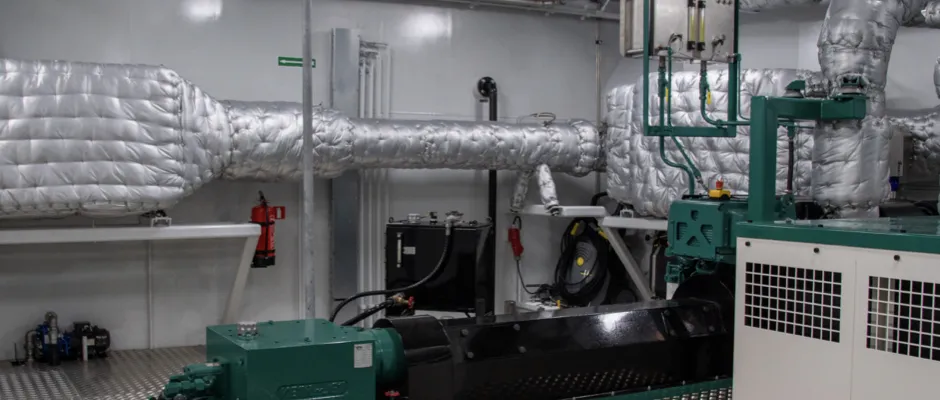
Within existing ships, engine rooms are typically designed around the original propulsion installation. Engines, exhaust silencers, auxiliary systems, pipe routes and maintenance zones have often remained in the same positions for many years without consideration for additional emissions technology.
As a result, a DPF system is frequently installed not in the position that is preferred from an emissions engineering perspective, but in the position that remains available within the existing configuration. That does not immediately create a problem. The technical assessment changes only when available space also begins to influence routing, accessibility, supporting structures or future maintenance activities. Those same spatial constraints may also become relevant when an SCR system forms part of the wider emissions architecture, because multiple emissions technologies must then be integrated within the same engine room environment.
A configuration may appear entirely logical during the engineering phase, only for it later to become apparent that a filter module can be accessed only after partial dismantling of surrounding systems or that an inspection hatch can no longer be fully opened. From that moment onwards, the emissions architecture is no longer determined solely by the requirements of the system itself. The engine room then begins to actively shape the final configuration.
Why Is Space Shortage Rarely Only About Installation?
When engine room space is discussed, attention often shifts immediately to whether the filter can be physically installed. In practice, that question usually represents only the beginning of the analysis.
A filter housing may fit within the available space, while future replacement of filter modules remains possible only if pipework, protective structures or adjacent components are first removed. Likewise, an installation that is fully accessible during construction may later complicate maintenance when service access depends on temporary dismantling of other systems.
This is where it becomes clear why lifecycle space is often more important than installation space. The former determines whether a system remains manageable over many years. The latter determines only whether the system can be installed today.
It is precisely this shift that transforms space within retrofit projects from an installation issue into an integration issue.
When Do Spatial Compromises Begin to Reinforce One Another?
The greatest challenges rarely arise from a single limitation. Much more often, they develop because several small spatial compromises gradually begin to reinforce one another.
A non-standard filter position requires additional pipe length. Additional pipework requires extra support. That support subsequently affects maintenance access or available working space around other installations. What initially appears to be a limited modification therefore develops into a chain of design decisions increasingly driven by space constraints.
At the same time, new dependencies often emerge. A component that remains accessible today may, during future maintenance, prove dependent on dismantling other parts of the installation. An inspection point that remains visible at delivery may later become difficult to access because of additional protective structures or supporting pipework.
As a result, the assessment shifts from physical fit to configuration robustness. The relevant question then becomes not how much space is available, but how many spatial compromises are required to keep the same configuration workable throughout its full service life.
When Does a Difference Emerge Between Technical and Spatial Feasibility?
Not every system that is technically suitable for a vessel automatically proves spatially suitable for the same installation.
This distinction becomes particularly visible when the emissions objective itself remains achievable, while the engine room offers insufficient freedom to integrate the system logically. The filter may function technically, but the required routing, accessibility, support or maintenance space becomes increasingly difficult to achieve without additional modifications.
In such situations, the technology remains possible while the integration environment imposes increasing constraints on how that technology can be applied. The assessment then shifts from whether a system works to whether the system remains practically manageable throughout its entire service life.
This is often where the true distinction between technical feasibility and spatial feasibility emerges.
When Does Engine Room Space Ultimately Determine the Integration of a DPF System?
Engine room space determines the integration of a DPF system as soon as available space exerts a greater influence on the configuration than the technical preference of the emissions system itself. At that point, the assessment shifts from system design to system integration and ultimately to lifecycle management.
For shipping companies, shipowners, superintendents and technical managers, the technical analysis therefore begins with recognising the space boundary of integration. As long as the engine room retains sufficient freedom for logical routing, maintenance access, structural support and future accessibility, the emissions system remains primarily governed by technical system logic. Once installation space still exists but lifecycle space begins to disappear, a situation emerges in which engine room space actively determines the emissions architecture. This shift explains why, within retrofit projects, the question is often not whether a DPF system can be installed, but whether it can remain workable throughout its full service life.
This Article Within the Series
The space boundary of integration forms the practical counterpart within Technical Configuration and System Integration of DPF Systems for Ships to the thermal regeneration boundary discussed earlier in How Does Low Exhaust Gas Temperature Affect the Regeneration of DPF Systems for Ships. While that article explained when insufficient exhaust gas energy limits regeneration stability, this article clarifies when the existing engine room itself begins to shape the configuration. The assessment therefore shifts from thermal reserve towards installation space, lifecycle space, maintenance access and the question of whether an emissions system can remain practically integrated over many years.
This spatial system boundary continues into How Does the Combination of SCR Systems and DPF Systems Affect the Emissions Chain on Board. Once it becomes clear when engine room space begins to limit the integration of a DPF system, it becomes particularly relevant how multiple emissions technologies interact within the same exhaust gas line and engine room environment. The analysis then moves from physical fit towards the dependency boundary of the emissions chain, in which temperature, flow behaviour, pressure loss and operating conditions can no longer be assessed on a component-by-component basis.
For shipping companies, shipowners, superintendents and technical managers, this progression is important because space shortage rarely determines only whether a filter can be installed. It also determines whether maintenance, accessibility, future dismantling and system interaction remain manageable when emissions technology becomes part of an existing installation. Within DPF systems for ships, this spatial assessment therefore forms a necessary contextual layer for particulate matter reduction that must remain not only technically achievable, but also operationally workable over the long term.