

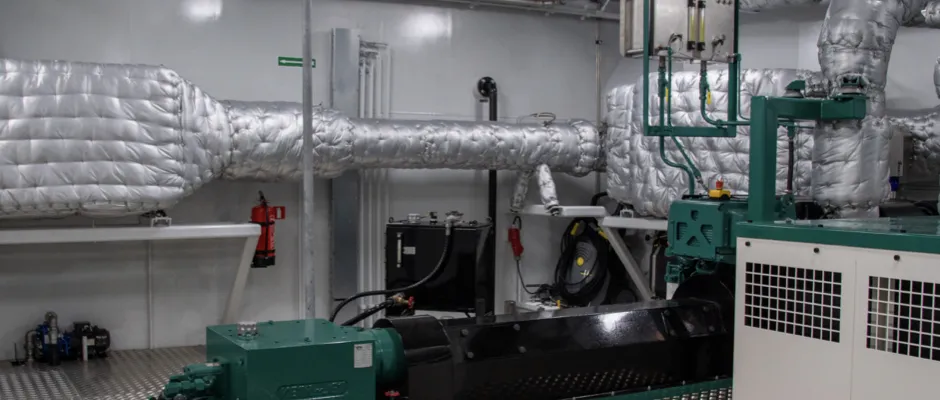
Technical Configuration and System Integration of DPF Systems for Ships
Author: Jeroen Berger • Publication date:
DPF systems for ships become technically relevant when particulate matter reduction must be integrated into an existing or new exhaust gas installation without regeneration, back pressure, engine room space or maintenance access moving beyond workable limits. For shipping companies, shipowners, superintendents and technical managers, risk mainly arises when the assessment is reduced too early to filter selection, while the existing installation, the operating profile or the combined emissions chain determines the final configuration. The first project-specific step therefore lies in assessing exhaust gas routing, thermal reserve, installation space, lifecycle space and interaction with any SCR systems.
This hub page forms the first cluster layer within the series around DPF systems for ships. The emphasis here is on the technical configuration and system integration of the emissions system. The series then shifts to Performance Assessment and Validation of DPF Systems for Ships, followed by Service Life, Retrofit and Emissions Compliance of DPF Systems for Ships and ultimately Economic Considerations and Strategic Decision-Making Around DPF Systems for Ships. This page therefore addresses the technical foundation on which the later assessment of performance, service life, emissions compliance and strategic investment choices builds.
A DPF system does not function on board as a standalone filter component, but as part of a thermal emissions system around the marine engine. Particulate matter capture, regeneration, exhaust gas temperature, pressure build-up and engine room integration must be assessed together, because a configuration that physically fits or appears logical from an emissions perspective may still create maintenance pressure, fouling or spatial constraints during day-to-day operation.
Within technical configuration issues around DPF systems, assessment rarely revolves around a single component. Much more often, the analysis shifts towards the boundaries within which an emissions system can remain stably integrated. Some boundaries arise from existing engine room configurations, while others are shaped by thermal behaviour, available space or the interaction between multiple emissions technologies within the same exhaust gas line. Together, these boundaries determine whether a DPF system becomes part of a manageable emissions installation or whether the configuration is gradually steered by constraints that only become visible during engineering, maintenance or operation.
Within this series, six of those boundaries emerge. Together they form the technical assessment framework for configuration and system integration of DPF systems for ships: the integration boundary of retrofit, the architecture boundary between newbuild and retrofit, the operational boundary of the operating profile, the thermal regeneration boundary, the space boundary of engine room integration and the emissions chain boundary that arises when DPF systems and SCR systems share the same operational environment.
This leads to one central technical question: does the selected configuration remain manageable under the actual operating profile in routing, temperature, accessibility, back pressure and system interaction, or is the installation gradually dictated by constraints that only become visible during engineering, maintenance or operation?
When Does Retrofit of DPF Systems Technically Fit Within an Existing Ship?
The first integration boundary within DPF systems arises during retrofit. This is where it becomes clear how much freedom the existing installation still leaves for emissions technology before accessibility, routing and maintenance logic begin to steer the configuration.
Retrofit of DPF systems technically fits within an existing ship when the existing installation retains sufficient space, accessibility and coherence to accommodate emissions technology without emergency solutions starting to determine the configuration. The assessment therefore does not begin with the question of whether the filter can be physically installed, but with whether the engine room layout, exhaust gas route, support structure, service access and maintenance logic retain enough technical capacity together.
In existing ships, the engine room is often arranged around the original engine installation. Engines, silencers, pipe routes, cable runs, foundations and maintenance zones were not designed around future particulate matter reduction. As a result, a DPF system may end up in the position that is still available, while that position does not automatically remain logical for inspection, cleaning, dismantling or later replacement.
This is precisely where it becomes clear that retrofit is not limited by installation space alone. As additional pipe length, modified support points, limited free height and shifted maintenance routes begin to reinforce one another, the configuration moves further away from emissions logic and towards technical compromise. The integration boundary arises as soon as the existing installation has more influence on the configuration than the DPF system itself.
The technical core remains that retrofit is defensible as long as the existing installation supports the DPF system. Once space, routing, accessibility and dismantling begin to steer the system architecture, the project gradually shifts from integration to redesign.
For a more detailed discussion of this integration boundary, see the article: When Does Retrofit of DPF Systems Technically Fit Within an Existing Ship.
When Does Newbuild Require a Different Configuration of DPF Systems Than Retrofit?
The second boundary is the architecture boundary between newbuild and retrofit. This boundary shows that the same emissions objective does not automatically have to lead to the same configuration.
Newbuild requires a different configuration when the emissions architecture does not have to be adapted to existing engine room constraints, but can be included in the overall design from the outset. The filter principle may remain the same, while the technical logic of the configuration changes fundamentally.
In retrofit, engine room layout, exhaust gas routing, foundations and maintenance routes are largely fixed. This often creates a configuration that is technically workable within existing constraints, but would probably not have emerged as the first design choice in a newbuild project. That difference marks the architecture boundary between newbuild and retrofit.
Where retrofit mainly revolves around manageable integration within existing constraints, newbuild creates the possibility to treat filter position, exhaust gas routing, maintenance access, supporting structures and any SCR integration as one design issue. The technical priority therefore shifts from controlled integration to system optimization.
The architecture boundary therefore makes clear that configuration is determined not only by emissions reduction, but also by the amount of design freedom that remains available before the installation is fixed.
For a more detailed discussion of this architecture boundary, see the article: When Does Newbuild Require a Different Configuration of DPF Systems Than Retrofit.
How Does the Operational Profile Determine the Choice of a DPF System on a Ship?
The third boundary within configuration issues is the operational boundary. This boundary arises when the suitability of a DPF system is no longer primarily determined by the engine configuration, but by the way the vessel is actually operated.
A DPF system may technically fit within an existing installation and have sufficient space within the engine room, while the operational profile still determines whether stable emissions reduction remains achievable. Ships with similar engine power can create completely different thermal conditions under actual operating conditions.
This is why the assessment shifts from nominal system characteristics to actual use. Continuous load, manoeuvring operation, stand-by operation, varying power demand and prolonged part load all influence the conditions within which regeneration and thermal stability must function.
The operational profile therefore forms the connecting layer between configuration and practical use. Not maximum engine power, but the actual operating profile ultimately determines whether regeneration behaviour, thermal reserve and maintenance burden remain within manageable limits.
For a more detailed discussion of this operational boundary, see the article: How Does the Operational Profile Determine the Choice of a DPF System on a Ship.
How Does Low Exhaust Gas Temperature Affect the Regeneration of DPF Systems for Ships?
The fourth boundary is the thermal regeneration boundary. This boundary determines when a DPF system is no longer assessed primarily on filter capacity, but on the amount of thermal reserve that remains available under actual operating conditions.
Regeneration becomes vulnerable as soon as the available exhaust gas energy remains insufficient over a longer period to keep accumulated soot in balance with filter fouling. Low exhaust gas temperature is therefore not only a temperature issue, but a system issue involving engine load, operating profile and thermal reserve.
A temporary drop in temperature does not have to create a critical situation in itself. The technical tension mainly arises when low load becomes part of the dominant operational profile. Ships with extensive manoeuvring operation, stand-by operation, varying power demand or prolonged part load can therefore create a thermal environment in which regeneration no longer remains sufficiently stable.
The most important shift does not lie in the lowest temperature, but in the duration for which insufficient thermal energy remains available. The system may appear to function normally, while the margin for stable regeneration gradually becomes smaller. By the time clear symptoms become visible, the system has often already been operating outside its most stable thermal range for some time.
For technical configuration, this means that filter capacity can never be read separately from the actual operating profile. A DPF system that appears suitable on paper may still become dependent on insufficient thermal reserve during day-to-day operation.
For a more detailed discussion of this thermal regeneration boundary, see the article: How Does Low Exhaust Gas Temperature Affect the Regeneration of DPF Systems for Ships.
When Does Engine Room Space Limit the Integration of DPF Systems on Existing Ships?
The fifth boundary is the space boundary of integration. This boundary arises when available engine room space has more influence on the configuration than the technical preference of the emissions system itself.
Engine room space determines the integration of a DPF system as soon as available space has more influence on the configuration than the technical preference of the emissions system itself. The question is then no longer only whether the system fits, but whether it remains accessible, maintainable and manageable throughout its full service life.
This makes the distinction between installation space and lifecycle space important. Installation space says something about fitting the system at the moment of installation. Lifecycle space says something about inspection, cleaning, replacement, dismantling and access to surrounding installations over years of use. That second level often determines whether a retrofit configuration remains technically robust.
The space boundary is rarely caused by one limitation. Much more often, it arises because several spatial compromises reinforce one another. A deviating filter position requires additional pipework. Additional pipework requires support. That support then affects maintenance access, working space or access to other systems. The assessment therefore shifts from physical fit to lifecycle control.
Within configuration issues, engine room space is therefore not a practical constraint, but a technical system boundary that determines whether an emissions installation remains workable in the long term.
For a more detailed discussion of this space boundary, see the article: When Does Engine Room Space Limit the Integration of DPF Systems on Existing Ships.
How Does the Combination of SCR Systems and DPF Systems Affect the Emissions Chain on Board?
The sixth boundary is the emissions chain boundary. This boundary arises as soon as separate emissions technologies can no longer be assessed independently because they share the same operational environment.
SCR systems and DPF systems become one emissions chain as soon as they depend on the same exhaust gas flow, the same thermal energy and the same operating conditions. From that point onwards, NOx reduction and particulate matter reduction can no longer be assessed entirely separately.
In separate assessment, both systems appear to have their own function. An SCR system focuses on NOx reduction, while a DPF system reduces particulate matter and solid particle numbers. Once both technologies are included in the same exhaust gas line, however, temperature behaviour, load changes, flow conditions and pressure loss influence the boundary conditions of both systems at the same time.
The technical assessment therefore shifts from component performance to chain performance. What appears favourable for one emissions function is not automatically the most stable solution for the full emissions treatment system. As dependency between the systems increases, the emissions chain increasingly determines the limits within which individual components can function.
The emissions chain boundary therefore marks the point at which DPF systems and SCR systems increasingly function as one emissions system rather than two separate emissions technologies.
For a more detailed discussion of this emissions chain boundary, see the article: How Does the Combination of SCR Systems and DPF Systems Affect the Emissions Chain on Board.
Technical Configuration as an Assessment of System Boundaries
Technical configuration of DPF systems for ships ultimately proves to be more than a matter of filter selection alone. Assessment repeatedly shifts towards another system boundary that determines whether an emissions system can remain stably integrated under actual operating conditions.
In retrofit, an integration boundary arises around existing installations. Newbuild exposes an architecture boundary between design freedom and existing constraints. The operational profile forms an operational boundary in which actual use becomes more important than nominal system characteristics. Low exhaust gas temperature then reveals the thermal regeneration boundary. Engine room space determines the space boundary of integration. The combination of SCR systems and DPF systems ultimately introduces an emissions chain boundary in which separate components can increasingly no longer be assessed independently.
These boundaries do not operate independently. A configuration that appears spatially logical may prove less thermally stable. A thermally stable configuration may be limited by engine room space. A technically suitable DPF system may become part of an emissions chain in which interaction with SCR systems ultimately becomes more decisive than the performance of the filter itself.
For shipping companies, shipowners, superintendents and technical managers, the practical value of configuration assessment therefore lies not in selecting one component, but in identifying the dominant system boundary within the actual operating profile. Together, these six boundaries form the technical assessment framework within which configuration and system integration of DPF systems for ships should be understood. Within the broader knowledge structure, the overarching page on DPF systems for ships remains the central reference point for the general function, application and technical positioning of the system.