

When Does Retrofit of DPF Systems Technically Fit Within an Existing Ship?
Author: Jeroen Berger • Publication date:
Retrofit of a DPF system technically fits within an existing ship when the existing installation retains sufficient space, accessibility and technical coherence to accommodate emissions technology without technical compromises starting to dominate the configuration. The assessment is not limited to the physical placement of the filter. At least as important is whether the engine room layout, exhaust gas route, support structure, service access and maintenance logic together retain enough freedom to make the DPF system a durably workable part of the existing ship installation.
For shipping companies, shipowners, superintendents and technical managers, this assessment becomes relevant as soon as particulate matter reduction becomes part of a decarbonization programme, emissions label, tender or future deployment strategy. As with retrofit of SCR systems for ships, a retrofit project may appear technically feasible in an initial assessment, while further engineering increasingly shows that existing silencers, pipe routes, inspection hatches or limited free height have more influence on the configuration than initially expected. Attention therefore often shifts early from the filter choice itself to a more fundamental question: does the existing installation support the integration of a DPF system, or does it begin to limit that integration?
When Does the Technical Integration Boundary of Retrofit Emerges?
The technical integration boundary emerges when a DPF system can no longer be logically incorporated into the existing configuration and more and more modifications are required to make installation, accessibility and maintenance possible. That boundary rarely becomes visible all at once. Much more often, it develops gradually as a retrofit project is worked out in greater detail.
In an early design phase, an available position often still appears sufficient. An exhaust gas pipe can be rerouted, a support structure adapted or a more compact housing considered. Only when installation sequence, service access and future dismantling become part of the same analysis does a more realistic picture emerge of the system’s actual fit.
This is precisely when it becomes visible whether retrofit is still supported by the existing installation or whether the installation itself is increasingly beginning to impose technical constraints. A filter that fits during installation, but later proves difficult to access for inspection, cleaning or replacement, is often already close to that boundary.
When Does the Existing Engine Room Begin to Dictate the Configuration?
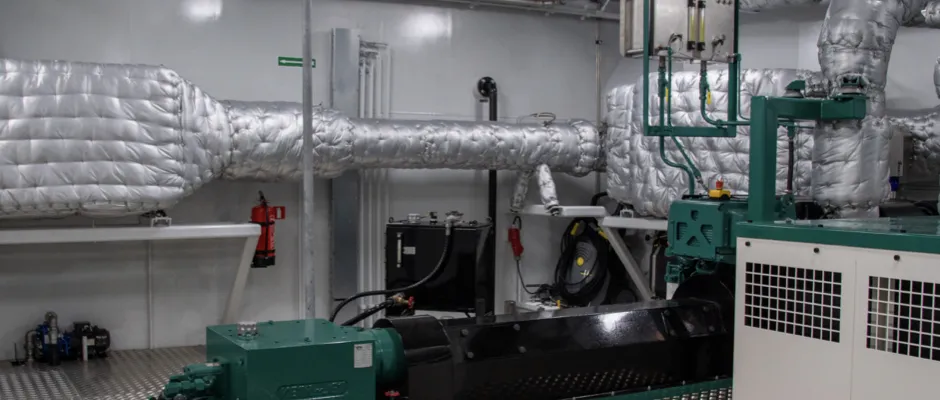
Within existing ships, the engine room is usually arranged around the original propulsion installation. Engines, exhaust silencers, cooling pipes, cable runs, foundations, access hatches and maintenance routes were developed around the original operating profile and not around future particulate matter reduction.
As a result, a DPF system is often installed in the position that remains available within the existing engine room, rather than in the position that would be preferred from an emissions engineering perspective. That does not have to be a problem in itself. The technical assessment changes only when that available space also imposes limitations on free height, service access or future dismantling.
A location that seems workable during installation may later block an inspection hatch, for example, or make maintenance work dependent on partial dismantling of surrounding installations. At that point, it becomes clear that available space alone says little. Far more important is whether the engine room retains enough freedom for the DPF system to remain a logical, accessible and safely manageable part of the installation.
When Do Technical Compromises Start to Accumulate?
Retrofit projects rarely become unworkable because of one isolated limitation. In practice, the greatest pressure usually develops when several small limitations begin to reinforce one another.
As soon as a filter position deviates from the originally preferred configuration, the impact is often not limited to that position alone. Additional pipe length frequently requires additional support points or insulation, while a relocated silencer may in turn affect access to existing fittings. A structurally feasible position may still prove unfavourable if filter modules cannot later be removed without additional dismantling.
The individual modifications usually remain technically manageable. Yet they rarely operate entirely independently of one another. This is precisely why the assessment gradually shifts from technical feasibility to technical robustness. The tipping point emerges when the configuration is no longer determined by emissions engineering logic, but increasingly by the need to work around existing constraints.
When Does Retrofit Shift From Integration to Redesign?
Not every technically executable retrofit project automatically remains a logical retrofit project. Some configurations ultimately require so many modifications to the existing engine room environment that the original installation layout has to be opened up step by step.
Pipe routes change, silencers are relocated, additional support structures appear and maintenance routes become increasingly dependent on temporary dismantling. Formally, the existing installation remains in place, but the number of necessary modifications gradually increases.
This also changes the technical question. The discussion is then no longer only about the integration of a DPF system, but about the extent to which the existing system architecture must be adapted to make that integration possible. This is often where the practical boundary lies between a technically logical retrofit project and a project in which redesign becomes increasingly dominant.
When Does the Existing System Architecture Retain Sufficient Capacity?
Retrofit of DPF systems technically fits within an existing ship when the existing installation can accommodate the emissions technology without accessibility, maintainability and technical coherence becoming structurally dependent on successive emergency solutions.
That does not mean that an engine room has to be ideal. A less favourable configuration can also function well technically as long as filter modules remain accessible, pipework can be supported logically and inspection points do not disappear behind new components. The assessment is therefore less about perfection and more about whether the installation retains enough technical capacity to remain manageable over the long term.
When future service, dismantling and fault recovery can take place without the DPF system constantly creating new limitations, retrofit usually remains a defensible technical route. The existing system architecture then still supports the emissions technology instead of continually limiting it.
Technical Assessment of Retrofit Within Existing Ships
When retrofit of DPF systems is being considered, the technical assessment ultimately does not revolve around whether a filter physically fits inside the engine room. The core question is whether engine room layout, exhaust gas routing, support points, free height, service access and maintenance logic together leave enough room to keep the system manageable throughout its full service life.
For shipping companies, shipowners, superintendents and technical managers, the next step therefore lies in a project-specific analysis of the existing installation. Retrofit of DPF systems technically fits within an existing ship as long as the existing configuration supports the emissions installation instead of limiting it. Once technical compromises around space, routing, accessibility and dismantling begin to steer the system architecture, the project gradually shifts from integration to redesign. That shift marks the point at which the technical boundary of retrofit comes into view and ultimately determines whether a DPF system can be logically integrated within the existing ship installation.
This Article Within the Series
The technical boundary of retrofit is defined in this opening article of the cluster Technical Configuration and System Integration of DPF Systems for Ships through space, accessibility, maintenance logic and the capacity of the existing system architecture. Because this is the first article within this cluster line, the emphasis lies on the fundamental question of when an existing installation still supports emissions technology and when technical compromises begin to steer the configuration. This introduces the integration boundary on which the further technical assessment of DPF systems within existing ship installations builds.
That integration boundary continues directly into When Does Newbuild Require a Different Configuration of DPF Systems Than Retrofit. Once it is clear under which conditions an existing ship can technically accommodate a DPF system, the next question is how the same emissions objective is approached when existing engine room layouts, pipe routes and maintenance structures have not yet been fixed. At that point, the analysis shifts from integration within existing constraints to the architecture choices that arise when design freedom is available from the outset.
For shipping companies, shipowners, superintendents and technical managers, this distinction is relevant because retrofit projects are often assessed on technical feasibility, while the long-term manageability of the configuration remains at least as decisive. The balance between integration, accessibility, maintenance and system coherence therefore does not stand alone, but forms part of the broader technical context of DPF systems for ships, in which emissions reduction, engine room integration, thermal behaviour and operational operability must be assessed together.