

How Does Limited Maintenance Access Increase Failure Pressure in SCR Systems on Existing Ships?
Author: Jeroen Berger • Publication date:
On existing ships, higher failure pressure within SCR systems often does not emerge because the emission technology itself is unsuitable. The problem usually begins once critical parts of the installation remain difficult to access for normal maintenance. Injectors, mixing sections, reactor zones, sensors and measurement points may be positioned correctly from a technical perspective, yet still prove too difficult to reach once the vessel enters daily operation.
As a result, maintenance gradually shifts from planned inspection towards reacting to recurring deviations. During engineering, the SCR installation often still appears logically integrable. Only during daily operation does it become visible how much additional time, safety preparation, dismantling work or downtime remains necessary to carry out simple inspections or corrections in practice.
That sensitivity becomes visible especially quickly in retrofit projects on existing ships. Engine-room layout, existing piping routes, limited service hatches and structural obstacles are often already fixed before emission aftertreatment is added. As a result, emission stability increasingly becomes dependent on maintenance work that remains difficult to execute on board.
Sometimes the problem does not lie in the reactor itself, but in the practical accessibility of the reactor during normal vessel operation.
Why Maintenance Accessibility Directly Influences SCR Stability
An SCR system only remains stable over the long term when injectors, sensors, mixing sections and reactor components can be inspected, cleaned and corrected in time. Once those components become difficult to access, small contamination problems remain present longer than is technically advisable.
That is frequently underestimated during retrofit engineering. An installation may fit within the available engine-room space while maintenance accessibility during daily operation proves far more limited than drawings originally suggested.
Injector zones are especially sensitive to that problem. Once inspection or cleaning only becomes possible after dismantling insulation panels, pipework or adjacent structures, maintenance tends to be postponed more quickly. Not because technical teams fail to recognise the issue, but because immediate correction becomes too hot, too time-consuming or too disruptive for the vessel’s operational schedule.
The installation usually continues functioning at that point, while failure pressure internally begins gradually increasing. The first signals often remain small: recurring alarms, additional corrective interventions, shorter cleaning intervals or emission values that temporarily improve after maintenance before slowly drifting again.
As a result, a relatively simple inspection may suddenly require hours of preparation. From that moment onwards, not only maintenance itself changes, but also the way technical teams begin planning and prioritising maintenance activity.
When Limited Engine-Room Space Increases Maintenance Pressure
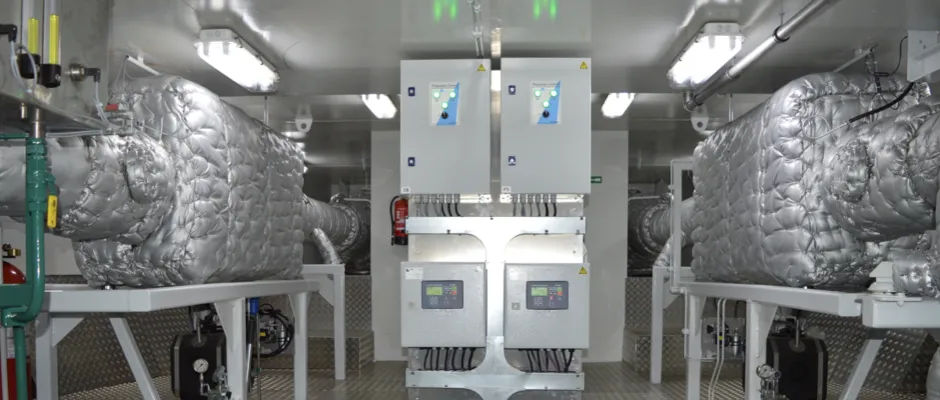
Within existing vessel installations, maintenance pressure often develops because SCR components are necessarily positioned around existing structures, exhaust-gas lines, pumps, cable trays and walkways. The installation is technically adapted to fit inside an engine room that was never originally designed for it.
Workboats, tugboats, offshore support vessels and older inland vessels are especially sensitive to this. Engine rooms remain compact, free working space stays limited and available downtime is often shorter than retrofit engineering originally assumed.
A reactor that appears accessible during drydock conditions may prove far less practical to access during daily operation, especially once components are positioned behind hot piping, insulation, structural sections or adjacent installations.
As a result, maintenance not only becomes more complicated, but also slower. Technical teams first need to wait for cooldown periods, install shielding, dismantle surrounding sections or create temporary access before actual inspection work can even begin. A relatively minor contamination issue around an injector may therefore gain disproportionately large influence over maintenance planning and vessel availability.
Not because the SCR system immediately fails, but because every corrective intervention gradually places heavier pressure on normal maintenance windows.
On intensively operated vessels, that quickly becomes problematic. Maintenance then has to be performed during short port rotations, waiting periods or limited operational windows. Precisely there, structural pressure begins emerging: the installation requires more attention while the vessel simultaneously retains less opportunity to carry out that attention carefully.
How Poorly Accessible Injectors Increase Failure Frequency
Injectors belong to the most maintenance-sensitive parts of maritime SCR systems. Once temperature loss, contamination or incomplete urea evaporation begins occurring, injector zones are often affected first.
With good accessibility, developing deposits can be removed early. Flow behaviour remains cleaner, mixing quality stays more stable and small deviations are corrected before contamination spreads further through the system.
With poor accessibility, the opposite often occurs. Corrective work is postponed until NOx measurements visibly deviate, an alarm returns or an inspection can no longer reasonably be delayed. By that point, contamination has often already progressed further towards the mixing section or reactor inlet.
That effect becomes stronger during prolonged low-load operation, winter conditions or standby activity. Precisely then, the risk of local deposits increases while maintenance still has to be scheduled around limited workspace and short downtime periods.
The technical root cause itself may remain relatively small while operational consequences on board rapidly become larger. Sometimes a vessel must wait for an appropriate maintenance window while the crew temporarily continues operating with recurring warnings. In other cases, alarms during busy manoeuvring phases quietly become accepted because the same warnings continue reappearing under low-load conditions anyway.
That does not solve the problem, but it does reveal that maintenance accessibility retains insufficient practical margin for stable emission management.
Why Maintenance Delays Reinforce Thermal Instability
Limited maintenance accessibility does not only create longer maintenance durations. It also directly influences the thermal stability of the complete SCR system.
Once contamination remains present longer inside injectors, mixing sections or reactor zones, flow distribution throughout the exhaust-gas line begins changing. As a result, local temperature differences, poorer urea mixing and increasingly unstable NOx conversion develop more easily.
Initially, the system may still function reasonably stably under higher load conditions. Later, the same installation becomes increasingly sensitive during low-load operation to temperature fluctuations, pressure loss and flow disturbance.
Maintenance then gradually shifts from preventive management towards reactive intervention. Technical teams begin correcting symptoms while underlying contamination and thermal sensitivity continue gradually increasing.
That creates a difficult tension particularly within existing retrofit installations. More maintenance would improve emission stability, yet physical accessibility simultaneously makes frequent corrective work increasingly difficult to execute.
Over time, a self-reinforcing pattern may emerge. Contamination remains present longer, flow behaviour becomes less homogeneous, NOx measurements react more unpredictably and cleaning requires more labour. As a result, cleaning is postponed again.
The installation formally remains available, yet maintenance reserve gradually disappears from the system.
How Limited Maintenance Accessibility Increases Operational Pressure on Board
The consequences of limited maintenance accessibility rarely remain restricted to the technical department alone. As failure pressure increases, the daily operational burden on board changes as well.
Crews increasingly face recurring warnings, temporary alarms and additional checks around emission values, system temperatures and urea dosing. That does not always create immediate failure, but it does remove operational calmness from daily vessel activity.
On vessels operating under intensive schedules, that pressure escalates quickly. Corrective maintenance must be scheduled during short downtime periods while accessibility to the installation itself continues requiring additional preparation.
As a result, an increasingly sharp contradiction emerges between technical necessity and available maintenance time. Cleaning an injector during a generous maintenance window remains relatively manageable. Reaching the same injector during a short port rotation, surrounded by hot piping, limited workspace and an approaching inspection completely changes the situation.
Additional pressure sometimes develops once emission deviations return shortly before contract-related measurements or operation within emission-sensitive areas. At that point, the issue shifts from maintenance towards operational reliability.
The installation formally remains available, yet requires increasingly greater effort in order to stay available. For superintendents, precisely that pattern becomes important: no immediate system failure, but an emission installation that increasingly begins demanding planning capacity, crew attention and maintenance availability.
Why Retrofit Projects Remain Especially Sensitive to Maintenance Limitations
Within newbuild projects, maintenance accessibility can be incorporated from the very beginning into reactor positioning, service hatches, piping routes and available working space around critical components. Retrofit projects rarely retain that design freedom.
Emission aftertreatment instead has to be integrated within already existing engine rooms. The SCR installation is adapted to the vessel, not the other way around.
That inevitably creates compromises. An injector ends up positioned just behind a piping section. A sensor technically remains reachable, but only after insulation removal. A reactor hatch can open, though not from a favourable working angle.
On paper, maintenance remains technically possible. On board, it often becomes difficult.
Every structural limitation subsequently increases the maintenance sensitivity of the installation. Limited workspace around reactor openings or mixing sections may still appear acceptable during engineering, yet later create major consequences for planning, safety and availability during daily maintenance.
That is why two technically comparable SCR systems may develop completely different maintenance behaviour. Not because of differences in reactor capacity itself, but because of engine-room layout, accessibility and retrofit configuration.
The same emission technology may therefore develop a completely different failure profile once the vessel operates long-term under fluctuating load conditions.
When Maintenance Pressure Leads to Structural Emission Instability
Not every limitation in maintenance accessibility immediately creates operational problems. The practical threshold usually emerges once maintenance delays, thermal contamination, recurring alarms and emission deviations begin structurally reinforcing one another.
From that moment onwards, the system shifts from manageable maintenance towards structural failure pressure. Injectors contaminate more quickly, cleaning intervals become shorter and technical teams retain progressively less opportunity to carry out corrections in time.
As a result, emission values become less predictable under fluctuating load. Maintenance pressure increases while emission stability simultaneously decreases.
At that point, maintenance accessibility no longer remains a practical detail, but becomes a direct stability factor within the complete emission system.
For shipowners and technical managers, the assessment then changes fundamentally. The question no longer revolves solely around whether the SCR system technically functions, but whether the system remains sufficiently maintainable to sustain stable emission performance during long-term daily operation.
On vessels dependent on emission-related contract conditions, audits or sustainability-based deployment criteria, that maintenance pressure may eventually also gain commercial significance.
The emission installation does not fail because of one major defect. It gradually becomes too difficult to manage in a stable operational way.
Why Maintenance Accessibility Becomes Part of System Stability
On existing ships, maintenance accessibility is still often treated as a practical side issue within retrofit engineering. In reality, accessibility to critical SCR components directly determines how stably the emission system can continue functioning under real operating conditions.
The limitation therefore does not only lie in reactor capacity, thermal behaviour or NOx conversion. It also lies in whether maintenance remains executable in time, safely and without disproportionate downtime inside the existing engine room.
For shipowners, operators, technical managers and superintendents, it therefore becomes important not to assess maintenance accessibility separately from emission stability. Once maintenance structurally becomes difficult to execute, the predictability of the SCR system also begins decreasing.
Only once engine-room layout, maintenance accessibility, thermal behaviour and daily vessel operation are assessed together does a realistic picture emerge of whether an SCR installation can remain stably and manageably deployable over the long term on existing ships.
This Article Within the Series
Within Emission Compliance, Retrofit and Degradation of SCR Systems for Ships, this article builds on When Does EU Stage V Require a Combined Emission Chain With SCR Systems on Newbuild Ships. Where that article showed how SCR systems, DPF systems, thermal management and engine management together form one integrated emission chain, the focus here shifts towards existing ships where that interaction becomes dependent on something far more practical: whether injectors, sensors, mixing sections and reactor zones remain accessible in time for maintenance.
The next step within the series is When Does Prolonged Low-Load Operation Cause Accelerated Fouling in Inland Shipping SCR Systems. After maintenance accessibility, the operational profile itself therefore becomes central, because prolonged low-load operation, temperature loss and waiting periods near locks or terminals determine how quickly contamination returns once an SCR system retains insufficient thermal reserve.
For shipowners, technical managers, superintendents and operators, that sequence matters because failure pressure rarely emerges from one isolated maintenance issue. Only once engine-room layout, accessibility, thermal behaviour and daily deployment are assessed together does it become visible whether an SCR installation remains manageable. Within that broader context, the page on SCR Systems for Ships remains the overarching framework in which maintenance accessibility, failure pressure, retrofit manageability and operational durability of emission performance are assessed together.