

When Does EU Stage V Require a Combined Emission Chain With SCR Systems on Newbuild Ships?
Author: Jeroen Berger • Publication date:
Within newbuild ships, the need for a combined emission chain with SCR systems rarely arises because one individual emission technology falls short on its own. The complexity begins once EU Stage V simultaneously demands low NOx emissions, particulate control and particle-number management within one engine and exhaust gas architecture.
At that point, an SCR system is no longer a separate aftertreatment step behind the engine, but part of an emission chain in which reactor, particulate filter, sensors, dosing technology, insulation, engine management and maintenance access all need to continue functioning together.
For shipowners, technical managers, superintendents and newbuild project teams, the assessment therefore shifts from component selection to the behaviour of the complete installation under real operating conditions. An engine configuration may formally comply with Stage V, while the emission installation itself still becomes sensitive during daily operation to temperature loss, regeneration behaviour, pressure loss or fluctuating NOx conversion.
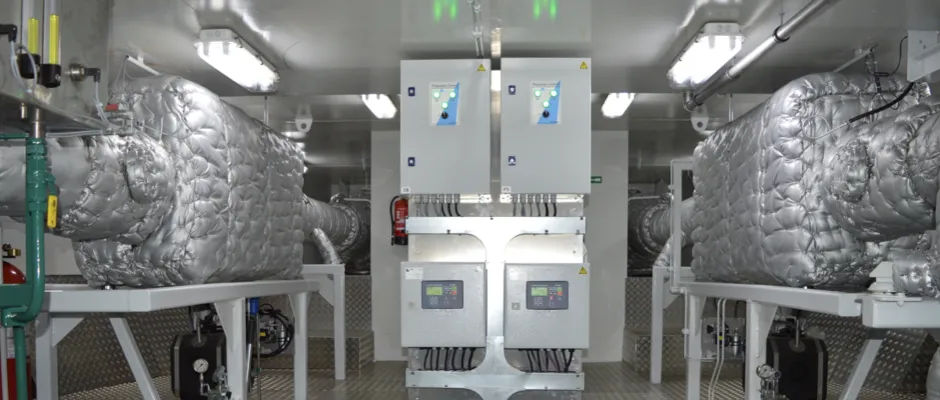
That sensitivity becomes especially visible on modern newbuild vessels. The emission installation has to be integrated compactly, often within limited engine-room space, with minimal space loss, good maintenance accessibility and sufficient thermal reserve. SCR systems, particulate filter systems, sensors, insulation, dosing technology and engine management therefore not only need to function correctly individually, but must also remain stable together during low-load operation, manoeuvring, standby conditions and short power peaks.
On paper, this is an emission architecture. On board, it is mainly determined by temperature, flow behaviour, pressure loss and maintenance accessibility.
Why EU Stage V Demands More Than NOx Reduction
For many maritime emission projects, the focus for years was primarily on NOx reduction through SCR systems. EU Stage V broadens that approach. In addition to NOx, particulate matter and particle numbers also become decisive, meaning particulate filter systems and additional emission-control measures increasingly become part of the same installation.
That changes the technical logic. An SCR reactor requires sufficient temperature for stable urea reaction and NOx conversion. A DPF system, meanwhile, requires controllable soot accumulation, pressure-loss management and regeneration behaviour. Both systems operate within the same exhaust gas stream, but do not always require exactly the same temperature, flow behaviour and load duration.
During trial-load conditions, that tension often remains only partially visible. The installation operates at controlled points, load behaviour is predictable and temperature response remains relatively stable within the expected bandwidth.
Under real operating conditions, the situation changes. Low load, short power peaks, manoeuvring, standby operation and varying work cycles continuously shift temperature and flow behaviour throughout the emission chain. Only then does it become visible whether the Stage V configuration retains sufficient thermal reserve to keep SCR performance and particulate control stable at the same time.
The regulation requires compliance. The vessel requires repeatable emission behaviour during daily operation.
Why Integrated Emission Chains Become Thermally More Sensitive
Within an integrated Stage V configuration, the SCR reactor, particulate filter, exhaust gas line and engine management continuously react to one another. A change in temperature or flow resistance therefore rarely remains limited to a single component.
A regeneration cycle can alter the temperature profile throughout the exhaust gas line. Increasing pressure loss can influence flow distribution. Low-load operation can simultaneously weaken the SCR reaction while also making particulate-filter regeneration less reliable. As a result, the emission chain becomes more sensitive than a simpler SCR configuration in which fewer components share the same thermal margin.
That sensitivity becomes visible quickly, particularly in workboats, inland shipping, offshore support and compact utility vessels. Such vessels rarely operate for long periods at one stable power point. The emission installation must continuously react to fluctuating load conditions, sometimes with limited time to thermally recover between two operational phases.
An installation may appear convincingly stable during continuous operation and still become unstable during transitions between low load, regeneration, acceleration and renewed load reduction. Those transition zones are technically important precisely because not maximum load, but load-response behaviour, often determines how reliably the emission chain performs during daily operation.
Load-response behaviour then becomes more important than nominal component capacity.
How Particulate Filter Systems Influence SCR Stability
Particulate filter systems change the behaviour of the complete emission chain. They add flow resistance, influence temperature distribution and require controlled regeneration behaviour. As a result, the SCR reactor does not always receive the same stable exhaust-gas flow as within a simpler exhaust configuration.
During prolonged low-load operation, temperatures can become too low for stable NOx conversion, while particulate-filter regeneration also becomes less reliable. Under higher load, temperature peaks may instead develop that alter heat distribution and gas flow throughout the emission chain.
That usually does not produce one clear, isolated fault. Much more often, a slowly shifting pattern develops: regenerations take longer, temperature warnings return more frequently, pressure loss gradually increases and NOx measurements become less reproducible during comparable load phases.
For project teams, that is where an underestimated risk appears. An SCR system may be correctly designed individually, and a particulate filter may be logically selected individually, while the combination within a compact newbuild installation retains far less thermal margin than the separate component assessments suggest.
The chain may then be compliant, but not automatically stable under the vessel’s real operating profile.
Why Compact Newbuild Installations Have Less Margin for Error
On modern newbuild vessels, emission aftertreatment is often integrated very compactly. That may appear efficient, but it also reduces the margin for error around thermal management, maintenance access and flow quality.
A Stage V installation requires space for reactors, particulate filter systems, sensors, dosing systems, insulation, inspection hatches and control technology. In compact engine rooms, that space is rarely generously available. As a result, design choices emerge that are technically understandable, but operationally may become sensitive.
A shorter pipe route helps reduce heat loss, but may limit mixing length. A compact module saves space, but can complicate maintenance accessibility. Additional insulation helps thermally, but may make inspections more difficult. None of those choices necessarily has to be wrong individually, but together they determine how stable the system remains once the vessel starts operating outside neat test conditions.
In workboat operations, that becomes visible quickly. A tugboat continuously switching between pushing, waiting and manoeuvring loads the emission chain differently from a vessel operating with long stable power phases. An offshore support vessel during dynamic positioning places different demands on thermal stability than the same installation during sea trials.
That is why “does it fit in the engine room?” is not enough. The real question is whether the system remains thermally, hydraulically and operationally stable once the vessel starts doing the work it was built for.
When Real Operating Load Becomes More Important Than Certification
Certification and trial-load testing are necessary, but they do not always reveal how an integrated emission chain behaves after weeks or months of fluctuating operation. During the first operating hours, much still appears stable. Only later do patterns begin to emerge.
A regeneration cycle returns more frequently than expected. A temperature zone remains just below range during low-load operation for slightly too long. Slowly increasing pressure loss only becomes truly noticeable after several maintenance reports. Sometimes the crew notices it before the data analysis does, for example through an alarm repeatedly returning during manoeuvring, a longer warm-up phase before the system settles down or a maintenance window proving too short because inspection of the emission module requires more disassembly than anticipated.
Those are not isolated details. They are early indications that the integrated emission chain is more sensitive than its certified status suggests.
For newbuild project teams, this means Stage V not only has to work on the design table. The installation must remain stable under the vessel’s actual operating profile, with sufficient thermal reserve, manageable pressure loss and maintenance requirements that fit within operational planning.
When a Combined Emission Chain Becomes Necessary
A combined emission chain becomes necessary once emission targets can no longer be achieved through NOx aftertreatment alone. Under Stage V, the challenge lies specifically in the combination of NOx, particulate matter and particle numbers. As a result, SCR systems, particulate filter systems and thermal management increasingly become integrated within one combined architecture.
That necessity arises particularly on newbuild vessels operating in markets where Stage V compliance, low-emission profiles or demonstrable sustainability carry significant weight. Workboats, inland shipping, port-related operations, offshore support and public infrastructure projects are especially sensitive to this.
But the technical question remains sharper than compliance alone: can the chain remain stable under the vessel’s real load profile?
For vessels with extensive low-load operation, standby conditions, manoeuvring activity or hybrid power fluctuations, that question becomes decisive. Not because Stage V itself creates instability, but because the required combination of emission technologies leaves less thermal margin for error.
A single emission solution may then become too limited. A combined chain becomes necessary, but also more critical in terms of temperature control, flow distribution, regeneration behaviour and maintenance accessibility.
Which Signals Indicate Insufficient System Stability
Instability within an integrated Stage V emission chain usually begins gradually and rarely with direct failure. Early signals include fluctuating NOx values under comparable load conditions, irregular regeneration cycles, increasing pressure loss, temperature warnings or maintenance intervals returning sooner than expected.
The rhythm of the installation often changes as well. At first, everything remains within limits, but with increasing corrective interventions. Later, trends become less stable. Eventually, the installation still formally functions, but operationally demands increasingly more attention.
The emission curve may still appear acceptable while the maintenance curve has already started to shift.
For superintendents, the combination of signals matters most. One temperature warning says little. Repeated warnings, unstable regeneration behaviour and less reproducible NOx measurements point far more clearly towards an emission chain retaining insufficient thermal reserve.
Why Stage V Ultimately Becomes a System-Level Decision
For many newbuild vessels, EU Stage V does not simply require an additional component, but a different design philosophy. SCR systems, particulate control, thermal management, engine management, engine-room layout and maintenance accessibility must all be assessed as one functioning system.
That is where the core issue lies. A Stage V-compliant installation only becomes truly usable once it not only complies during certification, but also remains stable during daily operation under fluctuating load, regeneration behaviour and temperature variation.
For shipowners, technical managers, superintendents and newbuild project teams, the key question therefore becomes not only which emission technology is required, but above all how the complete chain behaves once the vessel operates under its real working profile.
Only when the SCR reactor, particulate filter systems, thermal packaging, pressure loss, maintenance accessibility and operational load profile are assessed together does a realistic picture emerge of the long-term stability of Stage V-compliant newbuild vessels.
This Article Within the Series
Within Emission Compliance, Retrofit and Degradation of SCR Systems for Ships, this article builds on How Do IMO Tier III and NECA Increase Retrofit Pressure Around SCR Systems on Existing Ships. Where that article showed how emission frameworks, operating areas and future deployment requirements increase retrofit pressure on existing vessels, the focus here shifts towards newbuild vessels in which EU Stage V requires an integrated emission chain where SCR systems, particulate filters, thermal management and engine management must function together in a stable way.
The next step within the series is How Does Limited Maintenance Access Increase Failure Pressure in SCR Systems on Existing Ships. After Stage V has been defined as a system-level choice for combined emission aftertreatment, the analysis shifts back towards maintenance reality: the moment when accessibility of injectors, sensors, mixing sections and reactor zones directly begins influencing failure pressure, maintenance load and long-term emission stability under real operating conditions.
For shipowners, technical managers, superintendents and newbuild project teams, that transition is practically relevant because a combined emission chain can only be assessed properly once temperature behaviour, regeneration behaviour, pressure loss and maintenance accessibility are read as one operational system. Within that broader context, the page on SCR systems for vessels remains the overarching framework in which Stage V compliance, integrated emission architecture, system stability and the long-term durability of emission performance are assessed together.