

How Do IMO Tier III and NECA Increase Retrofit Pressure Around SCR Systems on Existing Ships?
Author: Jeroen Berger • Publication date:
On existing vessels, retrofit pressure around SCR systems rarely arises because one emission regulation suddenly forces immediate technical replacement. In practice, that pressure usually develops gradually once IMO Tier III and NECA operation begin influencing the deployability of older engine configurations within emission-sensitive operating areas, ports and contract environments.
For shipowners, technical managers, superintendents and operators, the assessment therefore shifts from general emission legislation towards deployability under real operating conditions. An existing engine installation may remain technically reliable for years, while the same configuration gradually becomes more difficult to deploy commercially or operationally once stricter NOx requirements increasingly become part of route planning, project selection or contract renewal.
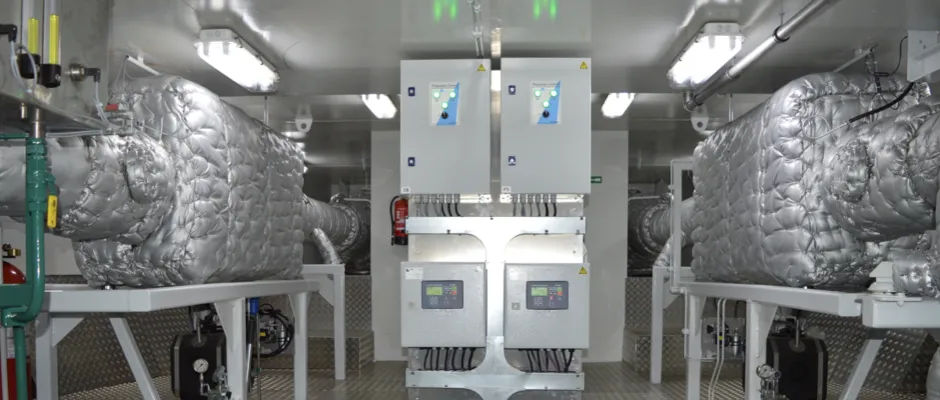
That tension develops especially quickly on existing vessels. Engine-room layout, exhaust-gas routing, thermal margins and available installation space are largely fixed before emission aftertreatment is added. Retrofit therefore revolves not only around emission reduction, but above all around whether an SCR system can remain stably integrated within an existing propulsion installation over the long term.
The engine remains deployable. The emission profile not always.
Why IMO Tier III and NECA Increase Operational Pressure
IMO Tier III imposes stricter NOx requirements on vessels operating within designated NOx Emission Control Areas, generally referred to as NECAs. For existing vessels, pressure mainly develops once the operating profile increasingly overlaps with emission-sensitive routes, ports or contract areas.
That pressure does not always become visible immediately. Many existing engine installations remain technically fully deployable outside NECA-related operations. Once vessels increasingly need to operate inside emission-sensitive regions, however, emission compliance shifts from a theoretical regulatory issue towards a practical limitation in planning, contract selection and operational deployability.
That tension develops relatively quickly particularly within offshore operations, coastal shipping, workboats and parts of inland shipping. Vessels that operated for years without additional emission aftertreatment then begin facing stricter emission requirements from clients, ports or contract conditions.
The question therefore gradually becomes less whether the engine still formally functions, and more whether the vessel remains sufficiently deployable within future routes and contract structures. That difference often only becomes visible once operational planning begins colliding with emission-related limitations. The vessel remains technically available, while the commercial freedom of movement becomes smaller.
The engine does not change first. The deployment conditions do.
Why Existing Vessels Are More Sensitive to Retrofit Pressure
On newbuild vessels, an SCR system can be integrated from the earliest design stage within engine-room layout, thermal loading and exhaust-gas routing. Existing vessels offer far less design freedom, meaning emission aftertreatment must be installed around existing structures, pipe routes and maintenance zones.
It is precisely those physical limitations that make retrofit projects sensitive once IMO Tier III compliance becomes operationally necessary. An SCR system requires not only space for the reactor itself, but also for mixing sections, dosing units, insulation, service zones and thermal management of the complete emission chain. Once DPF systems or additional aftertreatment are integrated as well, that integration becomes even more sensitive.
In practice, this regularly proves more complicated than early retrofit studies suggest. Older engine rooms encounter heat loss, limited maintenance accessibility or routing conflicts more quickly once integrated emission aftertreatment is added to configurations that were never originally designed for it.
The real retrofit pressure therefore arises not only from regulation itself, but from the combination of limited engine-room space, fluctuating load and increasingly strict emission requirements along existing operating routes.
How NECA Operation Places Thermal Stability Under Pressure
NECA operation not only increases the need for NOx reduction, but also increases pressure on stable emission performance under fluctuating load. Many existing vessels do not operate under fully constant load conditions, particularly within workboat operations, tug operations, offshore support and coastal service profiles.
That is often where the technical friction begins.
An SCR system only remains stable when exhaust-gas temperature, residence time and flow quality remain sufficiently within the reactor’s reaction window. Older engine configurations lose thermal stability more quickly under fluctuating load than modern installations. As a result, temperature zones develop more easily in which urea reacts incompletely, crystallization forms, particulate filters become more heavily loaded or NOx conversion becomes less predictable.
On some installations, that sensitivity becomes visible once exhaust-gas temperatures remain below approximately 270 degrees Celsius for prolonged periods during manoeuvring, standby operation or extended low-load conditions. The exact threshold remains project-specific, but it is precisely that prolonged low-temperature operation that makes NECA deployment technically less predictable for existing vessels.
For technical managers, this creates a complex retrofit dilemma. A vessel may demonstrate sufficient NOx reduction during engineering calculations or trial operation, while the same installation later proves less stable during prolonged NECA operation under the vessel’s real operating profile. In such situations, behaviour during load transitions often says more about system usability than nominal reactor capacity alone.
Why Commercial Deployability Increasingly Carries More Weight
Retrofit pressure around SCR systems is becoming progressively less driven purely by regulation itself. During daily operation, the commercial pressure surrounding emission compliance is growing more strongly because ports, clients, offshore contracts and sustainable tender processes increasingly emphasize demonstrably lower emission profiles.
Initially, that effect often remains only partially visible. A vessel retains access to existing routes and contracts while emission-related conditions gradually become more common within commercial selection criteria. Later, emission compliance shifts from technical optimization towards strategic necessity.
For older engine installations, that creates pressure to consider SCR retrofit earlier than originally planned. Not because the engine has mechanically reached the end of its service life, but because future deployability within emission-sensitive operations becomes less self-evident.
In some cases, that tension only emerges shortly before contract renewal or expansion into emission-sensitive operating areas. Emission aftertreatment then suddenly proves decisive for the future deployability of an otherwise technically usable vessel. That makes retrofit decisions more urgent than the mechanical condition of the engine alone would suggest.
How Older Engine Configurations Make Retrofit More Complex
Many older engine configurations remain mechanically reliable, but operationally prove less suitable for stable emission aftertreatment under IMO Tier III-related load conditions. Older injection systems, limited control strategies and fluctuating exhaust-gas temperatures especially increase sensitivity to thermal instability inside SCR reactors.
That difference is regularly underestimated during early retrofit assessments. An engine may provide sufficient power and remain technically acceptable, while the same installation fails to maintain sufficiently predictable exhaust-gas temperatures for long-term stable NOx reduction.
Problems then arise around temperature loss, fluctuating flow distribution or recurring contamination inside injector zones and reactor components. As a result, not every retrofit remains sustainably stable over the long term.
Combined SCR and particulate filter systems particularly increase sensitivity within existing engine-room configurations. Some installations remain relatively reliable under continuous load, but lose emission stability once the operating profile fluctuates more frequently or prolonged low-load operation becomes part of normal service.
Crew members sometimes first notice that through small operational shifts. Reactor warnings return more frequently during manoeuvring, warm-up procedures become increasingly important before entering emission-sensitive zones and short port rotations suddenly require additional corrective work around emission systems. The installation remains available, but the thermal reserve becomes smaller.
Which Signals Indicate Increasing Retrofit Pressure
The first signals of retrofit pressure rarely arise through direct technical failure. In many cases, pressure develops instead through operational limitations, emission deviations or changing contract conditions.
Vessels increasingly receive emission-related questions during tenders, stricter emission reporting requirements or additional demands regarding operation within specific emission-sensitive regions. At the same time, technical signals may become visible in SCR installations that react more sensitively to temperature fluctuations, recurring NOx deviations or increasing maintenance pressure under fluctuating load.
Some technical teams first notice the shift through increasing corrective interventions around emission measurements or reactor contamination. Crews meanwhile encounter temporary alarms or irregular emission values more frequently during manoeuvring and low-load operation. In some cases, a port arrival or project start becomes preceded by additional warm-up procedures, sensor checks or cleaning because previous deployment within an emission-sensitive area produced too much measurement instability.
For superintendents, the combination of operational and technical signals becomes especially important. A vessel developing more emission deviations while simultaneously becoming increasingly dependent on emission-sensitive operations will usually encounter retrofit pressure more quickly.
From that moment onward, emission reduction no longer remains a separate optimization project. It becomes part of the vessel’s future deployment strategy.
When Retrofit Pressure Becomes a Structural Limit
Not every existing vessel immediately requires an SCR system once IMO Tier III or NECA pressure increases. The practical limit usually arises once deployability, emission stability and existing engine configuration no longer remain sufficiently aligned under real operating conditions.
That moment differs strongly per vessel, operating area and load profile. Some existing installations retain sufficient operational flexibility for years thanks to stable exhaust-gas temperatures. Other configurations become restricted relatively quickly once emission-sensitive operations become a structural part of the operating profile.
For shipowners, technical managers, superintendents and operators, it therefore becomes important not to assess retrofit pressure purely as a regulatory effect. In many cases, increasing pressure around IMO Tier III and NECA mainly reveals that existing propulsion installations are becoming operationally less compatible with future emission and deployment requirements.
Only once operating profile, exhaust-gas temperature, engine-room configuration and commercial deployability are assessed together as one interconnected system does a realistic picture emerge of the true retrofit pressure surrounding maritime SCR systems on existing vessels.
This Article Within the Series
Within Emission Compliance, Retrofit and Degradation of SCR Systems for Ships, this article builds on When Does Thermal Contamination Cause Degradation of an SCR Catalyst for Ships. Where that article showed how temperature fluctuations, deposit formation and uneven reactor loading gradually deteriorate catalyst performance, the analysis here shifts towards pressure from emission frameworks: the moment when IMO Tier III, NECA operation and future deployment requirements determine whether SCR retrofit on existing vessels remains technically, operationally and commercially sustainable.
The next step within the series is When Does EU Stage V Require a Combined Emission Chain With SCR Systems on Newbuild Ships. After retrofit pressure around existing vessels has been defined through IMO Tier III, NECA and operational deployability, the focus shifts towards newbuild vessels in which stricter emission frameworks no longer require only an SCR reactor, but an integrated emission chain in which SCR systems, particulate filters, thermal management and engine management must continuously remain aligned.
For shipowners, technical managers, superintendents and operators, that transition is practically relevant because retrofit pressure can only be assessed properly once regulation, operating profile, engine-room configuration and thermal stability are read together as one interconnected system. Within that broader context, the page on SCR systems for ships remains the overarching framework in which IMO Tier III, NECA operation, retrofit pressure and the long-term sustainability of emission performance are assessed together.