

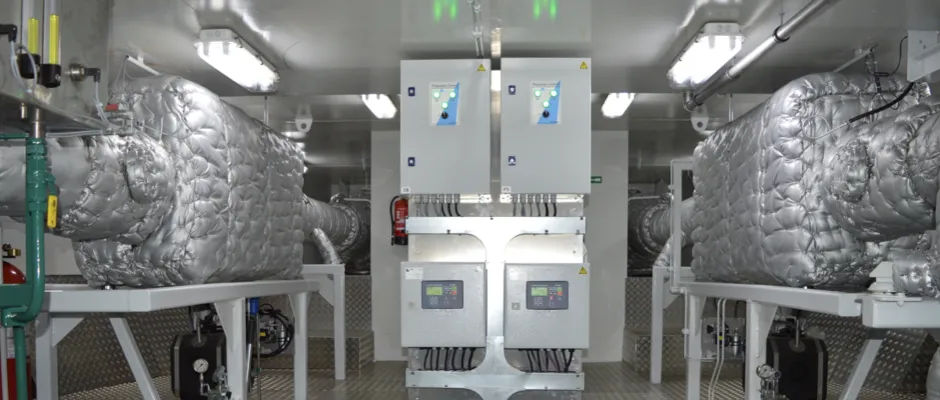
Emission Stability and Configuration Risks of SCR Systems for Ships
Author: Jeroen Berger • Publication date:
SCR systems for ships become technically vulnerable once temperature, flow behaviour, urea mixing and reaction time no longer remain stable together under real operating conditions. This becomes especially visible on existing ships, workboats, offshore support vessels and compact newbuild vessels where exhaust aftertreatment must function inside limited engine room space, fluctuating engine loads and exhaust gas routing that retains little thermal reserve.
For shipping companies, shipowners, technical managers and superintendents, the real risk does not begin at complete system failure but once NOx reduction becomes less reproducible while engine operation, propulsion and operational availability continue functioning normally. In practice, that instability often starts subtly. NOx trends begin drifting slowly during low-load operation, operators manually correct urea dosing more frequently and thermal recovery after manoeuvring takes noticeably longer than during earlier operating periods.
The next step then becomes assessing the SCR system as a complete emission chain, where exhaust gas temperature, mixing quality, pressure loss, residence time and installation layout must all be evaluated within the same operating profile.
Within the broader framework of SCR Systems for Ships, this cluster page forms the technical foundation layer for emission stability. The SCR reactor is not treated separately from the engine, exhaust gas routing, urea injection, mixing section, DPF system integration, thermal management or maintenance accessibility. It is precisely that interaction that determines whether exhaust aftertreatment retains sufficient thermal stability and flow consistency under low-load operation, manoeuvring, standby conditions or fluctuating power demand to support reproducible NOx reduction.
From that technical foundation arises the need to later evaluate irregularities within Emission Validation and Performance Limits of SCR Systems for Ships. Once emission stability begins deteriorating over longer operating periods, the assessment shifts towards Emission Compliance, Retrofit and Degradation of SCR Systems for Ships. Only after that does the broader decision-making process around market access, investment capacity, residual value and lifespan extension move into Commercial Deployability and Investment Pressure Around SCR Systems for Ships.
This page therefore positions itself as the starting point of the complete emission architecture. First, it must become clear when an SCR system begins behaving unstably due to configuration limits, heat loss, flow disturbance or insufficient reaction time. Only after that can emission measurements, retrofit decisions, maintenance strategy or investment choices be assessed reliably.
The underlying articles examine individual phenomena such as low exhaust gas temperature, crystallisation, limited engine room space, incorrect urea mixing, pressure loss, combined exhaust aftertreatment and insufficient residence time. At first glance, those issues appear different. Technically, however, they converge around one central question: does the SCR system retain sufficient thermal, flow-related and chemical stability under real operating conditions to keep NOx conversion reproducible?
That is where the value of this technical layer lies. Not every emission problem begins inside the catalyst itself. Instability often develops earlier in the conditions under which exhaust gas, urea, ammonia formation and catalyst surfaces must interact. Particularly inside engine rooms where maintenance windows remain short and load fluctuations follow each other rapidly, such early warning signs often appear long before formal alarm conditions develop.
When Does Exhaust Gas Temperature Move Outside the Stable Reaction Range?
Low exhaust gas temperature becomes critical once the SCR system structurally retains too little thermal energy to fully evaporate urea and maintain stable catalytic reaction behaviour. The engine itself continues operating normally while the exhaust aftertreatment system loses the thermal reserve on which reproducible NOx conversion depends.
On existing ships, this becomes especially visible during prolonged low-load operation, manoeuvring or standby conditions. Exhaust gas increasingly reaches the reactor outside its stable temperature range. Urea reacts less completely, deposits begin forming around injectors and mixing sections and reactor zones become loaded less evenly. In practice, temperature-related alarms often first begin returning sporadically during waiting periods or slow sailing operations before structural emission instability becomes visible.
The deeper analysis appears in When Does Low Exhaust Gas Temperature Cause SCR System Failure on Existing Ships. That article explains why SCR failure is often not a sudden component defect but the result of gradually losing thermal continuity throughout the entire exhaust gas system.
When Does Structural Sensitivity to Crystallisation Develop?
Low-load operation causes crystallisation once limited engine load persists long enough for the exhaust gas system to cool thermally. A brief temperature drop may remain manageable, but prolonged low-load operation makes injectors, mixing sections and reactor inlets increasingly vulnerable to solid urea deposits.
On board, this initially often remains subtle. An injector requires attention slightly earlier, NOx readings fluctuate mildly and cleaning intervals slowly move forward. Underneath, however, the reaction environment changes. Urea distribution becomes less homogeneous, colder zones retain deposits more easily and new fouling develops faster in the same locations. Operators sometimes first notice this through increasing urea consumption or recurring fouling around the same injector position during maintenance rounds.
The technical analysis appears in When Does Low-Load Operation Cause Crystallisation in Marine SCR Systems. There, crystallisation is not treated as an isolated maintenance issue but as a signal that operating profile, thermal reserve and SCR configuration are no longer sufficiently aligned.
When Does Engine Room Space Begin Limiting Emission Stability?
Limited engine room space becomes critical once reactor positioning, mixing length, piping layout, insulation and maintenance accessibility can no longer all remain achievable simultaneously. The SCR system still physically fits inside the vessel while retaining too little operational margin under real load conditions for stable temperature behaviour and homogeneous flow distribution.
This becomes especially visible in workboats and offshore support vessels. Tugboats, multicats, dredgers and crane vessels combine compact engine rooms with fluctuating operating loads. Spatial compromises therefore appear more quickly through recurring temperature deviations, increasing pressure loss, fouling around injectors and less reproducible NOx values. At the same time, operational pressure grows because inspections and cleaning increasingly must be planned inside short maintenance windows.
The deeper analysis appears in When Does Limited Engine Room Space Prevent a Stable SCR System in Workboats. That article shows why limited space is not merely an installation issue but a direct condition affecting emission stability itself.
When Does Mixing Quality Become Critical for Reproducible NOx Reduction?
Urea mixing becomes decisive once ammonia, exhaust gas and temperature no longer remain sufficiently homogeneous before reaching the reactor. The catalyst may theoretically retain enough capacity while certain reactor zones receive too little reactive loading and other zones become increasingly vulnerable to ammonia surplus, local deposits or fouling.
On retrofit installations aboard existing ships, that sensitivity often develops because of short mixing sections, bends, diameter transitions or asymmetrical inlet flow. Under stable operating load, the system may still perform acceptably. During fluctuating operation, NOx measurements, urea consumption and maintenance behaviour become significantly more unstable. In practice, this increasingly results in small dosing corrections or recurring discussions between operators and technical departments about inconsistent measurement trends during similar load conditions.
The deeper analysis appears in How Does Incorrect Urea Mixing Cause Unstable NOx Reduction in SCR Systems on Existing Ships. There, the root cause is not primarily sought in reactor capacity itself, but in the metres upstream of the reactor where mixing quality, flow behaviour and temperature converge.
When Does Flow Resistance Begin Disturbing Emission Stability?
Pressure loss becomes an emission problem once increasing flow resistance alters exhaust gas distribution through the mixing section, reactor and catalyst. The installation remains technically operational while exhaust gas increasingly seeks zones of lower resistance, causing reactor loading to become less uniform.
That process usually develops gradually. Crystallisation, deposits, fouled reactor inlets and partially obstructed flow channels collectively increase resistance inside the exhaust gas system. Later, NOx measurements become less reproducible and emission values respond more strongly to small changes in engine load or temperature. Such deviations often first become visible during higher load peaks or after extended operating periods without major cleaning work.
The deeper explanation appears in When Does Pressure Loss Cause Unstable Emission Performance in Marine SCR Systems. That article demonstrates why pressure loss is not merely a flow parameter but a system-level signal of declining emission stability.
When Does Combined Exhaust Aftertreatment Lose Thermal Stability?
Combined exhaust aftertreatment becomes sensitive once the SCR reactor, particulate filter, regeneration behaviour and additional emission technologies must share the same limited thermal margin. Each component may appear logically designed individually while the combined system retains too little stability to maintain temperature, flow behaviour and reaction consistency.
On newbuild vessels, this tension especially develops inside compact emission architectures. Particulate filter regeneration, pressure loss, heat distribution and SCR reaction behaviour all influence one another within the same exhaust gas line. Under fluctuating load conditions, small thermal shifts can therefore directly affect NOx conversion, regeneration behaviour and reactor stability. In practice, operators often respond by deliberately scheduling regeneration periods outside peak load or manoeuvring operations.
The deeper analysis appears in How Does Combined Exhaust Aftertreatment Cause Thermal Instability in SCR Systems on Newbuild Ships. That article approaches combined emission chains not as separate components but as one thermally interconnected system.
When Does Reaction Time Become a Limitation for NOx Conversion?
Residence time becomes critical once exhaust gas, ammonia and catalyst surfaces retain too little effective reaction time to maintain stable NOx conversion. The reactor may appear physically present and theoretically large enough while the gas stream in reality moves too quickly or unevenly through the system.
On existing ships, this strongly depends on reactor length, gas flow rate, mixing section design, engine room space and piping configuration. Under favourable load conditions, the system may still achieve acceptable values. During fluctuating operation, manoeuvring or high gas flow conditions, sensitivity to limited reaction time increases far more rapidly. Measurement drift and unstable NOx readings often first appear during short load transitions where temperature and flow behaviour receive insufficient time to regain thermal balance.
The deeper analysis appears in When Does Insufficient Residence Time Reduce NOx Conversion in SCR Systems on Existing Ships. That article explains why nominal catalyst capacity alone means little once reaction time, flow distribution and mixing quality no longer remain stable together under real operating conditions.
How This Cluster Forms the Technical Foundation for SCR Assessment
This cluster exclusively examines the technical conditions under which SCR systems for ships either maintain or gradually lose emission stability. Thermal continuity, urea mixing, pressure loss, residence time and installation layout are therefore not interpreted as isolated fault points but as interconnected factors within the same emission chain.
For shipping companies, shipowners, technical managers and superintendents, this forms the first technical assessment layer before emission measurements, retrofit decisions, maintenance planning or strategic deployability can be evaluated reliably. First, it must become clear whether the SCR system retains sufficient thermal stability, flow consistency, mixing quality and reaction time under the vessel’s actual operating profile to support reproducible NOx reduction.
Within that broader relationship, the page on SCR Systems for Ships remains the overarching framework in which technical stability, validation behaviour, retrofit limits, maintenance pressure and commercial deployability ultimately converge as one integrated emission architecture.