

When Does Limited Engine Room Space Prevent a Stable SCR System in Workboats?
Author: Jeroen Berger • Publication date:
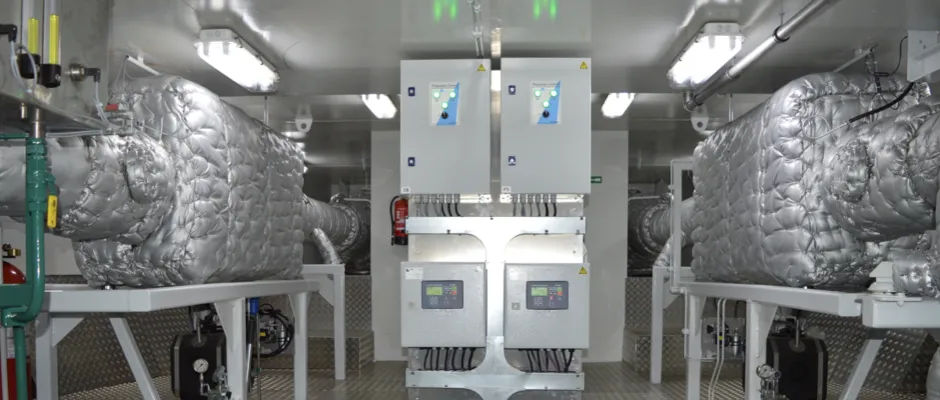
Within workboats, SCR instability rarely develops because the reactor theoretically lacks sufficient capacity. Far more often, the problem begins once the available engine room space forces the emission system into spatial compromises that no longer remain thermally and flow-wise stable under real operating conditions.
The installation still just fits within the available space, yet operationally begins reacting increasingly nervously once engine load, temperature and flow continuously fluctuate during day-to-day deployment.
For shipping companies, shipowners, superintendents and technical managers, the assessment therefore gradually shifts from theoretical emission capacity towards practical system sustainability inside a compact engine room. During engineering, an SCR installation may appear entirely logical, while months later the same configuration begins developing recurring emission deviations, thermal instability and increasing maintenance pressure under the vessel’s real operating profile.
That risk becomes especially visible in the workboat sector. Tugboats, offshore support vessels, multicats, dredgers and crane vessels frequently combine compact engine rooms with strongly fluctuating load profiles. Exhaust aftertreatment must therefore be integrated around existing installations, pipe routes, auxiliary systems and maintenance paths that were never originally designed for extensive SCR configurations, meaning the real system limit usually does not appear during design itself but only later during actual vessel operation.
Why Engine Room Space Directly Affects Emission Stability
An SCR system only functions stably when reactor position, mixing length, pipe routing, insulation and thermal behaviour align sufficiently with one another. Once limited engine room space restricts that configuration freedom, installations more quickly emerge in which exhaust gas no longer reaches the reactor under stable conditions.
In compact workboats, that often begins early in the retrofit process. Space around the main engine is largely fixed, exhaust gas lines can only be relocated to a limited extent and maintenance access must remain available between existing systems.
As a result, the reactor regularly ends up in less favourable positions inside the engine room: sometimes further away from the engine, sometimes closer to cold structural sections and sometimes in locations where insulation or mixing length can only be implemented partially.
Individually, those compromises often appear manageable. Together, however, they slowly begin changing the thermal behaviour of the entire emission chain.
During sea trials, that effect often remains limited at first. Under stable load conditions, many configurations initially perform acceptably. Under real working conditions, however, heat loss, flow disturbance and thermal instability gradually begin building structurally into the system.
The installation may appear technically integrated correctly while the operational margin within which SCR should remain stable slowly disappears.
Why Reactor Positioning Becomes So Critical in Workboats
Within SCR systems, the distance between engine and reactor directly determines how much thermal energy remains available before catalytic conversion takes place. The greater that distance becomes, the greater the risk of temperature loss inside the exhaust gas path, creating difficult trade-offs inside compact workboats between available space, maintenance access and thermally stable positioning.
The thermally ideal reactor position is often physically impossible within the available engine room layout. Existing pipe routes, deck structures, maintenance zones and safety clearances limit the freedom to place the reactor in the most stable position.
As a result, configurations emerge that appear structurally logical while operationally reacting far more sensitively to low-load operation, manoeuvring or prolonged standby conditions.
That becomes especially visible in older retrofit projects. Reactors are sometimes positioned relatively close to outer bulkheads, poorly insulated compartments or cold pipe zones, causing heat loss during prolonged low-load operation to increase more rapidly than originally expected during engineering.
The reactor remains available while operating increasingly close to the edge of its stable temperature range. On board, that difference usually only becomes noticeable later: first through slight temperature fluctuations, then through less reproducible NOx measurements and eventually through slowly increasing maintenance pressure around injectors, reactor zones and mixing sections.
The installation does not suddenly fail. Instead, it gradually loses thermal stability, making emission behaviour increasingly sensitive to load fluctuations that originally appeared manageable during design.
How Limited Space Degrades Flow Quality
Space limitations do not only affect thermal behaviour. Flow quality inside the SCR system also becomes disrupted more quickly once mixing sections, piping and reactor zones lose sufficient geometric freedom.
A stable SCR reaction requires time for urea evaporation, time for mixing and time for relatively homogeneous gas distribution before the reactor is reached. Compact engine rooms frequently lack that space, making short mixing sections, sharp bends, abrupt diameter transitions and asymmetrical pipe configurations unavoidable compromises.
Under stable load conditions, the system may initially cope reasonably well with those limitations. Under fluctuating operating profiles, however, those compromises begin reinforcing one another. A shorter mixing section makes ammonia distribution more sensitive, an additional bend disturbs flow and a compact reactor integration increases local temperature differences, causing the reactor to become progressively less evenly loaded during real working conditions.
That rarely appears immediately as one major malfunction. Far more often, smaller deviations appear first: fluctuating NOx measurements, recurring temperature warnings or reactor zones fouling more quickly than expected.
Only later does it become clear that no individual component forms the real problem. The issue lies in the limited spatial margin of the complete configuration.
Why Maintenance Access Is Often Taken Seriously Too Late
Within the workboat sector, maintenance access is still frequently underestimated during SCR retrofits. An installation may function correctly from an emission perspective while operationally becoming unstable once inspection, cleaning and corrective maintenance become practically difficult to perform.
That mainly occurs when injectors, reactor hatches, sensors or mixing sections remain only partially accessible between hot piping, existing structures and other engine room components.
Initially, that often remains manageable. Over time, however, operational pressure gradually increases because cleaning takes longer, inspections are postponed and smaller contamination remains present longer before corrective action takes place.
As a result, sensitivity to crystallisation, pressure loss and thermal disturbance increases further. Some installations therefore do not become technically defective immediately, but still develop progressively less stable emission behaviour because maintenance becomes practically difficult within the vessel’s working rhythm.
That becomes especially visible during intensive deployment periods. Configurations that appeared maintainable on paper prove operationally insufficiently accessible to remain stable over the long term.
Why Workboat Operating Profiles Expose Spatial Compromises More Aggressively
Workboats rarely operate under stable engine load. Thermal and spatial compromises inside compact SCR configurations therefore become visible far more quickly than under more constant deep-sea operating profiles.
Tugboats continuously switch between peak load and low power operation, offshore support vessels spend hours on standby during dynamic positioning and dredgers combine stationary operation with sudden power fluctuations, causing the SCR system to operate continuously around shifting thermal limits.
Once limited engine room space also forces suboptimal reactor positioning, short mixing sections or additional heat loss, situations develop more quickly in which the emission system no longer retains sufficient reserve to respond stably to those load fluctuations.
The difference between theoretical design load and real operating profile therefore often proves much larger in workboats than initially assumed. Some configurations appear fully acceptable during engineering calculations while only months later daily operation reveals how small the thermal margin actually became.
Which Signals Indicate Space-Related SCR Instability
Space-related instability usually develops gradually and is therefore often recognised late as a structural system problem.
The first signals remain subtle: fluctuating temperature measurements, increasing pressure loss and NOx measurements becoming less reproducible during manoeuvring or prolonged standby operation.
After that, maintenance behaviour begins changing. Injectors foul more quickly, reactor zones require more frequent inspection and cleaning intervals gradually shorten while smaller alarm notifications continue recurring under similar operating conditions.
During prolonged low-load operation, a slight ammonia slip odour may sometimes appear around sections of the exhaust path or heat may linger longer around compact pipe sections than previously observed during earlier operating phases. Individually, such observations may appear minor. Together, however, they frequently form the first operational pattern of thermal instability inside an excessively compact emission installation.
Meanwhile, the propulsion installation itself remains fully available, causing the underlying instability to be underestimated easily.
Operationally, the result is often an installation that technically continues functioning completely while retaining progressively less operational reserve to maintain stable emission performance during fluctuating deployment.
For superintendents, the pattern itself becomes the decisive factor. One deviation may remain incidental, but structurally recurring temperature deviations, increasing maintenance pressure and fluctuating NOx values far more often indicate configurations retaining insufficient spatial margin for stable SCR operation.
When Engine Room Space Becomes a Real System Limit
Not every compact engine room automatically causes emission problems. The operational limit usually develops once thermal restrictions, maintenance pressure and flow disturbance begin structurally reinforcing one another within the vessel’s real operating profile.
From that moment onward, the system loses predictable behaviour under normal working conditions. Maintenance intervals shorten, corrective interventions increase and technical teams spend steadily more time on cleaning, adjustment and interpretation of emission behaviour.
For vessels dependent on emission-related contract requirements, sustainability tenders or operation inside emission-sensitive areas, that instability eventually begins carrying commercial consequences as well.
At that point, the installation is no longer limited by catalyst capacity. The engine room itself becomes the limiting factor.
Why Limited Space Ultimately Becomes More Than a Retrofit Problem
Within the workboat sector, limited engine room space is still frequently treated as a practical installation problem that could be solved through more compact components or smarter routing.
In reality, operational SCR instability usually reveals something larger. The available spatial margin proves structurally insufficient to keep thermal behaviour, flow quality and maintenance reality stable over the long term within the vessel’s real working profile.
The limitation therefore does not exist solely in reactor volume or available square metres, but in the combined effect of heat loss, maintenance access, load dynamics and flow behaviour throughout the complete configuration.
For shipping companies, technical managers and superintendents, it therefore becomes increasingly important not to assess engine room space purely as an engineering question, but as part of the vessel’s operational stability itself.
Only once thermal behaviour, maintenance reality and the real operating profile are assessed together as one system does a realistic picture emerge of whether an SCR installation in workboats can remain stably deployable over the long term.
This Article Within the Series
Within Emission Stability and Configuration Risks of SCR Systems for Ships, this article builds on When Does Low-Load Operation Cause Crystallisation in Marine SCR Systems. Where that article showed how low engine load, incomplete urea evaporation and deposit formation can destabilise the SCR path, the discussion here shifts towards the physical integration of the system itself: reactor position, pipe routing, mixing length, insulation and maintenance access collectively determine whether exhaust aftertreatment remains stable under fluctuating working conditions in workboats.
The series then continues with How Does Incorrect Urea Mixing Cause Unstable NOx Reduction in SCR Systems on Existing Ships. After defining the spatial limits of compact engine rooms, the focus shifts towards mixing quality ahead of the reactor itself: whether urea, exhaust gas and temperature combine homogeneously enough under real operating conditions to maintain reproducible NOx reduction.
For shipping companies, shipowners, technical managers and superintendents, that sequence matters because space limitations only gain real significance once physical integration, flow behaviour, heat loss and maintenance reality are assessed together. Within that broader relationship, the page on SCR Systems for Ships remains the overarching framework in which engine room layout, configuration margins, mixing conditions and operational emission stability converge as one integrated emission architecture.