

How Does Combined Exhaust Aftertreatment Cause Thermal Instability in SCR Systems on Newbuild Ships?
Author: Jeroen Berger • Publication date:
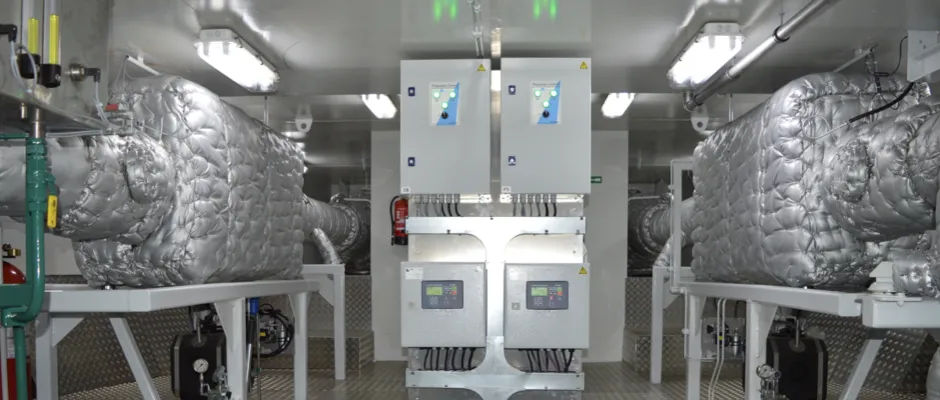
On newbuild ships, thermal instability inside SCR systems increasingly develops not because catalyst capacity is insufficient, but because several emission technologies become thermally dependent on one another inside the same exhaust gas line. Once SCR reactors, particulate filters, regeneration strategies and additional exhaust aftertreatment systems must operate together within one compact emission architecture, the system becomes more sensitive to small temperature shifts that gradually begin affecting the entire emission chain under real operating load.
For shipping companies, shipowners, technical managers and newbuild project teams, the assessment therefore shifts away from individual component performance towards the thermal manageability of the complete system. An SCR installation may appear fully correct during engineering for IMO Tier III or Stage V-related emission targets, while the same configuration still develops fluctuating NOx reduction, unstable regeneration or irregular temperature behaviour under real operating conditions.
That difference mainly develops on modern newbuild ships where emission systems are increasingly integrated into compact layouts around limited engine room space, short piping runs and high efficiency targets. Reactor position, insulation quality, heat distribution and flow routing then begin directly affecting the thermal stability of the complete emission system.
Installations that look highly efficient during design often retain less thermal reserve in operation than older, simpler exhaust gas configurations.
Why Combined Emission Systems React More Sensitively Thermally
An SCR system only remains stable when exhaust gas temperature, ammonia formation and flow behaviour stay sufficiently constant to support reproducible NOx conversion. Once several emission technologies begin relying on the same thermal margin, system stability changes fundamentally.
Combinations of SCR reactors and particulate filter systems make that sensitivity especially visible. A particulate filter affects not only pressure loss inside the exhaust gas line, but also heat distribution, gas velocity and temperature behaviour towards the SCR reactor. Regeneration cycles add another layer of thermal dynamics.
The result is an emission chain in which every load change produces several temperature responses at once.
During design calculations, that behaviour can still appear manageable. Under real operating conditions, however, small temperature losses begin carrying more strongly into NOx conversion, regeneration behaviour and reactor stability, making the thermal balance of the complete installation increasingly difficult to hold.
This is why systems that still perform acceptably under stable load can gradually become more sensitive to temperature fluctuations, emission deviations and regeneration issues once load conditions begin varying.
How Particulate Filters Disturb the Thermal Balance of SCR Systems
Within combined emission chains, particulate filters directly affect the thermal behaviour of the complete exhaust gas line. Every regeneration cycle changes heat loading, flow resistance and thermal distribution inside the system.
That creates a tension that often appears smaller during engineering than it becomes in service.
The temperature range favourable for stable SCR operation is not automatically the same range in which particulate filter regeneration proceeds efficiently and under control. During prolonged low-load operation, exhaust gas temperatures may become too low for stable NOx conversion while also leaving insufficient thermal energy for correct particulate filter regeneration.
Under higher load, the opposite problem can develop. Local temperature peaks then begin disturbing reactor loading, flow distribution and ammonia reaction again, causing different parts of the emission chain to influence one another thermally with increasing force.
This becomes especially visible on compact newbuild ships. The available thermal margin must be shared across several emission technologies at once, while engine room space, pipe routing and maintenance access become increasingly constrained.
A configuration that appears logical for both SCR and DPF system and flow behaviour temporarily move outside their stable operating range while propulsion continues functioning normally.
Those transition moments often create the first operational instability.
An installation can appear stable under continuous load while, under real operating conditions, it increasingly develops temperature deviations, regeneration issues or fluctuating NOx measurements. Often, this does not happen at maximum load, but during the constant transitions between operating states, where the system gradually starts losing its predictable thermal balance.
Some crews first notice it when regeneration takes longer than during commissioning, or when emission warnings mainly return during DP operations and short port rotations.
Why Compact Engine Rooms Reduce Thermal Reserve
On modern newbuild ships, exhaust aftertreatment is increasingly integrated closer around the main engine. That creates more compromises between available space, maintenance access and stable heat management.
Every additional reactor, pipe section or emission component affects heat distribution inside the exhaust gas line. Once installation space becomes limited, the risk increases that insulation, mixing length or reactor positioning can no longer be implemented optimally.
Combined SCR and DPF configurations are especially sensitive to this. A reactor position that appears logical from the engine room layout may still cause additional heat loss or unfavourable temperature distribution inside the emission chain under operating load.
That difference is not always fully visible during engineering. Only during daily operation do small thermal deviations begin accumulating into structural emission instability.
For newbuild project teams, this creates a difficult design problem. Compact emission integration reduces available thermal reserve while modern emission frameworks demand increasingly stable emission performance across a wider operating profile.
The technical question then quietly shifts from “does the system fit?” to “does the system retain enough thermal reserve once the vessel actually enters service?”
How Thermal Instability Slowly Creates Operational Pressure
Thermal instability inside combined emission systems rarely appears suddenly. Usually, the system first develops small deviations that remain operationally manageable for some time.
NOx measurements begin fluctuating slightly more. Regeneration cycles return more frequently. Reactor zones react more sensitively to load changes. Maintenance intervals slowly shorten.
That gradual character is exactly what makes combined emission problems deceptive.
For technical teams, the installation initially still appears manageable. The engine runs normally, emission values remain acceptable during individual measurements and faults remain limited.
Only later does it become visible that the system is becoming less thermally reproducible during daily operation.
Some crews first notice recurring temperature warnings during manoeuvring. Other installations develop fluctuating emission values during low-load operation or varying sailing speeds.
After longer winter operating periods, this often becomes sharper. Long low-load intervals, cold ambient air and hours of standby operation gradually pull away the thermal reserve before the first clear emission deviation appears.
The installation does not fail immediately. The thermal stability on which reproducible emission performance depended slowly begins to slip.
When Combined Exhaust Aftertreatment Reaches a System Limit
Not every thermal deviation immediately causes serious emission problems. The practical limit usually develops once heat loss, regeneration behaviour and flow disturbance begin structurally reinforcing one another inside the same emission chain.
From that point onward, the system loses thermal predictability under normal operating load.
The emission system then requires more frequent correction, cleaning or recalibration to maintain stable emission values. At the same time, sensitivity to load fluctuations continues increasing.
For shipping companies and technical managers, the situation therefore shifts from manageable emission technology towards operational system pressure. Maintenance burden and downtime risk increase, together with uncertainty around emission performance during inspections, contract validation or deployment inside emission-sensitive operating areas.
For newbuild ships that depend on stable emission performance within tenders, sustainability criteria or NECA-related deployment, that instability may eventually begin directly affecting commercial deployability.
That is where the real system limit of integrated exhaust aftertreatment appears: not when one component fails, but when the complete emission chain no longer retains enough thermal reserve to absorb operational variation in a stable way.
The engine remains available. Emission stability does not.
This Article Within the Series
Within Emission Stability and Configuration Risks of SCR Systems for Ships, this article follows on from When Does Pressure Loss Cause Unstable Emission Performance in Marine SCR Systems. Where that article showed how increasing system resistance and asymmetrical flow internally destabilize the reactor, the focus here shifts towards integrated emission chains in which SCR reactors, particulate filters, regeneration behaviour and additional aftertreatment systems must share the same limited thermal margin within one compact exhaust gas architecture.
From that thermal system layer, the series moves further into When Does Insufficient Residence Time Reduce NOx Conversion in SCR Systems on Existing Ships. Once it becomes clear how combined exhaust aftertreatment places temperature behaviour and flow stability under pressure, the next technical limit comes into view: the point where exhaust gas, ammonia and catalyst surfaces retain too little reaction time under real operating conditions to keep reproducible NOx conversion stable.
For shipping companies, shipowners, technical managers and newbuild project teams, that sequence matters in practice because emission instability inside modern newbuild ships rarely develops from one individual component. Far more often, instability gradually grows from temperature shifts, regeneration cycles, compact integration and declining thermal reserve inside the complete emission chain. Within that broader relationship, the page on SCR Systems for Ships remains the overarching framework in which thermal behaviour, emission integration, flow stability and operational deployability converge as one integrated emission architecture.