

How Does an ESD Reduce Fuel Consumption on Ships by Lowering Power Demand?
Author: Jeroen Berger • Publication date:
An Energy Saving Device (ESD) can save fuel because the ship needs less shaft power at the same speed. A Pre-Swirl Stator (PSS), Pre-Duct, Propeller Boss Cap Fins (PBCF) or Rudder Bulb can, under suitable conditions, improve the hydrodynamic interaction between the hull, propeller and rudder. The propulsion system therefore needs to deliver less mechanical power to achieve the same ship performance. How much fuel this saves then depends on the losses in the drivetrain and the engine's specific fuel consumption at the new operating point. A percentage reduction in the required shaft power therefore does not automatically lead to an equally large percentage fuel saving. On ships with a controllable pitch propeller, shaft generator or electric propulsion, the distribution of power between the machines involved also plays a role. In addition, the operational profile determines for how many operating hours the improvement is actually used. The fuel saving therefore results from the combination of lower hydrodynamic power demand, the efficiency of energy generation and the way the ship is operated.
Why Does an ESD Lead to Lower Shaft Power at the Same Speed?
To maintain a particular ship speed, the propulsion system must deliver sufficient force to overcome the opposing hydrodynamic and other relevant forces on the ship. For this purpose, the propeller receives mechanical power through the drivetrain. Some of that energy is converted into flow losses around the propeller and aftbody. An ESD is intended to limit certain losses or improve the hydrodynamic interaction between the propulsion components.
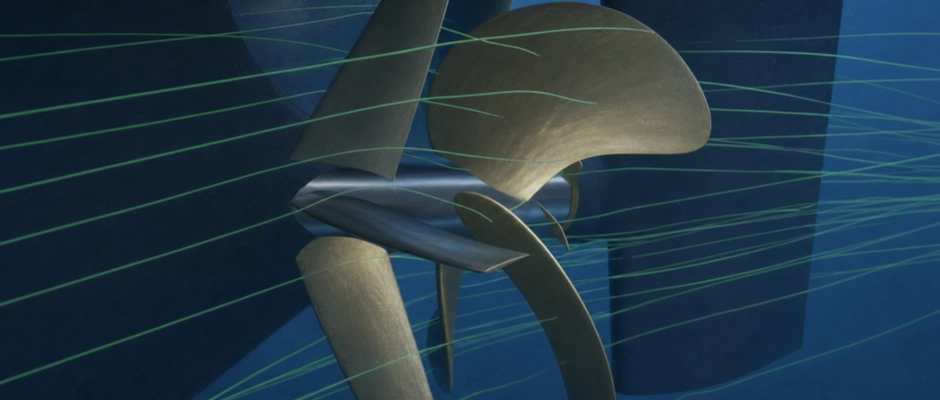
This can happen in different ways. A Pre-Swirl Stator changes the inflow direction of the water before it reaches the propeller, while a Pre-Duct influences the flow towards the propeller plane. A PBCF operates in the flow region around the propeller hub, and a Rudder Bulb influences the interaction between the propeller slipstream and the rudder. Although the operating principles differ, the final improvement must become apparent in the same quantity: the power that the complete propulsion system needs to deliver a particular ship performance.
It is not sufficient here for only the propeller to operate more favourably. A stator or duct itself generates hydrodynamic forces and can also change the forces on the hull and rudder. The net power reduction arises only when the combined operation of these components becomes more favourable at the same ship performance.
Lower shaft power demand is therefore not a direct fuel measurement, but a reduction in the mechanical energy that must be delivered to the propeller per unit of time. To link the saving to the ESD, this power demand must be compared at equivalent speed through the water, draught, trim and relevant environmental conditions. The condition of the hull and propeller must also be sufficiently comparable.
If the ESD actually requires less shaft power at the same ship speed, there is scope to reduce the power delivered by the propulsion system. How much fuel is saved by this is then determined by the engine, the drivetrain and any other parts of the energy supply system.
How Is Lower Shaft Power Translated into Lower Engine Power?
In conventional diesel-mechanical propulsion, the main engine delivers the mechanical power that is transmitted to the propeller through the drivetrain. If the propeller needs less power to achieve the same ship speed as a result of an ESD, the engine can also deliver less power.
The size of that reduction depends on the drivetrain. In a slow-speed two-stroke engine with direct propeller drive, power transmission is relatively straightforward. In a medium-speed engine with a gearbox, additional mechanical losses arise. Bearings and other drivetrain components can also absorb power. It must therefore be clear where the power has been determined. The engine's brake power is the mechanical power available at its output coupling. The power ultimately delivered to the propeller may be lower because of drivetrain losses.
A power measurement between the engine and gearbox therefore does not necessarily represent the same quantity as a measurement on the propeller side. If a shaft generator draws power from the drivetrain, the location of this power take-off can also make a difference. A measurement point before the shaft generator may include both propulsion power and the power for electricity generation.
For a reliable fuel calculation, it must ultimately be known how much brake power the combustion engine delivers. This is the power quantity to which the engine's specific fuel consumption generally relates.
When propulsion power decreases, the mechanical losses may also change. In an initial calculation, these losses can be approximated under suitable conditions using a drivetrain efficiency. For a more accurate assessment, it must be established whether that efficiency remains sufficiently similar at the new rotational speed and lower load.
Engine power is determined by the torque delivered and the rotational speed. If an ESD changes the propeller's operation, a different engine operating point may also arise. With a directly driven fixed-pitch propeller, for example, the new self-propulsion point may have a different rotational speed and torque. With a CPP, blade pitch and rotational speed can be combined differently.
As a result, the engine needs to deliver less mechanical energy per hour when the ESD operates favourably. However, how much fuel is saved has not yet been established. An engine does not convert the chemical energy in fuel into mechanical power with the same efficiency at every load. The lower engine power must therefore be linked to the specific fuel consumption at the original operating point and at the new one. The distinction between propeller power and engine power is necessary here to prevent drivetrain losses or power drawn by a generator from being attributed incorrectly.
Why Is Specific Fuel Consumption Decisive for the Final Saving?
Specific fuel consumption, or Specific Fuel Oil Consumption (SFOC), indicates how many grams of fuel an engine consumes per kilowatt-hour delivered. The usual unit is g/kWh. Multiplying the engine power in kW by the corresponding SFOC and dividing the result by 1.000 gives fuel consumption in kilograms per hour.
SFOC is not a fixed property that remains the same under all conditions. It depends on, among other things, the engine type, load, rotational speed and engine settings. An engine may start to operate more efficiently or less efficiently at lower power. Fuel demand must therefore be determined separately for both operating points.
A hypothetical example illustrates this. Suppose that, before installation of an ESD, a seagoing ship needs 5.000 kW of engine power at a particular speed. The specific fuel consumption at that operating point is 185 g/kWh. The main engine then consumes 925 kilograms of fuel per hour.
After installation, 4.800 kW of engine power is still required at the same ship speed. The power demand is thus 4 per cent lower. However, if the specific fuel consumption at the new operating point rises to 188 g/kWh, the fuel demand is 902,4 kilograms per hour.
The saving then amounts to 22,6 kilograms per hour, or approximately 2,4 per cent of the original fuel consumption. Engine power therefore falls by 4 per cent, but in this example the main engine uses only 2,4 per cent less fuel.
The values are purely illustrative. Both power values are engine outputs, with any relevant drivetrain losses already taken into account in the required engine powers. The SFOC values do not represent a particular engine model. It is also assumed that the same fuel with comparable properties is used in both situations.
The example shows why a fixed conversion factor between power saving and fuel saving may be insufficiently accurate. If SFOC instead becomes more favourable at lower load, the percentage fuel saving may exceed the relative reduction in engine power. With a less favourable SFOC, part of the hydrodynamic improvement is offset by less efficient energy conversion.
In exceptional cases, that offset may be so large that lower engine power demand saves hardly any fuel or does not even lead to lower fuel consumption. Whether this happens depends on the actual engine characteristics and the change in operating point. Lower power therefore provides a favourable starting point, but is not proof on its own of the size or even the existence of a fuel saving.
What matters in the assessment is the difference between the total fuel demand at the two operating points. Not SFOC alone but the product of engine power and specific fuel consumption determines how much fuel is needed per hour.
The relevant engine characteristics must be available for a calculation specific to the ship. It is important that the SFOC data correspond to the actual engine settings and the load and rotational speed range used. It must also be checked whether the new operating point is suitable for prolonged operation.
Catalogue values warrant attention here. The stated specific fuel consumption of a marine engine generally relates to defined reference conditions and a particular calorific value of the fuel. Actual onboard consumption may differ because of the fuel used, engine condition and operating conditions. If different fuels are compared, the fuel properties and the calculation basis used must be sufficiently well known.
The fuel saving from an ESD is therefore determined not only by the size of the hydrodynamic improvement, but also by the way the engine responds to that improvement.
When Does an ESD Deliver Fuel Savings per Hour and When per Nautical Mile?
Lower power demand can be used in different ways. The chosen mode of operation determines whether the benefit is most apparent in fuel consumption per hour, per nautical mile travelled or in the sailing time required.
If the ship continues to sail at the same speed, the engine can deliver less power. At a favourable new operating point, fuel consumption per hour decreases. Because the distance travelled per hour remains the same at the same speed through the water, the quantity of fuel per nautical mile through the water also decreases.
Take the hypothetical example with consumption of 925 kilograms per hour before installation and 902,4 kilograms afterwards. If the ship sails at 15 knots through the water in both situations, the calculated consumption falls from approximately 61,7 to 60,2 kilograms per nautical mile through the water. The percentage saving then remains equal to the reduction in fuel consumption per hour.
Another option is to use the available power improvement for a higher ship speed. If the engine maintains approximately the same operating point and fuel consumption per hour, the ship can cover more distance per hour. Fuel consumption per nautical mile may then decrease without consumption per hour falling to a comparable extent.
For consumption over a complete voyage, however, the actual distance, speed over the ground and sailing time required must be taken into account. Current, route choice and weather conditions can cause the relationship between speed through the water and distance travelled over the ground to change. A theoretical reduction per nautical mile through the water is therefore not automatically the same saving per nautical mile travelled over the ground.
Other energy consumers also play a role. A shorter voyage duration may mean that auxiliary systems need to run for fewer hours. If the ship arrives earlier because of a higher speed but then spends longer in port, part of that benefit may shift to a different operating period.
For a short-sea ship with fixed arrival times, it may be attractive to retain the original ship speed and convert the ESD improvement into lower fuel consumption. If time savings are more important operationally, a higher speed may instead have value.
A comparison at constant speed therefore answers a different question from a comparison at constant engine power. The saving must always be linked to the operating strategy for which the device is actually being assessed.
What Influence Do CPP, Shaft Generators and Electric Propulsion Have?
On a ship with a Controllable Pitch Propeller (CPP), an ESD can change the most favourable combination of propeller blade pitch and rotational speed. The fuel saving therefore depends not only on the power reduction, but also on control of the propulsion system.
If the original combinator curve is retained, the engine may reach a different load point than when blade pitch and rotational speed are optimized again. Because specific fuel consumption depends partly on these quantities, the two control strategies may produce different fuel outcomes.
A shaft generator adds a second power demand to the drivetrain. In Power Take-Off (PTO) operation, mechanical power is used to generate electricity. The power delivered by the main engine must then support both propulsion and electricity generation, taking the relevant conversion losses into account.
Suppose that the ESD reduces the required propulsion power while electrical demand remains the same. The main engine may then need to deliver less power, but the percentage reduction in total engine load is smaller than it would be if propulsion alone demanded power. The corresponding fuel saving again depends on SFOC at the new engine operating point.
In a PTO/PTI system, electrical power can also be added to the drivetrain. In Power Take-In (PTI) operation, part of the propulsion is provided by an electric machine. A reduction in the required propeller power can then lead to a lower load on the main engine, the electric machine or both, depending on the control system.
It must therefore be established where the power reduction occurs in practice. Lower propeller power does not automatically mean that only the main engine consumes less fuel. The electrical energy may, for example, be generated by auxiliary engines or come temporarily from a battery. If energy storage is used, the recharging required later must also be taken into account for a complete energy balance.
A similar question arises with diesel-electric propulsion. Under suitable conditions, an ESD reduces the mechanical power that the propulsion motor must deliver to the propeller. Through the electric motor, power electronics and generators, this affects the electrical power demand.
The fuel saving then depends on the efficiency of these conversions and the load distribution among the running generator sets. If lower propulsion demand makes it possible to take a generator set out of service, the improvement may differ from that achieved when the same generators continue to run at a slightly lower load. The SFOC characteristics of the remaining generator sets also matter.
Lower electrical power demand also does not always lead directly to the same percentage fuel saving. In a hybrid installation, temporary changes in battery charge or the use of different energy sources can distort the result if only a limited measurement period is assessed. The fuel calculation for a complex propulsion system must therefore be carried out on the basis of the complete relevant energy balance. The ESD reduces hydrodynamic power demand; the configuration and control of the propulsion system determine how this benefit is translated into fuel consumption.
How Is the Fuel Saving over a Voyage or a Full Operating Year Calculated?
An ESD does not deliver the same power improvement under every operating condition. The engine's specific fuel consumption may also change with load. The annual fuel saving therefore cannot be determined reliably by applying the highest predicted ESD percentage to the entire annual consumption.
For a representative annual calculation, the main sailing conditions are assessed separately. A bulk carrier may, for example, sail laden for a large proportion of its operating hours and also spend extended periods in ballast. The draught, propeller loading and possibly the hydrodynamic contribution of the ESD differ between the two conditions.
For each relevant operating point, it is first determined how much shaft power the ship needs with and without an ESD. It is then established which engine or generator power corresponds to this and how much fuel the machines involved consume. The difference in fuel consumption per hour is then multiplied by the number of operating hours in which those conditions occur. Combining the results for the different operating points gives an estimate of the fuel saving over the sailing periods under investigation.
Unfavourable operating points must also count. If an ESD offers no benefit under certain conditions or instead increases power demand, this reduces the total energy saving. Omitting such operating conditions could give an overly favourable picture of annual performance.
Care must be taken to ensure that the same underlying assumptions are used for both configurations. If the ESD is assessed at constant ship speed, the operating hours for the sailing conditions concerned can generally be kept the same. If the ESD is used to sail faster, the sailing time and possibly the distribution of operating hours change. Fuel consumption over the complete voyage must then be recalculated.
The ship's total annual fuel consumption also warrants a separate assessment. During port stays, loading and unloading, and other periods without propulsion, auxiliary engines or other systems may continue to consume fuel. These components of fuel consumption do not automatically decrease when the ESD causes the propeller to require less power.
A reduction of, for example, 3 per cent in propulsion fuel therefore does not necessarily mean 3 per cent less fuel for the whole ship. The balance between propulsion, electricity generation and other consumers determines the overall result.
In installations with a shaft generator, PTO/PTI or diesel-electric propulsion, the actual energy distribution must also be taken into account. A change in generator load can affect the fuel consumption of the machines involved, even when the electrical demand for other ship functions remains the same.
The annual calculation must therefore match the actual operational profile and the chosen operating strategy. The result is the difference between the expected fuel demand of the ship with and without an ESD under the same relevant operating assumptions, not a simple multiplication of a hydrodynamic saving percentage by total annual consumption.
When Can the Fuel Saving Actually Be Attributed to the ESD?
Lower power demand provides the hydrodynamic basis for fuel saving. To establish how much fuel an ESD actually saves, it must also be known how the engine and any coupled energy supply systems respond to that change.
Measurements of shaft power, engine rotational speed, fuel consumption and relevant electrical power flows can be used for this purpose. The measurement data must relate to sufficiently comparable ship conditions and to the same defined energy supply system.
The distinction between power and fuel measurements remains important. Lower shaft power shows that less mechanical energy is needed for propulsion. Lower fuel consumption shows that energy generation requires less fuel. The relationship between the two changes depends on engine load, specific fuel consumption and the other energy flows.
If, for example, an ESD is installed during dry-docking and the propeller is polished at the same time, the measured fuel consumption afterwards may be lower because of both measures. Changed engine control or load distribution among generators can also have an influence. The entire difference must then not be attributed solely to the ESD without additional substantiation.
A suitable reference therefore remains necessary for the separate ESD contribution. If a directly comparable measurement without an ESD is missing, hydrodynamic calculations and engine characteristics can help estimate the fuel saving. The outcome then remains dependent on the assumptions and uncertainties involved.
The accuracy of the fuel data warrants attention here. A small expected saving may be difficult to demonstrate when the measured consumption difference is comparable to the uncertainty of the fuel measurement or the corrections applied.
With fuel meters, it must be clear which engines are being measured and whether the recorded flow rate actually represents consumption. Depending on the fuel system, the return flow may need to be taken into account for this purpose. Where necessary, volume measurements must also be converted to fuel mass using the correct density and temperature. The calibration of the measuring instruments and synchronization with power and operating data affect the reliability of the comparison.
If different fuels or measurement periods are compared, the fuel quality and calorific assumptions must also be sufficiently well known. A difference in measured kilograms of fuel per hour may partly relate to a different energy content of the fuel used and therefore need not have been caused entirely by the ESD.
In a hybrid or diesel-electric installation, the condition of the energy supply system must also be sufficiently comparable. Lower fuel demand during a short measurement period may, for example, result partly from temporary battery discharge. Without accounting for the additional energy generation required, the final saving is then overestimated.
For a technical manager, it is particularly important that the reported saving remains identifiable as a reduction in shaft power, the main engine's fuel consumption or the ship's total consumption. These percentages are not interchangeable without further calculation.
An Energy Saving Device leads to fuel savings when the lower hydrodynamic power demand is translated into lower fuel demand from the engines or generators involved. At the same ship speed, the propulsion system can then operate with less mechanical power. How large the final saving is depends on the specific fuel consumption at the new operating point, drivetrain losses and the other energy consumers. By linking these factors to the operating conditions that actually occur, it can be established how much fuel the ESD is expected to save per hour, per voyage and over the operating year.
This Article Within the Series
Lower fuel demand can also contribute to an improvement in operational CII, while different technical assumptions apply to EEXI. For the investment decision, what then matters is how the expected saving across the operational profile relates to the costs and payback period of an ESD retrofit. This assessment forms part of the economic assessment of ESD investments.