

When Are Additional Measurements Needed Alongside CFD to Verify ESD Performance?
Author: Jeroen Berger • Publication date:
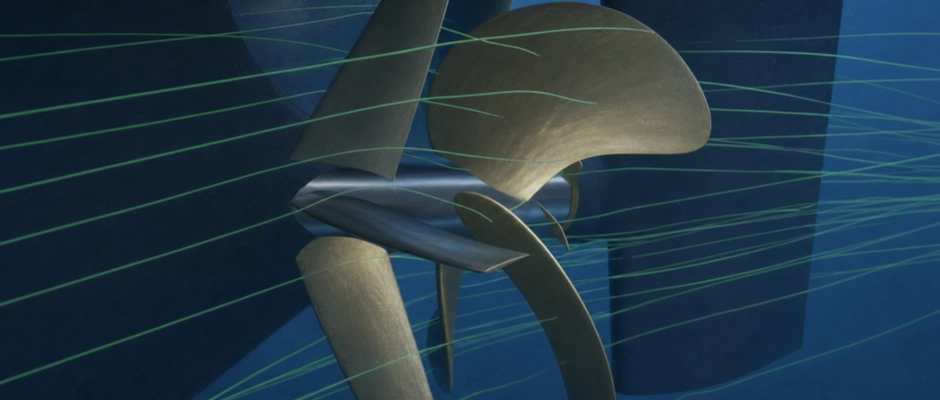
Additional measurements alongside Computational Fluid Dynamics (CFD) are needed when the calculations and existing validation data provide insufficient certainty about the operation, power saving or technical suitability of an Energy Saving Device (ESD). CFD can predict how a Pre-Swirl Stator (PSS), Pre-Duct, Propeller Boss Cap Fins (PBCF) or Rudder Bulb changes the flow around the propulsion system. The reliability of that prediction depends on the models used, the available experimental substantiation and the accuracy that the design decision requires. Model tests can check the predicted propulsion performance under controlled conditions. Targeted flow and force measurements help establish whether the calculated hydrodynamic behaviour actually occurs, while specialized tests may be needed to investigate cavitation, pressure pulses or fluctuating loads. Full-scale measurements can then help confirm the predicted improvement under actual ship conditions. Not every ESD requires the same combination of research methods. Additional measurements are particularly useful when an uncertainty that is decisive for the design choice, technical approval or substantiation of the expected saving is reduced through those measurements.
When Does CFD Provide Sufficient Certainty for an Initial Design Choice?
CFD makes it possible to develop and compare ESD geometries without physically testing every variant. The calculations show how a different shape or position affects the flow, propeller loading and hydrodynamic forces. Less promising designs can thus be ruled out and promising versions optimized further.
For an initial design selection, this approach may be sufficient when the method used is suitable for the flow phenomena under investigation. For a Pre-Duct, for example, different profile shapes and positions can be investigated numerically. If the results clearly distinguish between the designs and the method is sufficiently reliable for this purpose, not every geometry needs to be tested separately in a towing tank.
However, the reliability must match the technical question. A CFD model that predicts the general inflow around the stern well does not necessarily also describe the vortex structures around the propeller hub with sufficient accuracy. A method suitable for exploring Pre-Duct positions may therefore fall short when comparing small performance differences between PBCF designs.
A distinction must be made here between numerical verification and physical validation. Verification investigates whether the calculated solution is sufficiently accurate for the chosen mathematical model, for example by assessing the influence of mesh refinement, convergence and, in time-dependent calculations, the time step. Validation concerns the agreement between the model prediction and reality. Experimental data are needed for this.
Those experimental data do not need to be collected afresh for every project. Earlier model tests or measurements can support the reliability of a method when the geometry, operating conditions and governing flow phenomena are sufficiently similar. However, the validity of that substantiation must be appropriate to the new design. Good agreement for an original propeller configuration, for example, does not automatically prove that the same prediction accuracy is maintained when an ESD introduces new flow phenomena.
A numerically stable calculation is therefore not proof on its own of a correct performance prediction. Conversely, a CFD method that has previously been sufficiently validated need not be supplemented with project-specific tests for every new application. The available evidence base, the size of the predicted difference and the consequences of a possible prediction error determine how much additional certainty is needed.
Which Uncertainties Make Additional Measurements Necessary?
The first question is where the uncertainty comes from. Not every deviation in a CFD result calls for a model test. Sometimes reliable ship data are missing, sometimes the numerical solution is insufficiently accurate, and in other cases the main uncertainty is whether the chosen flow model describes the relevant physics correctly.
In a retrofit, for example, it may emerge that the actual propeller hub or rudder position differs from the available drawings. If a PBCF or Rudder Bulb is developed on the basis of those data, the calculation may assume an incorrect geometric fit. An additional inspection or a 3D scan is then likely to provide more value than a more accurate CFD calculation of the original model.
A different situation arises when the numerical results are sensitive to the chosen calculation settings. If a more refined calculation produces a substantially different prediction of propeller torque or ESD forces, the numerical uncertainty must first be investigated. A model test can provide additional information about the actual performance, but does not remedy the shortcoming in the numerical solution.
Experimental measurements become more important when the physical prediction itself remains uncertain. This can happen, for example, when the inflow to a Pre-Swirl Stator is not described sufficiently well or when the local hub flow governs the predicted PBCF result. In such cases, flow and force measurements can help establish whether the model represents the relevant effects correctly.
That importance becomes apparent in comparative research into CFD predictions for the same Pre-Swirl Duct. Different calculation methods produced varying predictions of the power improvement, including both favourable and unfavourable results. The representation of the wake field and the operating propeller proved particularly influential. An accurately calculated initial configuration therefore does not automatically provide sufficient certainty about a small predicted ESD saving.
The size of the expected performance difference also matters. If two designs yield almost the same calculated power saving, the ranking may be sensitive to small model deviations. An additional test can be valuable when a reliable determination of that difference actually leads to a different design choice.
That is not always the case. If two geometries perform similarly within the prediction uncertainty and one version is clearly simpler structurally, an extensive experiment does not necessarily offer more value for the decision. The situation is different when the uncertainty concerns a possible cavitation problem or an unacceptable structural load. Additional substantiation may then be required, even when the calculated energy saving already appears convincing.
The nature and consequences of the uncertainty therefore determine the direction of the investigation. Missing geometric data call for inspection or measurement, numerical errors for further verification, and insufficiently substantiated flow predictions for suitable experimental validation. In this way, situations in which expensive tests are carried out without the decisive uncertainty being reduced as a result are avoided.
When Do Model Tests and Flow Measurements Add Value?
Model tests are particularly valuable when the predicted propulsion performance must be investigated experimentally under controlled conditions. During a self-propulsion test, it can be established how the ship configuration operates with and without an ESD, and which rotational speed and torque the model propeller needs at the operating point under investigation. The results support the assessment of the overall hydrodynamic improvement. The relevant scale effects and extrapolation methods must then be assessed for full-scale application.
If a device, for example, improves the propeller inflow but itself generates unfavourable forces, the combined effect must appear in propulsion performance. An isolated favourable change in the flow is insufficient evidence of this.
Force measurements on the ESD can then explain why the overall performance changes. For a Pre-Duct, an assessment can be made of which force develops on the duct profile and how the propeller responds to it. For a Pre-Swirl Stator, the forces on the stator fins can be related to the changed propeller loading. The individual measurements thus help explain the contribution of the different components.
For co-rotating hub devices, it must be clear which forces and moments are already included in the measurement of the complete propeller configuration. When a PBCF is measured together with the propeller, the contribution of the hub fins may already form part of the recorded thrust and torque. Without a clear definition of the components being measured, the separate effect of those components may be misinterpreted.
Flow measurements answer a different question. With Particle Image Velocimetry (PIV), the speed and direction of the water can be determined in suitable measurement planes. Depending on the measurement arrangement, two or three velocity components are recorded. Using these measurements, an assessment can, for example, be made of whether a stator actually generates the predicted pre-swirl or how a Pre-Duct changes the velocity distribution towards the propeller.
Behind the propeller, measurements can provide insight into the propeller slipstream and vortex structures around the hub. For a PBCF, it can thus be assessed whether a predicted change in the hub vortex is actually visible. The measurement planes and the spatial and temporal accuracy must be appropriate to the phenomenon under investigation. A local flow measurement does not automatically confirm the total power saving.
For a useful experimental comparison, the correct inflow must also be reproduced. Particularly for ESDs that interact with the wake field around the stern, an incorrect distribution of velocity and flow direction can affect the measured operation. It is therefore important that the ship model or chosen test arrangement represents the relevant interaction with the operating propeller with sufficient reliability.
The choice between these measurements depends on what remains unknown. If the total power difference is uncertain, a propulsion test is the obvious choice. If the calculations predict an improvement but the explanation for it is doubtful, targeted flow or force measurements may be more suitable.
These approaches have been combined in research into a Pre-Duct with an internal stator, a Pre-Swirl Stator and hub fins. The forces and moments on the components under investigation were measured separately, while PIV made the flow in front of the propeller and devices, at their position and behind them visible. CFD was used to investigate the observed effects further.
The same extensive research programme need not automatically be followed for an individual ESD project. The added value arises when the chosen measurement checks precisely the aspect of the prediction that remains insufficiently certain for further development.
When Are Cavitation, Pressure or Vibration Measurements Needed?
Lower calculated power demand does not automatically mean that an ESD is technically suitable under all operating conditions. The device may change the loading on the propeller blades and the flow towards the rudder. Cavitation, fluctuating pressure loads and vibration may therefore also change.
If phenomena that govern technical suitability are not described with sufficient reliability by CFD, specialized investigation may be needed. The required measurements differ according to the problem.
Cavitation observations focus on the location, form and development of vapour formation in the flow. A Pre-Swirl Stator can change the blade loading in such a way that certain cavitation phenomena diminish, but can also cause unfavourable local loads under other operating conditions. For a PBCF, the cavitating hub vortex may be particularly relevant.
These phenomena can be investigated under controlled conditions in a cavitation tunnel or suitable reduced-pressure test facility. The inflow, propeller loading and pressure conditions must correspond sufficiently closely to the intended application. The cavitation number, advance coefficient and relevant propeller loading play a role in selecting representative test conditions. The properties of the test water, the presence of cavitation nuclei and scale-dependent phenomena can also affect the outcome.
The visible occurrence of cavitation does not automatically prove that a component will suffer erosion damage. If the possible erosive action governs technical suitability, additional erosion investigation may be needed. Among the aspects examined are the dynamic behaviour of the cavitation and the locations where the vapour structures collapse. Specialized model tests can help identify areas with an increased risk of erosion.
Pressure measurements answer a different question. Measurements of fluctuating pressure on the aftbody can, for example, show whether modified propeller inflow leads to different pressure pulses. This is relevant when the ESD changes the loading on the propeller blades or when higher pressure fluctuations pose a risk of onboard vibration and noise.
However, a measured pressure pulse is not the same as a measured structural vibration. The response of the ship structure also depends on its natural frequencies, damping and the transmission of fluctuating loads. If the consequences for the structure are critical, vibration measurements or an additional dynamic analysis may be needed.
The same applies to the ESD itself. A stator fin or duct profile may experience favourable hydrodynamic forces on average, while the fluctuating load governs the structural design. In that case, it must be established whether the calculated loads and the dynamic properties of the structure are substantiated with sufficient reliability.
Additional cavitation, pressure, erosion or vibration investigation is therefore particularly relevant when the phenomenon concerned forms a governing technical limitation. An average power saving may already have been predicted with sufficient accuracy, while separate certainty about cavitation behaviour or fluctuating loads is still needed for the final design.
Why Can Scale Effects Make Full-Scale Measurements Necessary?
Model tests make it possible to investigate an ESD under controlled conditions. However, the flow at model scale is not identical in every respect to that around the actual ship. An experimentally established improvement cannot therefore be transferred directly to full scale without further assessment.
In conventional ship model tests, similarity of the flow influenced by gravity is sought, in part through the Froude number. The ratio of inertial to viscous forces, described by the Reynolds number, cannot be kept the same at the same time. The development of the boundary layer along the hull therefore differs between the model and the actual ship.
This can be particularly relevant for ESDs. A Pre-Swirl Stator or Pre-Duct is located in the flow near the aftbody. If the velocity distribution and flow direction at the propeller plane differ at model scale, the device may operate under different conditions from those at full scale.
For a Pre-Swirl Stator, this affects the pre-swirl that the propeller receives. The forces on the stator profile may also differ. A Pre-Duct can be sensitive to differences in local inflow and boundary layer development. Around a PBCF, the Reynolds numbers of the hub fins and the characteristics of the local vortex structures also play a role.
These differences do not mean that model tests are unsuitable. However, the prediction for the actual ship requires a sound extrapolation. For devices that generate pre-swirl, changes in the axial and tangential inflow, among other things, must be distinguished. A scale correction that considers only a change in the mean axial inflow may misinterpret the influence of the generated pre-swirl.
An additional scaling challenge arises in cavitation tests. Alongside the inflow, the pressure conditions must also be sufficiently representative. At model scale, the Froude number, Reynolds number and cavitation number generally cannot all correspond simultaneously to the full-scale situation. The chosen test arrangement and the consequences of those differences must therefore be taken into account in the interpretation.
CFD calculations at model and full scale can help investigate how the flow changes when the scale is adjusted. Experimental methods in which a more representative wake field is reproduced can also provide additional information. Such methods have been used in original ESD research to improve understanding of the influence of scale effects.
Full-scale measurements become particularly valuable when the remaining uncertainty in extrapolation is important to the design decision or the expected saving. A sea trial can then help establish whether the predicted power improvement is achieved on the actual ship.
That measurement also has a defined scope. Agreement between calculated and measured power saving supports the performance prediction, but does not automatically prove that every local flow structure has been predicted correctly. Conversely, a discrepancy can have several causes, including scale effects, model uncertainty or differences between the actual and assumed ship conditions.
When Are Sea Trials Needed to Confirm the Predicted ESD Saving?
If a shipowner wishes to establish whether an ESD actually delivers the predicted power saving after installation, a controlled speed–power trial can provide the necessary experimental substantiation. The prediction is thereby checked against the performance of the actual ship.
The sea trial must correspond to the conditions for which the CFD prediction has been prepared. If a Pre-Swirl Stator has been developed for a particular draught and cruising speed, for example, the measurement must provide sufficient information to assess the performance under comparable conditions. A sea trial at a different propeller loading does not necessarily test the same predicted result.
The accuracy of the power difference is also decisive. A small expected ESD saving may be difficult to demonstrate when differences in speed, wind, waves and current require large corrections. The measurement arrangement, instruments and expected uncertainty must therefore be appropriate in advance to the performance improvement that is to be established.
Identical propeller rotational speeds are not necessary here. The ESD may change the operation of the propeller, so that a different rotational speed and torque are required at the same ship speed. The relevant comparison concerns the shaft power required under equivalent ship conditions.
Published research on a seagoing bulk carrier shows how sea trials and CFD can complement each other. For a Pre-Swirl Stator, targeted speed–power trials were carried out before and after installation. The results were compared with full-scale CFD calculations, with the geometry actually installed also being taken into account. This combination provided additional substantiation for the configuration under investigation.
The research does not provide a general saving guarantee for other ships. Its value lies mainly in the way a numerical prediction is linked to a carefully conducted performance measurement.
A sea trial must also have a suitable reference without an ESD to demonstrate the separate contribution. If the hull is also cleaned or the propeller repaired during the same dry-docking, the measured performance change may encompass several improvements. The total power difference may then have been established reliably without the separate ESD contribution having been demonstrated directly.
If a reference is missing, hydrodynamic calculations can provide support, but the separate ESD saving then remains partly dependent on that calculated initial condition. A model-assisted estimate must not be presented as a directly measured effect.
Recognized methods for speed–power trials help to carry out measurements and corrections in a verifiable manner. The scope and accuracy of the chosen method must be appropriate to the ship concerned and the expected performance difference. Even a sea trial conducted in accordance with a recognized method does not automatically prove that the measured improvement was caused solely by the ESD.
A sea trial becomes particularly important when full-scale performance actually needs to be confirmed, for example as part of agreed performance verification or when uncertainty in the scale prediction is decisive for the technical decision. Such a measurement is not necessary for the development of every individual design variant.
What Additional Value Does Performance Monitoring Offer During Operation?
A controlled sea trial investigates propulsion performance within a defined measurement range. During normal operation, however, a ship sails at varying speeds and under different loading conditions and environmental influences. Performance monitoring can help assess how performance develops under those conditions.
Operational data on, among other things, ship speed, shaft power, draught and propulsion settings are used for this purpose. For a Controllable Pitch Propeller (CPP), the blade pitch and associated control strategy are relevant. The data must be sufficiently accurate to identify comparable operating conditions and assess changes in power demand.
For a short-sea ship that regularly alternates between laden and ballast voyages, this can provide valuable information. An ESD may show a clear improvement at the usual cruising speed, while its contribution at a lower propeller loading differs. If a suitable reference is available, monitoring can help investigate whether the measured performance at different operating points agrees with the earlier predictions.
However, the interpretation calls for caution. Hull fouling, coating ageing and a changing propeller condition also affect power demand. If the ship needs more power a few months after installation, this does not prove that the ESD has become less effective. Nor does a favourable trend in fuel consumption demonstrate on its own how much of that trend is caused by the device.
The quality of the reference also remains important. Monitoring after installation can show how the current propulsion system performs, but without sufficiently comparable data for the situation without an ESD, the separate contribution cannot be established directly. That problem is not automatically solved by collecting more operational measurement data.
Performance monitoring therefore primarily complements a controlled sea trial when the development of propulsion performance over a longer period or under varying operating conditions needs to be investigated. The sea trial can provide a clear performance comparison at a limited number of operating points. Monitoring provides additional insight into operation during service, insofar as the available reference and data quality allow.
How Do You Determine Which Additional Measurement Is Actually Needed?
The choice of additional investigation starts with the technical question that still cannot be answered with sufficient reliability after the CFD calculations. It must be clear which outcome is needed to select a design, grant technical approval or confirm a predicted saving.
If the actual geometry is insufficiently known, inspection or a 3D scan is the obvious choice. Uncertainty caused by insufficient mesh refinement calls for additional CFD verification rather than a model test. If the predicted flow direction or force distribution remains doubtful, targeted PIV or force measurements may provide more value.
Uncertainty about overall propulsion performance requires a different approach. A self-propulsion test can help establish whether a design delivers the predicted improvement under controlled conditions. If cavitation characteristics or fluctuating pressure loads are particularly critical, specialized investigation in a suitable test arrangement is the more obvious choice. Where there is a possible risk of erosion, assessment of cavitation phenomena alone may be insufficient.
Additional scale analysis may be necessary for extrapolation from model to full scale. When it must ultimately be confirmed how much power the actual ship saves after installation, a controlled sea trial can provide the relevant information. Performance monitoring is then valuable when developments during prolonged operation also need to be assessed.
The choice also depends on the consequences of the uncertainty. If two ESD geometries perform almost equally and one version is structurally simpler, a costly additional test need not always lead to a better decision. If a measurement needs to establish whether a design meets critical cavitation or loading requirements, additional validation may be necessary before further engineering is justified.
The expected accuracy of the measurement must also be assessed in advance. An experiment that cannot distinguish a small performance difference with sufficient reliability may provide little decisive information. The research plan must therefore specify not only what is measured, but also which uncertainty is expected to be reduced by it and how the outcome affects the technical decision.
In certain projects, a sufficiently substantiated CFD prediction can provide the necessary basis for further development. In other cases, model tests, specialized measurements or sea trials are necessary to reduce a decisive uncertainty. The required depth of investigation depends on the available substantiation, the technical risks and the performance that needs to be demonstrated.
Additional measurements alongside CFD are therefore particularly needed when the predicted ESD operation, technical suitability or full-scale saving cannot be established with sufficient certainty. The appropriate measurement is chosen on the basis of the missing evidence. A targeted research approach thus emerges in which each additional test actually contributes to a more reliable design or a better-substantiated performance conclusion.
This Article Within the Series
Even when additional tests support the CFD prediction, the comparison basis for the measured ESD effect remains decisive for conclusions about the separate saving. The choice between calculations, model tests and full-scale measurements forms part of hydrodynamic design and performance validation of ESDs. During further development, the difference between ESD design for retrofit and newbuild also plays a role, because the available design freedom and ship structure determine how the device can be integrated.