

How Do You Compare an ESD Investment with Propeller or Rudder Optimisation?
Author: Jeroen Berger • Publication date:
An investment in an Energy Saving Device (ESD) is compared with propeller or rudder optimization by establishing which modification delivers the greatest technically and economically justifiable benefit for the same ship performance. A Pre-Swirl Stator (PSS), Pre-Duct, Propeller Boss Cap Fins (PBCF) or Rudder Bulb can reduce specific propulsion losses, while a modified propeller or a new rudder changes the operation of an existing main component. The measures may address different losses, but may also interact or partly exploit the same benefit. The alternatives must therefore be investigated from a common baseline configuration, with an equivalent technical condition and a representative operational profile. Alongside the net power saving, the implications for cavitation, manoeuvrability, structural implementation and maintenance also count. The work required and financial returns may also differ materially. The best investment is therefore not automatically the device with the highest individual saving, but the feasible configuration that delivers the greatest net benefit substantiated with sufficient reliability over the expected operating period.
Which Propulsion Losses Must the Investment Reduce?
A meaningful comparison starts by asking where the existing propulsion arrangement loses energy and which components actually offer room for improvement. A propeller may operate less efficiently because its geometry does not suit the current operational profile. Losses may also relate to flow around the propeller hub, unfavourable inflow from the stern or the interaction between propeller and rudder. These phenomena are connected, but do not necessarily require the same solution.
If a bulk carrier consistently sails more slowly than originally envisaged, the existing propeller may operate away from the operating point for which its blade geometry was developed. A modified pitch and loading distribution may then improve propulsion efficiency. In that case, the relevant problem lies not solely in the flow ahead of or behind the propeller, but potentially in the propeller geometry itself.
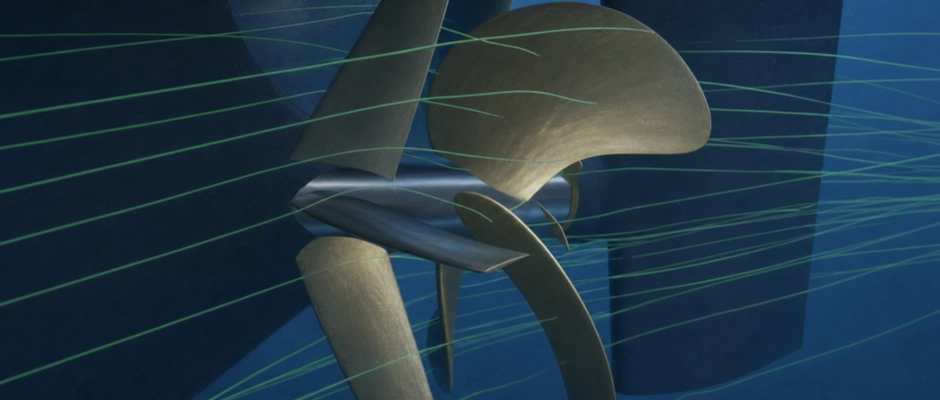
A Pre-Swirl Stator, by contrast, affects the direction of water flowing into the propeller. A Pre-Duct can change the flow to the propeller plane in a different way, while a PBCF affects flow around the propeller hub. A Rudder Bulb operates behind the propeller and is matched to the local flow between hub and rudder. These devices may enable additional improvements without the propeller or entire rudder always having to be replaced.
Rudder optimization addresses another aspect. The rudder’s shape partly determines how the propeller slipstream is used and which hydrodynamic forces arise during straight-ahead sailing and steering. A modified rudder profile may affect resistance, but also the flow direction behind the propeller, cavitation behaviour and available steering force.
The causes of a higher power demand must be carefully defined. A fouled hull or damaged propeller may impair performance without the original propulsion design being fundamentally unsuitable. If routine maintenance can reverse this deterioration, that recovery must be distinguished from the additional improvement that a new investment makes possible.
It is important here that losses cannot always be added directly from individual measured values. A change in propeller geometry may also affect flow and forces around the rudder. An ESD may likewise change propeller loading. The diagnosis must therefore not only identify the individual components, but also show where the relevant hydrodynamic interaction arises.
The initial design choice follows from an assessment of the propulsion arrangement in the intended maintenance condition. Only once the losses that remain are clear can a meaningful comparison be made of whether a stand-alone ESD, a new propeller or a modified rudder offers the most suitable point of intervention.
When Can Propeller Optimization Deliver More than a Stand-Alone ESD?
Propeller optimization may be more attractive if the existing propeller is a major constraint at the operating point at which the ship is now used. An Energy Saving Device can reduce certain hydrodynamic losses, but does not automatically change the geometry through which the propeller converts supplied power into thrust.
For a fixed pitch propeller, diameter, blade area, pitch distribution and geometric blade angles are among the features that may be modified. The load can thus be distributed differently across the propeller blades. Particularly if the current propeller no longer suits the usual speed or available engine load well, a redesign may offer opportunities that cannot be achieved to the same extent with a stand-alone ESD.
Design freedom is constrained by the available propeller space, required thrust, cavitation requirements and the drivetrain’s mechanical properties. A larger diameter or changed blade loading may appear hydrodynamically attractive, but must fit within the available clearances and the technical limits of the propulsion arrangement. Pressure pulses, vibration and required manoeuvring performance may also constrain the design choice.
For a Controllable Pitch Propeller (CPP), the way in which blade pitch and rotational speed are combined warrants attention first. A modified combinator curve may improve the combined efficiency of propeller and engine for the current operational profile without a new propeller being needed immediately. Whether this produces sufficient benefit depends on the existing blade geometry, engine characteristics and capabilities of the propulsion control system.
If the propeller is already well matched to the relevant operating range, further optimization may instead offer limited benefit. A Pre-Swirl Stator or PBCF may then be of interest to reduce remaining losses without replacing the entire propeller. Even then, whether the added device actually improves net propulsion performance must be established.
The choice becomes more complex if propeller replacement is already planned. A new propeller may then be developed to work with an ESD. The original propeller no longer automatically provides the right reference for the additional ESD contribution. It must first be established how a suitable new propeller performs without an ESD, and then what a device adds to that configuration.
The design variants must not be treated unequally. Comparing a fully optimized stator with a propeller geometry selected only provisionally may produce an incorrect ranking. Conversely, it is equally unsound to optimize a new propeller extensively and assess the ESD as an arbitrary addition that has not yet been matched.
Both alternatives must be technically credible and fit within the design freedom actually available for the investment concerned. If a different propeller is also developed for the arrangement with an ESD, it must remain clear that this is an integrated propulsion alternative.
Propeller optimization warrants particular attention if the propeller itself has substantial potential for improvement. A stand-alone ESD becomes more attractive if the existing propeller remains suitable and the additional device can specifically limit remaining hydrodynamic losses.
When Is Rudder Optimization an Attractive Alternative?
Rudder optimization becomes an option if the existing rudder geometry interacts unfavourably with the propeller slipstream or if a new design can reduce resistance without impairing the steering function. On many seagoing ships, the rudder is directly behind the propeller and is subjected to water flow whose speed and direction vary across its surface.
A conventional rudder profile need not be optimally matched to that local flow everywhere. With a twisted rudder, for example, the leading edge can be matched over its height to the local inflow direction. Depending on the design, this may change pressure distribution, flow separation and cavitation characteristics.
Research into twisted rudders shows that such a modification can improve cavitation characteristics and propulsion performance for specific ship configurations while manoeuvring characteristics remain intact. That outcome is not automatically transferable to other ships. The effect depends on factors including the propeller slipstream, rudder profile, propeller–rudder distance and rudder angles investigated.
The potential improvement must be assessed for the complete rudder operation. A more favourable profile during straight-ahead sailing is not automatically the best choice if it means the ship needs different rudder angles to maintain its course or if manoeuvring characteristics change. Resistance during normal course corrections may also contribute to operational energy consumption.
A Rudder Bulb is a particular case. This ESD is matched to the flow behind the propeller hub, but may also form part of a new rudder design. If a complete high-efficiency rudder with an integrated bulb is developed, the investment is not solely the addition of a stand-alone ESD. For a technical comparison, the alternative actually offered must therefore be established: a bulb on the existing rudder, a modified rudder without a bulb, or an integrated rudder structure whose geometry has been optimized jointly.
An entirely new rudder may offer additional possibilities, but also requires an assessment of the rudder stock, bearings, supports and steering gear. The existing plant must remain suitable for the changed hydrodynamic loads and required manoeuvres.
A distinction must also be made between a rudder that creates less resistance and one that uses the propeller slipstream more favourably. Both mechanisms may affect propulsion, but do not automatically produce the same result. The net power demand of the complete ship remains decisive for the comparison.
Rudder optimization becomes particularly interesting if the existing rudder demonstrably offers room for improvement or if replacement is already part of the maintenance schedule. For a rudder that functions well technically, a less extensive ESD retrofit may be more attractive, provided the remaining potential for hydrodynamic improvement is sufficiently substantiated.
How Do You Compare the Alternatives on the Same Performance Basis?
The alternatives must be compared against a baseline that has the same meaning for all investment options. For an existing ship, this is usually the propulsion configuration that would be used without the investment being investigated, including necessary maintenance work that is already planned.
If, for example, the hull will be cleaned and the existing propeller polished during the next docking, that work must not be attributed solely to the ESD variant. The performance reference must also represent an appropriate maintenance condition for the alternatives involving a new propeller or modified rudder.
Sufficiently developed configurations are then investigated: the existing propulsion arrangement, suitable propeller optimization, a stand-alone ESD, rudder optimization and possibly an integrated combination. Not every option needs to be calculated in full if its technical unsuitability is already evident in an earlier assessment. The alternatives that remain relevant to the investment must, however, be investigated at a comparable level of reliability.
For each alternative, it is established how much shaft power the complete ship needs at corresponding speed through the water, draught and trim. The relevant environmental conditions, technical condition and measurement or calculation method must also be sufficiently comparable. Power must be assessed at a corresponding position in the drivetrain.
The propeller need not operate at the same rotational speed, blade pitch or torque in every configuration. A different propeller or ESD may change the propulsion operating point. The comparison concerns the power each configuration needs to deliver the same ship performance.
A favourable open-water performance from a new propeller in isolation is insufficient. The actual inflow behind the ship and the interaction with the rudder affect total propulsion performance. A favourable force on an ESD profile also does not, on its own, prove that the complete configuration requires less power.
This is also evident with a PBCF. Experimental and numerical research on a propeller–rudder system has shown that the presence and design of the rudder can affect the net saving from the hub device. A result for the propeller with a PBCF without a rudder must therefore not be used as the saving for the complete ship without further assessment.
Computational Fluid Dynamics (CFD) and suitable model tests may be used to investigate the propulsion arrangement as an interacting whole. For small predicted differences, the uncertainty of the comparison is also important. An accurately calculated baseline configuration does not automatically prove that the difference between two alternatives has been predicted equally accurately.
For the financial comparison, the power results are linked to a representative operational profile. A design that performs favourably mainly at a rarely used speed may therefore save less energy annually than an alternative with a more modest improvement across the main operating conditions.
The permitted design freedom must also be clear. If a complete propeller–rudder system is redeveloped, that configuration must be compared with an appropriate alternative within the same technical and operational constraints. Otherwise, there is a risk that one solution appears more favourable because more freedom to optimize it has been allowed.
A fair comparison therefore does not require every component to remain identical, but does require each variant to represent a clearly defined and technically feasible alternative. Only then can the difference in propulsion performance be meaningfully linked to the associated investment.
Why Must Savings from an ESD and a New Propeller or Rudder Not Simply Be Added Together?
A new propeller and an ESD may each deliver a favourable power improvement, but the combined saving need not equal the sum of the two results. The measures change components of the same flow system.
A Pre-Swirl Stator, for example, affects the inflow direction at the propeller. If the propeller geometry subsequently changes, how the generated pre-swirl is used may also change. The existing stator may consequently provide more or less additional improvement than with the original propeller.
Effects may also overlap with rudder optimization. A new rudder with a modified bulb contour may reduce certain losses behind the propeller that are also affected by a stand-alone Rudder Bulb. If the two solutions partly address the same loss, a second measure may provide less additional benefit than predicted in isolation.
The reverse is also possible. Joint optimization may create new possibilities because the propeller, ESD and rudder are specifically matched to one another’s flow. The total improvement may therefore differ from that achieved by adding unchanged components separately.
To make that distinction clear, four configurations may be investigated for a bulk carrier: the original propulsion arrangement, a new propeller without a stator, the original propeller with a stator, and the new propeller with a stator. This comparison shows what propeller replacement delivers on its own and what the stator adds to each propeller configuration, provided the other relevant assumptions remain equivalent. An assessment may also be made of whether the combined improvement is greater or smaller than would be expected from the two separate measures.
If the propeller is then reoptimized for the arrangement with a stator, a different comparison arises. The difference from the new propeller without a stator may then describe the benefit of an integrated design choice, but not necessarily the stator’s individual effect on an otherwise unchanged propeller.
That distinction matters for an investment decision. A shipowner who only wants to add an ESD to an existing propulsion arrangement needs information about the additional saving from that device. If propeller and stator are replaced or designed together, the performance of the complete package must primarily be compared with the relevant alternatives.
The order in which measures are added may also affect the calculated additional contribution. A stator’s saving relative to the original propeller need not equal the saving from the same stator after the propeller has already been optimized. Both differences may be correct, but answer different technical questions.
The total improvement must therefore not be constructed by adding individual saving percentages without additional analysis. Each relevant combination must be assessed on its own combined propulsion performance.
Which Technical Constraints and Implementation Costs Affect the Choice?
A favourable hydrodynamic improvement is only part of the investment comparison. Implementation must also fit within the existing structure, available docking time and required technical approvals.
For propeller optimization, the available diameter, hull and rudder clearances, and the mechanical properties of the drivetrain may be decisive. A new propeller may call for additional checks of cavitation, pressure fluctuations, shaft loading and torsional vibration. If parts of the hub or shaftline are modified, the project scope may increase further.
A Pre-Swirl Stator or Pre-Duct particularly requires attention to the structural attachment to the stern. The supports must be able to transfer hydrodynamic loads safely without unacceptable deformation or fatigue problems. For a PBCF, the boss cap and mechanical attachment are important, while for a Rudder Bulb, the connection to the existing or new rudder structure must be assessed.
A complete rudder replacement may also affect the steering system and supporting structure. The assessment must therefore go beyond the predicted difference in shaft power. A configuration with favourable power performance remains unsuitable if the required safety, manoeuvrability or structural reliability cannot be sufficiently demonstrated.
The maintenance schedule may strongly affect the economic ranking. If a propeller needs replacing anyway, the benefit of a high-efficiency version is compared with an appropriate standard replacement propeller. The same applies to a new rudder that forms part of planned work.
If, however, the propeller and rudder remain technically serviceable for many years, early replacement solely to save energy may be a much more extensive project. An additional ESD may then be more attractive, provided installation is technically feasible and produces a sufficient saving.
For each alternative, the additional work that would not take place without that investment must therefore be established. Engineering, structural modifications, any additional docking time, performance verification and future maintenance needs are relevant.
The timing of expenditure also counts. A propeller that would be replaced in a few years anyway involves a different additional investment from one replaced immediately solely to save energy. The financial model must compare those alternatives at the same decision point and over the same assessment period.
Operational reliability also warrants attention. A stand-alone ESD may be less extensive than a new propeller or complete rudder, but has its own attachments and inspection points. Technical reliability and repair options must suit the ship’s remaining operating period and maintenance programme.
The most suitable solution is therefore not necessarily the least extensive or hydrodynamically most efficient arrangement. The chosen investment must provide sufficient benefit within the technical and operational constraints that actually apply to the ship concerned.
How Is the Annual Financial Benefit of the Alternatives Compared?
The financial comparison starts with the annual fuel saving from each relevant configuration. The expected power differences at the main speeds and loading conditions are converted into the propulsion plant’s fuel consumption for this purpose.
A new propeller may, for example, perform favourably mainly within the current cruising-speed range, while an ESD provides a different benefit under other loading conditions. The improvement must therefore be linked to the operating hours in which those conditions actually occur.
The engine operating point may also change. Lower shaft power does not automatically mean the same percentage reduction in fuel consumption, because the engine’s specific fuel consumption may shift. For a CPP, shaft generator or electric propulsion, control and energy flows may further affect the final outcome.
Once the annual fuel reduction has been established, the net financial return can be calculated for each alternative. Avoided fuel costs and any other benefits that can actually be attributed are weighed against the additional investment and relevant operating costs.
The comparison must always concern the same decision point and remaining operating period. If a propeller must be replaced in a few years anyway, the financial effect of early replacement differs from that of an optimized replacement propeller installed at the originally planned time.
Which party receives the financial benefits is also important. Under a time charter, the shipowner may finance the investment while the charterer pays for fuel. The financial attractiveness for the ship as a whole need not then be the same as the net return for the investor.
With several alternatives, the additional financial value is particularly important. A new propeller may be attractive on its own, while adding an ESD to it produces insufficient extra saving to justify the additional costs. Conversely, an integrated arrangement may be economically more favourable than any of the individual measures.
For alternatives that differ in investment size and economic life, a cash flow comparison using net present value may provide more insight than the simple payback period alone. The payback period shows how quickly an investment is recovered, but not necessarily which solution produces the greatest financial value over the remaining operating period.
Uncertainty in the saving must also be assessed. A higher predicted return may be less convincing if the result depends strongly on an infrequently used operating point or an insufficiently validated flow prediction. An alternative with a slightly lower but better-substantiated annual saving may therefore become economically more attractive.
A reliable investment comparison therefore shows not only the expected net return, but also the consequences of plausible deviations in fuel saving, operating hours, maintenance costs and implementation. If a small adverse outcome already changes the preference between two alternatives, that difference particularly warrants further attention.
The financial comparison is sound only if the same operational assumptions, an appropriate investment reference and a net return predicted with sufficient reliability are used for each alternative. General saving percentages or indicative market prices cannot replace that ship-specific assessment.
When Do You Choose an ESD, Propeller Optimization, Rudder Optimization or a Combination?
The choice follows from the technical diagnosis and the alternatives that are actually feasible within the available ship configuration.
A stand-alone ESD is a natural choice if the existing propeller and rudder suit the current operational profile well, but relevant losses around the propulsion arrangement can still be reduced. The device must then demonstrably provide enough additional benefit without a larger intervention being necessary.
Propeller optimization warrants more attention if the existing propeller itself is the main constraint. This may be the case, for example, if a ship operates for long periods at speeds or engine loads different from those for which the propeller was originally designed. A new geometry may then improve baseline performance before the additional value of an ESD is investigated.
Rudder optimization may be attractive if the existing rudder interacts unfavourably with the propeller slipstream or if a different design can improve propulsion efficiency while retaining the required manoeuvring characteristics. A planned rudder replacement also provides an opportunity to incorporate a Rudder Bulb directly into the new design.
An integrated approach becomes relevant if the alternatives actually complement one another. A new propeller may, for example, be designed for the pre-swirl from a Pre-Swirl Stator, while a modified rudder is better matched to the new propeller slipstream. The combined added value must then be evident from the performance of the complete configuration.
A less extensive solution may also be the best investment. If a PBCF provides an improvement substantiated with sufficient reliability and the existing propeller otherwise remains suitable, a complete propeller replacement need not be economically more attractive. Conversely, a new propeller–rudder system may add value if both components need replacing anyway.
Not every ship, however, has a meaningful choice between all these possibilities. Existing geometry, structural constraints and available downtime may rule out certain variants early. It is then more efficient to investigate the remaining alternatives in sufficient depth than to try to develop every conceivable arrangement to the same degree.
The final choice depends on more than the highest calculated power saving. The relevant design variants must remain technically suitable for the expected operating conditions, including requirements for cavitation, vibration, structural reliability and manoeuvrability. Their annual fuel saving must also be compared with the actual additional work and net financial consequences.
An ESD investment is therefore assessed not as a stand-alone product choice, but as one possible way to improve the ship’s propulsion. If the existing propeller or rudder is the main constraint, optimizing that component may deliver more. If the baseline configuration performs well, an additional ESD may instead be the most attractive improvement. And if several modifications demonstrably reinforce one another, an integrated design may be preferable. A reliable comparison makes these differences clear on the basis of the same ship performance, the same starting condition and the net benefits that the investor can actually realize over the remaining operating period.
This Article within the Series
A sound comparison starts with hull–propeller–rudder interaction as the basis for ESD selection, because this determines where opportunities for hydrodynamic improvement lie. Determining whether a technically promising solution also constitutes a sound investment calls for a sufficiently substantiated feasibility analysis. The financial assessment of the different options forms part of the economic assessment of ESD investments.