

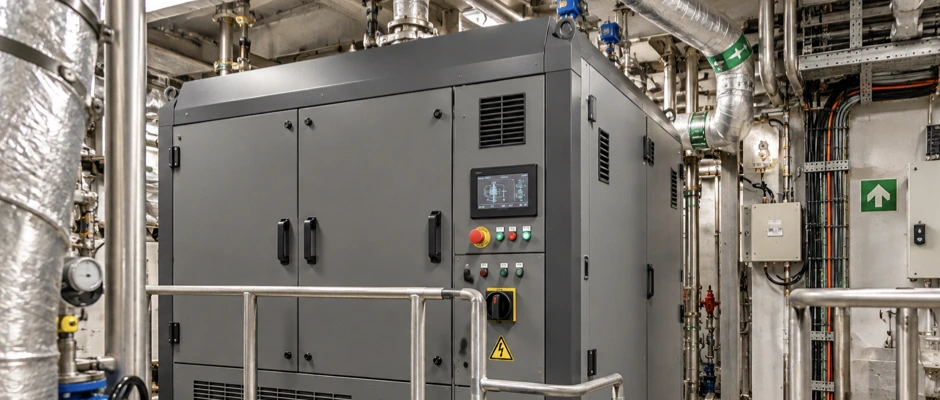
System Selection and Integration of Waste Heat Recovery Systems (WHRS) for Ships
Publication date:
A waste heat recovery system can use heat from exhaust gases, engine cooling water and other suitable heat-carrying circuits for heating or electricity production. The configuration that suits a ship depends on the amount and temperature of the available waste heat, the ship's existing energy demand and how heat can be extracted and rejected.
Selecting a system requires a combined assessment of the heat sources and the ship's existing systems. The exhaust system and engine cooling impose different limits on heat extraction. For electricity generation, the condenser, shipboard electrical system and coordination with existing generating sets must also be considered. Particularly when several engines are used or other energy-saving measures are planned, the heat supply may change substantially during operation. The chosen configuration must therefore suit the conditions under which heat recovery will actually operate.
Which Form of Waste Heat Recovery Suits the Energy Demand?
If a ship requires heat for heating, hot-water supply or other thermal applications for a sufficient number of operating hours, direct heat use may be suitable. The heat is then transferred through a heat exchanger to a heat consumer or a dedicated heat circuit. The recovered heat must be at the required temperature, and enough heat must be available when it is needed.
If electricity is the main requirement, conversion via a steam cycle or an Organic Rankine Cycle (ORC) may be considered. These technologies have different requirements for source temperature, heat transfer and additional shipboard systems. Under suitable conditions, an ORC can use heat that would be less practical to recover with a conventional steam system. This does not, however, mean that ORC is the best solution for every heat source.
Available heat and existing energy demand together determine the choice between direct heat use, a steam cycle and ORC. The assessment must also identify which heat is already being used on board. If a new recovery system diverts heat from existing consumers, additional energy may be needed elsewhere to maintain their original functions. The appropriate conversion route therefore depends not on the maximum available thermal power, but on how much of the ship's existing energy production the chosen configuration can actually displace.
Assessing Heat Sources Under Actual Engine Operating Conditions
Exhaust gases and engine cooling water differ in temperature and in the conditions under which heat is available. For exhaust gases, mass flow rate, temperature and the extent to which the gases may be cooled determine how much heat can be extracted. For engine cooling water, the specified engine temperatures, circulation and existing temperature control also play an important role.
A high temperature alone does not make a heat source suitable. Heat must be available for enough operating hours, and the chosen system must be able to receive it within the required technical limits. It also matters whether heat is delivered directly to a consumer or carried through a water or thermal-oil circuit. Such an intermediate circuit may simplify the connection, but it does not create an additional primary heat source. Assessing the suitability of a heat source for waste heat recovery therefore requires separate consideration of the heat's origin, temperature, quantity and existing use. A heat balance based solely on rated engine load gives too little information when the ship operates for long periods at other loads.
On ships with multiple engines, the available heat supply also varies with the combination of engines in operation. Two partly loaded generating sets need not provide the same exhaust gas and cooling-water conditions as one more heavily loaded set. An engine that has been shut down no longer supplies a sustained supply of heat from combustion, while another may release more heat because its load has changed.
How the individual heat sources are connected also affects what is possible. A shared heat transfer circuit can carry heat from several engines, but its temperature distribution and control arrangements must accommodate changing engine combinations. The effect of several running engines on available waste heat is therefore particularly relevant when the ship regularly brings generating sets into service, takes them out of service or operates them at different loads. When selecting the heat supply arrangement, it is important to know which engines actually deliver heat during the same operating periods and how that heat can be conveyed to the recovery system within acceptable technical limits.
Extracting Exhaust Gas Heat Without Restricting Engine Operation
An exhaust gas heat exchanger must operate within the limits of the existing exhaust system. The heat exchanger extracts heat from the exhaust gas stream but also creates flow resistance. Total exhaust back pressure must therefore remain within the engine's permitted limits, taking account of pressure losses in pipework, silencers, exhaust gas boilers and any aftertreatment equipment.
The extent to which the exhaust gases may be cooled also limits heat recovery. The fuel, gas composition and local surface temperatures influence the conditions under which condensation or corrosion may occur. Certain exhaust gas aftertreatment systems also need to operate within a suitable temperature range. The location of an additional heat exchanger must therefore be assessed in relation to the entire exhaust gas system. The combination of temperature and pressure conditions determines the limits that back pressure and exhaust gas temperature impose on exhaust gas heat recovery. A larger heat exchanger surface area or greater heat extraction is not necessarily beneficial if it brings the system closer to engine limits or introduces additional losses.
System selection must also account for part-load operation, potential fouling and the availability of cleaning equipment and bypass arrangements. The original exhaust gas discharge arrangement must remain functional when the WHRS is operating at reduced output or is out of service. The arrangement required depends on the engine and the chosen heat exchanger configuration.
Using Cooling-Water Heat While Preserving the Original Cooling
Under suitable conditions, engine cooling water can supply heat for direct use or feed the hot side of an ORC. A high-temperature cooling circuit may be particularly suitable for this purpose. However, the connection must be compatible with the specified engine temperatures and existing circulation and control arrangements.
An additional heat exchanger can absorb some of the heat that would otherwise be rejected through the original engine cooler. Under suitable conditions, the existing thermostatic control can compensate by reducing heat rejection through the original cooler. However, if the additional heat extraction exceeds what the existing controls can compensate for, the cooling-water temperature may fall too low.
The hydraulic arrangement is also important. A heat exchanger introduces a pressure drop and may alter the distribution of cooling water. In a series connection, the additional resistance may affect the pump operating point. In a parallel connection, sufficient circulation through the engine and other connected components must be maintained. For the recovery of cooling-water heat without disrupting engine cooling, both temperature control and water flow are therefore essential. The WHRS must be able to reduce heat extraction when the engine produces less heat. Engine cooling and water circulation must also remain available if the WHRS fails or is undergoing maintenance. The amount of heat that can be extracted from engine cooling water within acceptable technical limits is therefore not necessarily equal to the total heat carried by the cooling circuit during engine operation.
The Condenser Requires a Separate Assessment of Ship Cooling
In an ORC that generates electricity, the process heat remaining after expansion must be rejected through the condenser. The available cooling-water temperature, flow rate and heat-transfer capacity help determine how much electricity the cycle can generate. Even with a favourable heat source, electrical output may therefore be limited if the available cooling does not meet the cycle's requirements.
The implications for shipboard cooling depend on the original heat source used by the ORC. When recovering heat from exhaust gases, heat previously rejected to the surroundings through the funnel may instead be transferred to the cooling system via the condenser. When recovering heat from engine cooling water, part of the original cooling load may instead be transferred to the ORC condenser. The overall distribution of heat therefore helps determine when the existing cooling-water system needs to be modified for a WHRS condenser. The total condenser duty must not be added to all the original heat flows as an entirely new cooling load without first assessing the heat balance.
Even when sufficient overall cooling capacity is available, the pipework arrangement, pump capacity and connection point may still impose constraints. The required cooling of other equipment must also be maintained. In some cases, redistributing cooling water or adding connections is sufficient. In others, the cooling system needs to be expanded. When a shortfall occurs only under certain conditions, a controlled reduction in ORC output may be a technically acceptable alternative.
Connecting a Heat-Dependent Generator to the Shipboard Electrical System
For electricity generation, the WHRS generator must be compatible with the ship's existing electrical distribution system and the chosen generator controls. Depending on the configuration, a direct connection or one via power electronics may be required. Electrical protection, power-sharing arrangements and coordination with the power management system (PMS) must also be appropriate.
Available WHRS output varies with the heat supply and cooling conditions. By contrast, the electrical output of a conventional generating set can be regulated directly by adjusting the fuel supply within the engine's permitted operating limits. The shipboard electrical system must also be able to continue functioning when the WHRS delivers less power or fails unexpectedly.
Effective coordination of electricity generation from waste heat with the shipboard electrical system requires establishing how much load can be transferred from the existing generating sets, what minimum loads apply and how much power reserve must be retained. Reducing the load on a running generating set requires a different assessment from shutting down a set entirely. If the WHRS recovers heat from generating sets whose load decreases because of the electricity generated by the WHRS, the available heat supply may also change. Engine load and WHRS output must then be determined for the same final operating configuration. This establishes how much electricity the system can technically generate and how much of that output the ship can safely use. These two values need not be equal in every operating mode.
Matching System Selection to Future Energy-Saving Measures
A ship's heat sources may change when other energy-saving measures are implemented. An improved hull, modified propeller or wind-assisted propulsion may reduce the required engine power. Exhaust gas and cooling-water conditions may consequently change even as the ship's overall technical energy efficiency improves.
Electrical energy savings may also alter how auxiliary engines are operated. Operating fewer generating sets or distributing the load differently may affect the heat still available to a WHRS. Thermal energy savings may have the opposite effect: when existing heat consumers need less engine heat, a larger share of the original heat supply may become available for additional recovery. When planning a WHRS, the effect of other energy-saving measures on available waste heat must therefore be taken into account. The future heat balance is more important in this respect than simply adding up the individual savings percentages.
A system designed solely around current engine operation may receive heat less suited to its operating requirements after a propulsion improvement. This does not automatically mean that total energy savings decrease. The direct savings from the other measure may outweigh the reduction in WHRS output.
From System Concept to Further Engineering
Initial system selection must identify suitable heat sources, establish which existing heat consumers retain priority and determine how the heat can be used within acceptable technical limits. It must also identify the main constraints in the exhaust gas system, engine cooling, the condenser and the shipboard electrical system. This information provides the basis for further development of the selected system.
For ORC-based waste heat recovery systems for ships, we work with a specialist international partner to support the assessment, selection, engineering and integration of suitable configurations. Data on actual engine operation and available heat form the basis for selecting heat exchangers, any intermediate circuits and the ORC configuration.
Once a technically suitable configuration has been established, the sizing and performance assessment of waste heat recovery systems can help identify an appropriate capacity for the ship's operating and load profile and estimate how much net energy can actually be delivered. The physical installation and economic value must then be assessed separately.
Within the broader subject of Waste Heat Recovery Systems (WHRS) for Ships, system selection establishes whether the available engine heat can be put to use through a suitable system. A reliable technical basis for further development exists only when the heat source, heat transfer, cooling and demand for the recovered energy are compatible under the same operating conditions.